Orkney travel writing; Journey March / April 2002
Inverness to Thurso
It was my last night in Inverness. I had spent an hour trying to decipher the rail-ferry timetable I had been handed the night before at the railway station. My objective was to reach Stromness on the island of Orkney, before the following evening. But hell, what did all those footnotes mean that were appended to the one through service that might be running the following day. A comma or two positioned at key points in this paragraph of symbols might have helped clarify matters. I took the easy way out and rang National Rail Enquiries.
‘Does the 11.24 from Inverness, that connects with the Scrabster to Stromness ferry, run tomorrow morning please?’
‘Let me see…. Yes, that is definitely running.’
‘Are you sure, because having ploughed through the footnotes in my timetable, it reads like tomorrow – the crossover between the winter and the summer timetable – is the only day in the year, when it does not run.’
‘One moment please. I’ll just check with my supervisor.’
The supervisor was equally certain that Orkney by the following evening was not so much a possibility as a dead cert. I hung up and rung the Ferry Inn in Stromness to arrange bed and breakfast. It hardly sounded like a tranquil backwater establishment – lots of loud chatting and clinking of glasses. In a raised voice the barman confirmed that there was room at the Inn and looked forward to seeing me the next day. I was quite looking forward to it myself in fact.
And what a scenic journey it was. One hour after clearing the oil refineries that lay just off the main land, the train started to tightly hug the coast line; the lapping sea; small towns; even smaller stations; request stops; lambs on the track; and finally, at the end of the line, Thurso.
Stranded in Scrabster
The ferry terminal for the early evening departure to Orkney was two and a half miles down the coast road in Scrabster – quite an energetic hike, with a bulky rucksack and shoulder bag. I studied my well worn timetable again and for once found a footnote to be welcomed – at Thuso station on each day the ferry sailed, there was a connecting Scottish City Bus Service, and in the car park outside the deserted station was the said Bus Service, with the driver sat behind the wheel. It was turning out to be a seamless journey.
‘Excuse me. Is this connecting bus for the Orkney ferry?’
‘Yes, it connects,’ the driver replied. ‘It goes past the ferry point. But you are just a touch early. We don’t leave for three hours. However, you can sit here until then, if you can handle the boredom.’
So, for all the attempts to co-ordinate the various transport means through footnotes, unless it was hidden under a microdot, the rail-bus link was one feature that just didn’t link up, unless you didn’t mind parking yourself on a rucksack for several hours, or catching up on sleep on the back row of the coach. This though was only just the start of my convoluted journey on this timetable cross-over day.
I started walking instead along the coast road that curled around the water’s edge, dropping down bit by bit to sea level and to Scrabster in the distance. And somehow I could never have envisaged that any coastal walk at the end of such a scenic train ride would cut through drab housing estates with damp grey maisonette buildings, to the extent it did.
I rounded the coast road’s curve and found myself on the level. It felt like it had been a long day so far, but at least the final leg of my journey was imminent.
I walked along the main drag in Scrabster – its only drag. The street was a hive of activity, containing a mixture of buildings relating to the ferry industry – fish filleting, the Fisherman’s Mission, cargo holds, a range of terminal administration buildings and a solitary pub. Lorries drove past every other minute with their loads. I carried on walking passed these buildings to its end and arrived at the ticket office.
‘One ticket for Stromness please.’
‘I’m sorry we can’t sell tickets until one hour before departure.’
‘OK, I’ll come back in an hour and a half.’
‘There is no point in doing that sir. Six o’clock tomorrow morning is the next sailing.’
My heart sank, although it hardly surprised me. The lack of potential passengers along the drag and at the ticket office should have been a clue, not to mention the distinct lack of a ferry in the harbour. These after all should have indicated that things were not quite right.
‘But look,’ I said rummaging in my shoulder bag,’the Scotrail timetable states that there is a ferry at 5 pm.’
‘Whatever your timetable says, please take it from me that the next ferry is at six in the morning, but if you can’t get up in time for that, there is one at midday.’
For all the impression of a joined up service, nothing was linking the different modes of public transport. It was as though, in this Celtic world, the cross over day between timetables was being treated as an early summer solstice with other worldly pursuits to worry about. Things would connect, but just not within the same day. I looked around for any hint of a residential community in Scrabster, weighing life up along the drag and on the hills that towered over the harbour.
‘And you won’t find anywhere to stay around here,’ added the ticket clerk.
From what I could see, I was quite relieved. Who would want to stay in an industrial sea faring complex like this, even for just a night?
I called at the Seaman’s Mission for a cup of tea and contemplated my next move – not that I had many options. It was a case of walking back up that long winding steep coastal road to Thurso, or if my legs or motivation was not up to it, sticking out a thumb to the passing lorries.
I decided to hitch. After fifteen minutes a car stopped. The driver wore a dog collar –it was the local minister.
‘I’ll soon find you somewhere to stay,’ he said. And took me to Ormlie Lodge, a grey stone mansion with gargoyles, which was in the process of being refurbished. We walked up the steps and into its interior. Work benches, dust and tins of paint were scattered across the floor.
He walked up the first fight of a wide staircase, shouting, ’Angus are yea up there’, and then another flight, ‘Angus are yea up there.’
‘Ach,’ he said, ‘lets go for a wee drive to see if we can find him. ‘
But then Angus’s assistant was walking up the driveway. ‘Jim,’ said the minister,’ please find a room for this chap here, until the ferry leaves tomorrow. Look after him now.’
And with that, Jim escorted me around the back of the building, to a large wooden annex, which contained musty smelling corridors, dingy carpets, dim lighting and lots of teenage students. It was a residential establishment for agricultural students. This wasn’t ideal, but I was past caring. I gave Jim twelve quid in exchange for a duvet and key, and located my room, which looked out onto more grim damp looking council maisonettes. I gave up trying to turn my sink tap off, which ran continuously into the night, and went out for a wander around the old-town.
Everywhere there was the squawking of crows nesting in trees on street corners.
I pondered over how the small grey stone and granite towns I had passed through, whilst having at most only a handful of a thousand people, seemed to sprawl for miles and miles. Thurso was no exception.
Entertainment was on offer in the pubs, with the live screening of the France versus Scotland football match. The French were the World Cup holders, and were due to fly out to the Far East in a few weeks’ time to defend their title. Would the Scots provide tough opposition for them in this warm up match?
Well of course the French were favourites on the night. But I was struggling to remember the last time that I had seen a team so comprehensively routed and outclassed to the extent the Scots were. It wasn’t just the 5-0 score line, but the explosive finishing of the world champions, their silky skills and the way in which the Scots hardly got a touch of the ball. They sloped off at the final whistle shell-shocked.
In any normal circumstances a riot might have broken out in the pub. But then this wasn’t a normal setting – I couldn’t detect many Scottish accents amongst the pub’s clientele. Most of them were English, with the power station at Dounreay providing employment for a fair number of people from south of the border. I couldn’t hear any taunting of the Scots, but maybe the invaders were just being diplomatic.
If I had been a betting man though, such was the extent to which the French were on a different planet, I would have gone out the next morning and put a hundred quid on them to retain their World Cup title in Japan. As it happened, they didn’t manage to hit the back of the net once in the Far East, before returning unceremoniously home after just three games. All of this just goes to show, I suppose, that the Scots were much more crap than I had originally thought during my night in Thurso.
Departures and arrivals
On the ferry the next morning, out on a breezy deck, I chatted to a man – a Londoner – who was returning to the island of Hoy, another ferry ride further on from Orkney. He looked well wrapped up for the two hour crossing, with his bobble hat, thick woolly jumper and goatee beard. Sipping from a bottle of Dark Orkney Island beer, he explained how he had come over to Hoy on business eight years ago, but had never left. He had owned the island’s only pub for a period, but that was a long story, he added.
‘So what do you do?’ I asked.
‘I do bits of plumbing and am now trying to make some money by writing web sites. I scratch a living.’
His enthusiasm for the primitive life was boundless. He told me how to find places on Hoy, where the modern world had yet to reach – crofts where you could crash out for free, the absence of electricity or running water just being a minor discomfort.
‘It only sounds a notch down from my hostel last night,’ I said.
‘You should catch a ferry over to Hoy tomorrow from Orkney,’ said the Londoner.
‘But will the ferries being running? It’s Good Friday remember.’
‘Ach, ach,’ he scoffed. This isn’t the Outer Hebrides you know. It is not Lewis, where carrying a large cross around with you is compulsory. Nor will you have to go searching for the secret entrance to the pub on a Sunday. If anything Orkney is quite a pagan place.
The ferry arrived at the Stromness docks, cutting through a grey mid-afternoon mist. In fact grey seemed to be the dominant colour – the murky grey sea, the grey overcast sky, the grey stone houses that dotted the hill sides with their grey slates and grey approach roads. Even the seagulls were a greyish white. And again, another sizeable spread out town, which belied its two thousand population.
Twenty strides away from the harbour was the Ferry Inn. I checked in, dropped my bags on the bed and went to the Tourist Information office back across the road.
There, on duty, I met a very helpful and frank Melanie.
I picked a small map up off the counter. ‘Oh, you don’t want that wee crappy thing,’ she said, ‘Here, take this instead,’ and produced a more detailed one from behind her.
She gave me a couple of tips on local people to phone who, for a fee, would pick you up and drive you to, well anywhere you wanted. With no car and only an intermittent bus service, this seemed to be by far the most effective way of getting round the island.
‘Or,’ she said, ‘you can hitch.’
She had spotted a couple of letters that I had for mailing, poking out of my pocket. ‘Can I post those letters for you?’
‘But is there a collection tomorrow?’ I asked. ‘It’s Good Friday remember.’
‘Ach’, she shouted, half embarrassed, half insulted, ‘Don’t say that. It’s not like that here you know. If anything Orkney is quite a pagan place.’
The four watering holes down the town’s main stretch, Victoria Street, were buzzing that evening in a way which was out of proportion to its small town image. At the Ferry Inn, a band were assembling their amplifiers, drum kits and guitars. The queue at the long bar was three deep. It felt like a New Year’s Eve back home. But here it was just another night out. I could not cope with the noise or the smoke and moved on to the next establishment, but it was just more of the same.

Ancient history
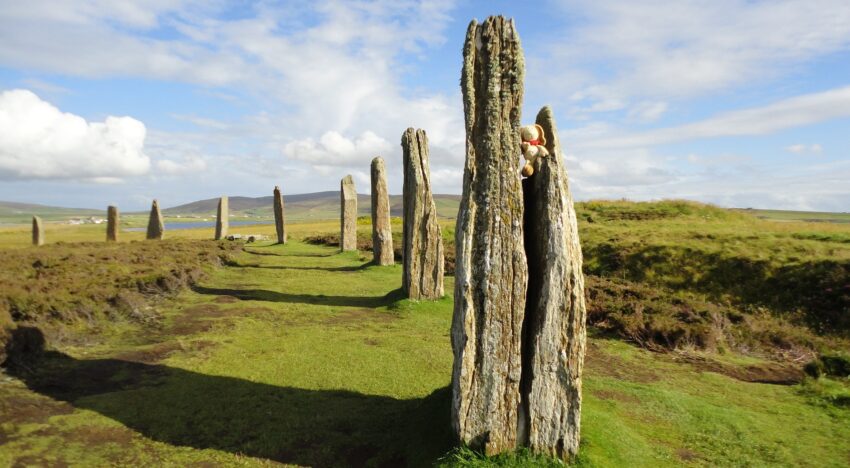
The next day, Murdo, one of Melanie’s recommendations, didn’t exactly say to me, ‘Hey, the small island of Orkney is crammed full of history going back to the year dot.’ And anyway, between his mumbling and Orkney dialect, I could only understand every other sentence. However, it soon became apparent that, in a short space of time, his mini-bus had criss-crossed over several millenniums.
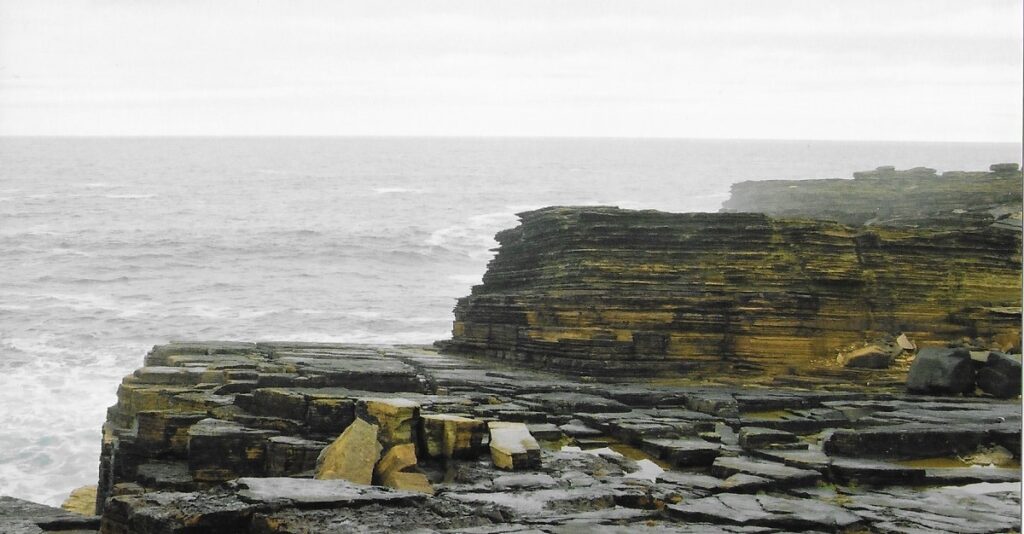
From fossilised iron age cliffs, we were catapulted forward to the time of Vikings and then back again to intact Neolithic villages. A further leap followed into the modern age as we drove past prisoner of war camps from the 1940s, that looked like they had only been built yesterday. And in comparison to Neolithic man, I suppose they had.
It went something like this:
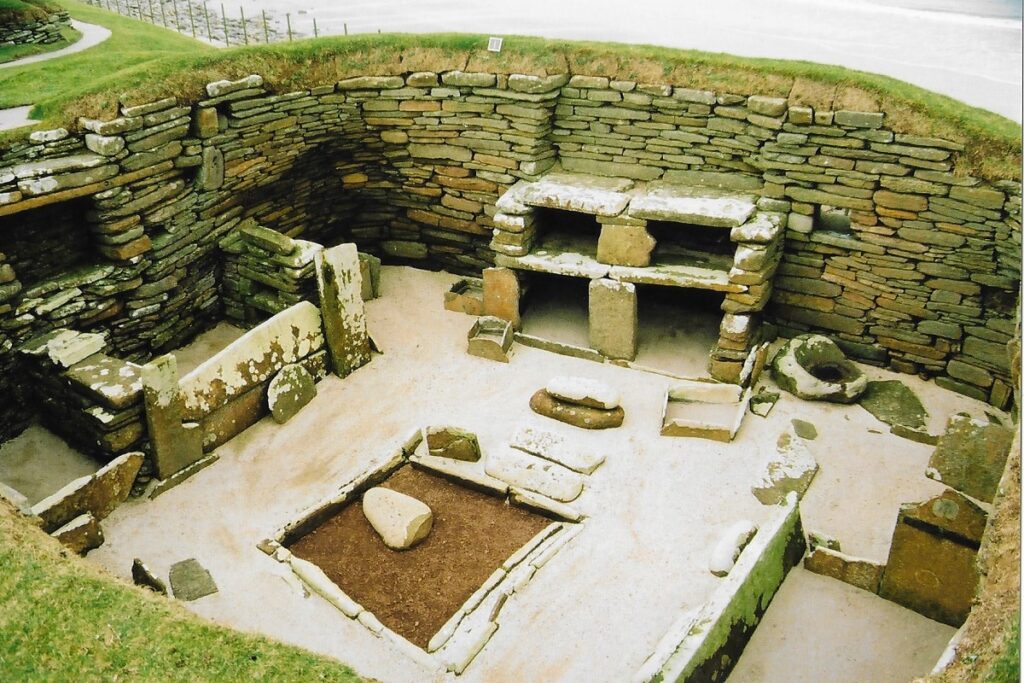
First of all, we stopped off at Sandwick Bay. Here seated inside a large mound, next to the shoreline was the preserved village of Skara Brae, which dated back five-thousand years. It had lay uncovered for centuries until the turf that covered the mound was stripped away by a storm in 1850 revealing a complex of stone beds, dressing tables and cupboards – a kind of Neolithic Ikea had remained uncovered since just after time began.
A couple of miles down the road, Murdo pulled over to another large mound in the middle of a field and muttered, ‘Maeshowe.’ I got out and trudged my way through the mud to this hill. Around the other side was a three-foot high entrance to a burial chamber. I got down on all fours and crawled my way through a long entrance passage, which emerged into a central chamber. Inside I met Stuart, the keeper of the mound. He wore a multitude of fleece layers, gloves and bobble hat and shifted from foot to foot to keep his circulation going in tomb’s chilly interior.
He sold me an entrance ticket and gave the lowdown. Built around 2700 BC, from huge thirty-ton flagstones, the complexity of the architecture and the grandness of the scale indicated that it was constructed to demonstrate the power of some form of social elite within the mainland tribal system. Each year at winter solace the red glow of the setting sun shines through a small aperture above the entrance passage and strikes the back wall of the chamber.
In the middle of the 12th century, several groups of Vikings entered the tomb, to shelter from a terrible storm. They were either heading to the Holy Land on a crusade, or had just returned from one. They left around thirty Rune inscriptions on the tomb walls – a heavily symbolised ancient Germanic alphabet, which spread to other parts of Europe, particularly Scandinavia, and was used in the middle ages as an alternative to the clergy’s Latin alphabet.
Stuart, now shone his torch over these etchings and did a spot of translating: ‘Ofram the son of Sigurd carved these Runes’ ; ‘These Runes were carved by the man most skilled in Runes in the western ocean; ‘Arnfithr Matr carved these Runes with this axe owned by Gauk Trandilsson in the South land.’
Then he moved onto a more intriguing inscription, ‘To the north west is a great treasure hidden. It was long ago that a great treasure was hidden here. Happy is he that might find that great treasure.’ There were several more, which contained the same subject matter
Such was the goulish manner in which he related his account, the layers of Celtic jewelry around his neck and his wide starring eyes, he might just as well have started his story off with, ‘Now it was a cold dark night and the moon was full.’
I wondered if he intended staying here he until the Winter Solace arrived, by which time he would have gone mad, or maybe he already was.
I left him waiting for his next visitor, which was not going to be forever – at least the high season started in two day’s time. I got back down on all fours and made my exit.
Murdo waited at a safe distance on the roadside. ‘OK?,’ he asked, as he accelerated away from Maeshowe.
‘Now it was a cold dark night and the moon was full,’ I quipped.
‘Oh him,’ he said.
Diving for history
We drove the ten miles to the Orkney capital, Kirkwall, population 7000, and pulled up at a Bed & Breakfast on the sea front. Mr. Flett, the elderly proprietor, was leaning on the gate.
‘Can yea take this lad in?’
‘Of course we can.’
‘And so how much will that be?’ I asked.
‘Seventeen pounds, with shared bathroom. But you will only have to share it with yourself, no one else is staying here at the moment. Also you can come and go as you please. We don’t lock any of our doors day or night.’
‘And does the price include breakfast?’
‘Why, of course it does – haggis, eggs, sausage, bacon, crumpet, mushroom, beans…’
He then paused in mid-phrase , and added, rather foolishly,’ Yes, you can have as much as you can eat.’ Did he know who he was talking to? Without further ado I dropped my bag over his threshold.
As I stepped into his hallway, Mr. Flett asked,’ Are yea here for the diving?’
Over the course of the next five seconds, a number of thoughts crossed my mind.
First there was a flashback from the previous evening. I leant on the bar counter of the regal Stromness Hotel – a stranger in Stromness. The barmaid’s opening line was ‘Are yea here for the diving?’
‘Well I did not realise you had coral reefs and tropical fish out here,’ I wanted to say. After all diving in these bleak conditions did not sound like something you would do for fun. Instead, I just looked at her perplexed and said, ‘Diving?’
‘Yes. Diving on the wrecks.’
‘The wrecks?’
‘The wrecks in Scapa Flow.’
And before I could say, ‘Scapa Flow?’ she gave up on me and went collecting glasses. ‘He comes out here, without knowing the first thing about us’, she must have thought. And of course to a large extent she was right.
But anyway I got Murdo to fill in some of the gaps on our drive over to Kirkwall. We were travelling along the coast road, when he pointed out to sea and murmured, ‘Scapa Flow.’
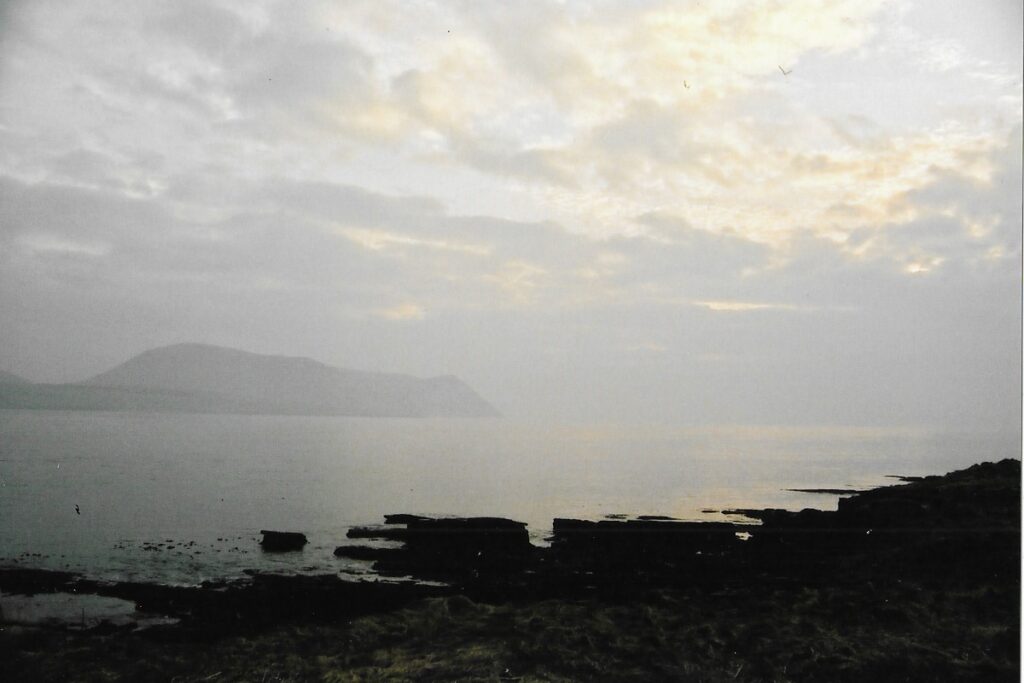
This huge expanse of water is sandwiched between Orkney, and the neighbouring islands of Hoy and South Ronaldsay. It forms one of the world’s largest natural harbours and was used by Viking ships in the thirteenth century. More recently, it formed an important naval base for British fleets in both World Wars.
World War I
Murdo started to tell me how the British Home Fleet had sailed to meet the German High Sea’s Fleet at the battle of Jutland in the First World War. But that was only half the story. After World War I, 74 German ships were interned in Scapa. Conditions for the German sailors were poor and there were several mutinies as the negotiations for the fate of the ships dragged on. When the terms of the armistice were agreed in 1919 with the announcement of a severely reduced German navy, the Admiral in charge of the German fleet in Scapa Flow, decided to take matters into his own hands. A secret signal was passed from ship to ship and the British watched incredulously as every German ship began to sink. Most of the vessels were salvaged but seven remain on the seabed, attracting divers from all over the world.
And so I pondered in Mr. Flett’s hallway, how may times I had just turned up in some far flung place, without really knowing much about its history. My research tended to take place post-the event. It may have left me in a state of ignorance at the time, but the element of surprise was certainly greater.
‘Are yea here for the diving?’ Mr. Flett asked again.
‘Oh sorry, erm. Diving Mr. Flett? No, I am not really doing anything particular, just sort of passing through.’
World War II
Shortly before we arrived at the B & B, Murdo had pointed to a buoy floating a few yards offshore.
On an unlucky Friday 13th October 1939, the famous battleship HMS Royal Oak was sunk by a German U-boat which had penetrated the navy’s main anchorage at Scapa flow. A total of 833 men lost their lives.
The Royal Oak was built during WW1 and fitted with an awesome array of firepower, but by 1939 had difficulty keeping up with more modern ships and was posted to the Scapa Flow to provide anti-aircraft cover.
The buoy marks the wreck – a war grave- which lies in thirty metres of water, upside down, with the upturned keel reaching to just five metres below the surface. Each year, navy divers remove the battle ensign flag from the previous year and raise a new one. It probably seemed unusual for the residents of the houses that looked out across the road and onto the buoy to know that as tranquil as the view was, they were sharing their day to day lives with hundreds of lost souls. Still, I guess they got used to it after a while.
My first port of call in Kirkwall was Saint Magnus’s Cathedral, a splendid twelfth-century construction with copper coloured brick arches that rise to dizzying heights. As I wandered down its aisles, the story of the Royal Oak had not quite disappeared. There tucked away in a corner was a remembrance plaque. The Royal Oak’s bell was added to the display when it was found by navy divers in the 1970s. Underneath the bell, a book lists all those who lost their lives. Every Monday a page is turned in remembrance.
Scrabster, Caithness, Scotland, KW14 7UX, United Kingdom
Kirkwall, Orkney Islands, Scotland, KW15 1DH, United Kingdom
Stromness, Orkney Islands, Scotland, KW16 3BU, United Kingdom
Radios galore
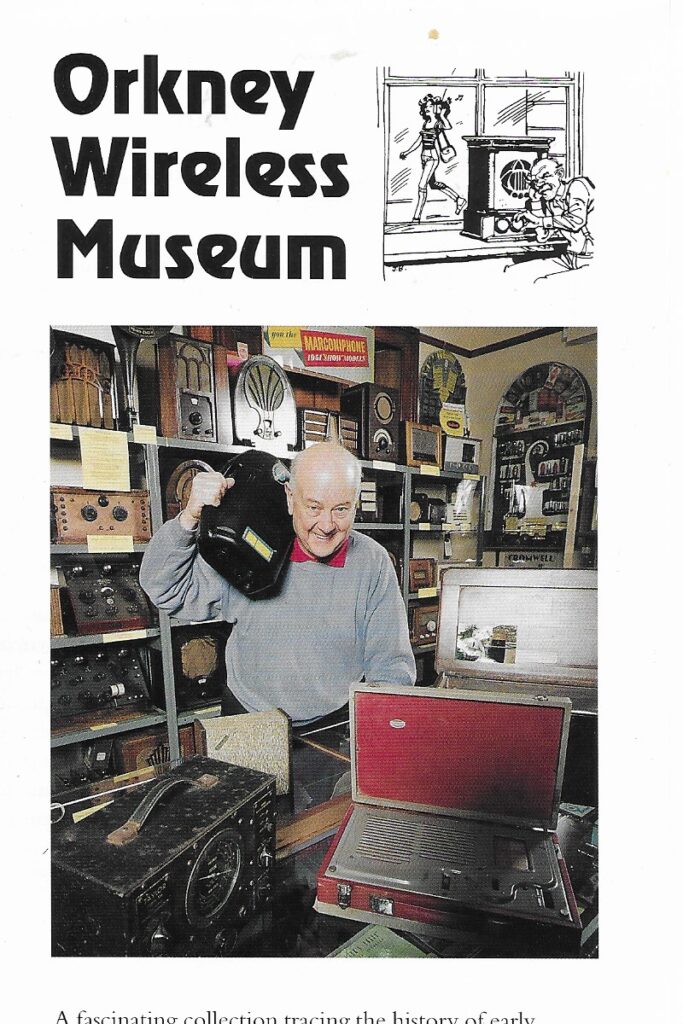
Later that afternoon, I stumbled across the Orkney Wireless Museum, which according to the leaflet I had picked up at the tourist office contained an extensive and varied display of domestic and defence wireless equipment dating back to the 1920s. My luck was out though. I peered at the opening times in the window. It was only open in the high season, which started on 1st April. I was a day too early.
I trudged my way back to the Flett’s and sat down in the lounge.
‘Will yea be wanting a cup of tea now?’
‘Oh yes please Mrs. Flett. I think I have worn myself out.’
‘So where have you just come from?’
‘Well I went to the Wireless Museum, but they don’t open until the season starts tomorrow.’
Mrs. Flett picked up the phone and dialled.
‘Sandy, it’s Jean Flett here. I have a young man staying with us who would like to see your museum, but he is leaving Kirkwall tomorrow. Is there any chance you could pop down today and show him round? Hold on I’ll just ask him.’
She turned to me and said, ‘He’s just putting his coat on. He’ll see you there in fifteen minutes, if that’s OK with you.’
Fifteen minutes later, Sandy met me outside the museum, with one of his pals.
‘Well, you gave us an excuse to come and do a spot of last minute shifting stuff around, before we seriously open tomorrow. Now are you a radio ham?’ he asked.
No, I’m sorry, I’m not. I’m just a bit curious that’s all.’
Well I’ll give you a bit of a tour. It’s normally three pounds admission, but seeing as I’m not officially open, then I won’t officially charge you. Just chuck a few pence in the tin on your way out instead.’
The display ran around the four-corners of a large room in chronological order. Sandy started off with 1920s wireless sets which had separate speakers and batteries, and needed two hands to tune them in. He then moved onto grand furniture sets of the 1930s before becoming stuck on displays relating to the history of the radio valve. Forty-five minutes later we were still stuck on valves. My head was lolling around and around. The tedium was excruciating. The fact was that glancing at old apparatuses from the 20s and 30s, with a bit about valves thrown in, was relatively interesting, for a minute or two, but no more. Unless of course you were a ….. ‘Are you sure you are not a radio ham?’ Sandy repeated.
‘Why? Do I look interested.’ I wanted to reply.
‘If you want, I can show you all the sets we have in our store room. There are around four-hundred old radios. ‘
I must have looked horrified. Now that certainly would be torture.
‘It’s OK, he said. I’m only joking. Not about the four-hundred sets, but forcing you to look at them. People here donate their radios to us all the time. When anyone kicks the bucket on Orkney, his or her old set just gets passed onto us.’
And with that he took me to the other side of the room to stacks of war-time related telecommunications and domestic radio equipment. I must have cheered up a bit, because his next line was, ’Why didn’t you just say. I would have brought you to this side straight away.’
Much of the equipment displayed on ‘this side’ had played a vital part in the Battle of the North Atlantic and North Sea. Unbeknown to local residents, an intense communication network involving radio and telephones was operating to protect the home fleet at Scapa Flow. And here were some of the leftovers – from short range speech transmitters for fighter planes to long range Morse sets for bombers; from the original Scapa Flow naval defence maps to spy suitcase radios. It was an enthusiast’s paradise. And after all this is what Sandy and his helpers (for more had now shown up) were. They had all seen active service in the war and knew their local history in this respect. Whilst in London they were in phony-war mode, up here in remotest Scotland, people were already very much on the front line.
I went back home, retrieved my digital valve-less peace-time radio from a small inside pocket and tuned it in. It was another world.
Breakfast with the Fletts
A full cooked breakfast is OK for a couple of days, but then the novelty wears off. You look at the plateful of food, and tend to feel full up after a slice of toast and a sausage. The Fletts certainly did not help in that respect.
Enter Mrs. Flett with a full tray of breakfast. Sets it down in front of me and then departs.
Five minutes later, enter Mr. Flett: ‘Would you be wanting some more toast now?’
‘No, I’m OK thanks Mr. Flett.’
‘Are you sure? It’s no problem you know.’
‘No, I’m fine thanks.’
‘You must shout out when you have run out and I’ll do you some more.’
Exits dining room.
Two minutes later. Enter Mrs. Flett.
‘Is everything fine now?’
‘Yes it’s fine thanks.’
‘Oh, you are getting low on toast. I’ll fetch you some more.’
‘No, no. There is no need really.’
‘Oh, it’s no problem. Just let me get you some.’
‘No really, no more toast thanks.’
‘Oh, I’ll just get you some anyway.’
Exit Mrs. Flett.
One minute later, enter Mr. Flett.
‘Is everything OK then?’
‘Yes thanks.’
‘How were the mushrooms?’
‘Very nice thanks.’
‘I’ll just get you some more then.’
‘No, no. It’s really OK thanks.’
It’s no problem to get you some more.’
‘No, really.’
Enter Mrs. Flett with the toast.
‘Now here is your toast. And so how are you doing on the mushrooms. I’ll just get you some more of those as well.’
‘No, please. I don’t need any more mushrooms.’
‘Are you sure?’
‘Yes, honestly’
‘Well I’ll just go and get some, in case you are able to manage them.’
Arghhh!

Breakfast with Lucy
No Scottish B & B, it seemed, was complete without its resident Scottish Terrier dog. Life at the Fletts was no exception.
Enter Lucy the Scottish terrier. Wags her tail, stands by the lone diner and looks up pleadingly, lest any scraps should fall her way.
Enter Mrs. Flett.
(Mrs. Flett) In an adoring rather than admonishing tone, ‘Lucy, you really are a naughty dog. I’m always telling you not to come into the dining room. It’s the sausages you know. She just loves the smell of them. Now go on, and into the hall now, there’s a good dog.’
Dog stays put at the table wagging her tail.
(Mrs. Flett) ‘Now go on Lucy. Into the hallway please.’ (gently eases dog out of dining room).
Mrs. Flett disappears into the kitchen to fetch more mushrooms, toast or whatever she thinks I need topping up with.
Door connecting hall to dining room edges open and in trots Lucy again, stands by my table and looks up as though to say, ‘Any chance mate.’
In wanders Mrs. Flett with the mushrooms.
Again adoringly, ‘Oh Lucy. She is such a naughty dog you know. I’m always telling her that she should not come in here. Now go on poppet, out you go.’
Dog ignores Mrs. Flett.
‘Now come on, there’s a good girl….’
‘For Pete’s sake,’ I wanted to shout out,’ the only order she is going to take any notice of is a boot up the jackskie. Now here, let me show you how it’s done. You’ll only need to do this once.’
Skaill House
The following day, I returned to Stromness, checked in at the Stromness Hotel and went on one of my mystery tours. After an hour’s walk, Skaill House loomed large – a kind of a House of the Baskervilles on the hill. Built in 1620, it is the biggest mansion house on Orkney and has been home to a number of Lords of the Manor, until it opened as a museum in 1997. It occupies a tranquil setting, overlooking the Loch of Skaill. But it wasn’t just past residents who would have enjoyed the peace and quiet that such a view afforded. One would assume that the souls who were interred within the Norse burial ground on which the mansion is built would also. Furthermore, before it was opened to the public, fifteen skeletons were discovered under the gravel leading to a porch. Well this was one that couldn’t be pinned on the butler, dating back as the human remains did to the time of the Picts. Add these to those that were found under a hall way in 1930, and it seemed like this whole corner of Orkney – only a few minutes walk away from the tomb of Maeshowe- was one big burial ground.
Skaill House has a definite colonial stamp on it. Laid out on a dining table, as though ready for lunch, was Captain Cook’s dinner service, from his ship the Resolution. On the floor and walls of a lounge were tiger skins from India. In the same room, on a sideboard, were positioned a range of invites to high society gatherings across the country from yesteryear. In the bedroom of the last Lady of the Manor, stood framed photos of a visit that the Lady had received from a close friend – pictures of the visitor walking up the drive to be greeted by the Lord and Lady and their staff. It was a 1970 shot of the Queen Mother.
Back at the hotel, I turned the television on and was greeted by a picture of the Queen Mother. 1901 – 2002 read the caption. She had died a couple of hours ago. I stayed with the special broadcast, which lasted for another hour and a half. In fact I even started to get quite interested in it, much of the programme portraying England over a period when the country still had a substantial colonial sway in the world. But by the time the credits started to roll, I was quite relieved. After all, the reason I had really switched on in the first place was to find out what time Match of the Day was going to be screened. Surely, they would now tell me.
I waited with baited breath. ‘There will now follow a special programme about the Queen Mother,’ said the announcer.
‘But I thought we had just had it,’ I shouted at the television and followed this up with a, ‘Queen Mother my arse!’ And with that I threw on my jacket and went out in search of some Dark Orkney Island Beer.
Intrepid Tales
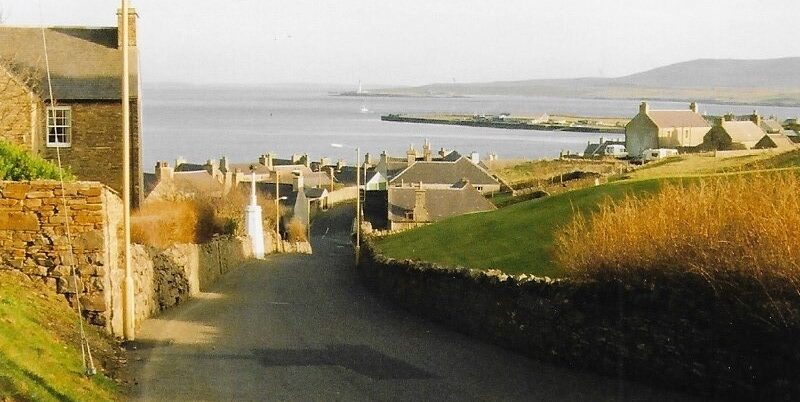
But before I was able to get my hands on the local brew, I called in at the small library on Victoria Street and was surprised by the high proportion of travel related books – both guides and literature, which lined one of its walls. I could not make my mind up whether living within such a small community, with not a lot to do but look out to sea, drove people to look for another form of escapism or whether there was a real wander lust spirit about the town’s residents, a case of no matter how serene the setting – for serene it certainly was – one had to travel on and visit alternative locations.
The strange case of the Books in Stromness continued a few doors down the road. Brown’s bookshop was a tiny store by all accounts and the display that greeted me upon entry didn’t indicate that there was much to be seen here. It was given over to Harry Potter. But then having got past this, things changed. Now I am not saying that I am a reader of particularly obscure books, but many of the ones I have bought over the last couple of years, I have had to order or at least wander around five sizeable book stores, before I was successful. But here, in this tiny store in this tiny community, were no end of titles I had acquired, or was planning to buy – a mixture of travel, biography and modern history (Patrick French, Liberty and Death – India’s Journey to Independence and Division; V.S. Naipaul, Beyond Belief – Islamic Excursions Among the Converted Peoples; Gillain Slavo, Every Secret Thing – My Family, My Country; Robert Byron, The Road to Oxiania; David Goldhagen, Hitler’s Willing Executioners – Ordinary Germans Under the Holocaust; Simon Winchester, The River at the Centre of the World – a Journey Along the Yangtze; Elizabeth Bullimer, May you be the Mother of a Hundred Sons – a Journey Among the Women of India; Vaclav Havel, Letters to Olga)
It felt like Christmas had come early. I could easily have spent an hour browsing here, but it was closing time. Are you open tomorrow, Easter Sunday?‘ I asked.
‘If it’s not raining.’ Said Mr. Brown, without any explanation.
The next day it was raining as I left the hotel and Mr. Brown had indeed stayed at home. Down the side of the bookshop was a narrow cobbled street, named Khyber, which at the top end afforded a panoramic view of the ferry terminal and the fishing boats which dotted the mile wide inlet. The name Khyber was something I’d have associated more with classical middle-Asia adventures and life on the edge in Pakistan – as in Khyber Pass. But it was an apt name, given the street’s proximity to all those books about far-flung expeditions and after all, maybe Orkney was a final frontier of sorts
As though to emphasise this, a matter of metres further on from Khyber was the Hudson’s Bay Well, where in centuries past ships took on water before heading over to Canada’s Artic terrain, in search of fur. Add this to Captain Cook’s dinner service at Skaill House, and well Orkney certainly had its connections with intrepid adventurers.
Tales from the Grave
I dropped back down to the narrow coastal footpath and decide to walk away from Stromness, until the path just disappeared into the sea. I hoped this would happen well before daylight had finished and the bumpy path which cut across the tops of shallow cliffs was still visible.
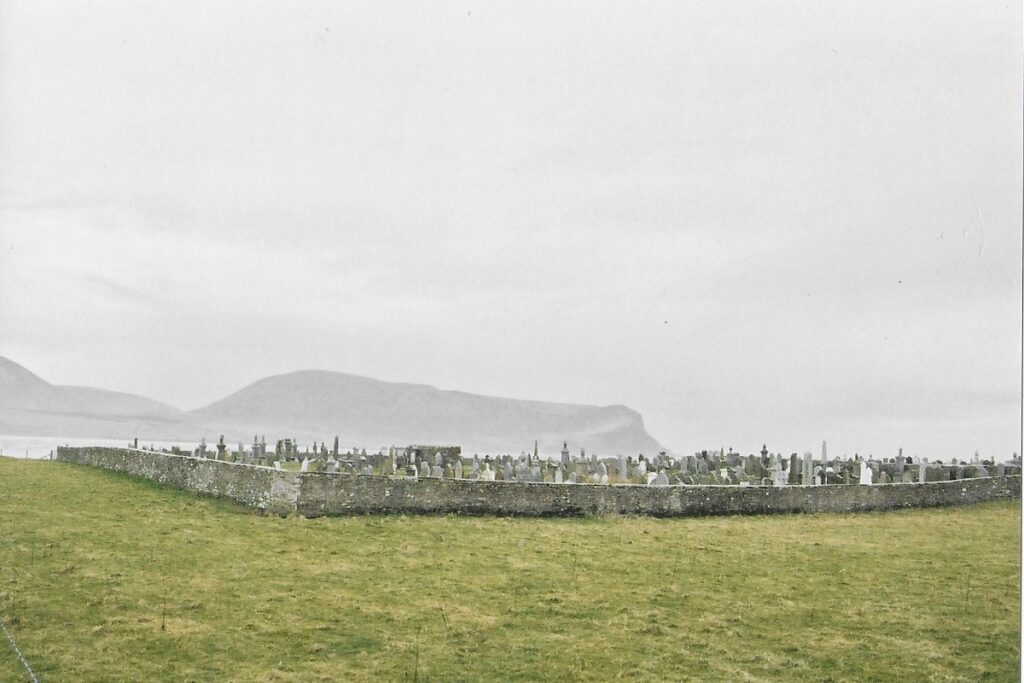
After a couple of hour’s isolation I rounded the corner and there nestling on a cliff’s edge was a graveyard containing the remains of many Orcadian pioneers from the nineteenth century. On my travels, old grave yards have always intrigued me, not out of any morbid fascination, but because they can frequently give a clue about the kind of life that existed in the vicinity all those years ago. I have often resorted to brushing away the dust and gunge off epitaphs dating back to previous centuries, just to see if they might yield up any kind of yarn.
And as I entered this Orkney graveyard, I thought back to when I was seventeen and read The Eagle has Landed – Jack Higgins’s fact based tale of the Third Reich’s failed attempt to kidnap Winston Churchill from the Kent countryside. It was not so much the yarn that captured my imagination, but how Higgins had discovered the tale in the first place. He had been looking at a church’s records for a different novel he was researching, when as a mild diversion, he slipped around the back to do a bit of epitaph spotting. And there hidden in the undergrowth were the graves of the German Storm Troopers who had come to a sticky end in a church ground shoot-out, during their perilous and outrageous mission. It was the making of Higgins. A pure chance discovery.
I leant forward to inspect the gravestones. Many stood at precarious angles. I brushed away the dirt from several of them.
Family graves contained, it seemed, unrelated people on their voyages from other parts of the world (‘Also deposited here Robert Williams from New Foundland’; ‘Also deposited here Author Munro from Sydney’; ‘Also deposited here the late James Beattie from Hudson Bay’).
Many of the people who were laid to rest here had taken their trades to the grave with them (Ian Marsh- Boat Builder; Andrew Brown-Writer; John Stein- Merchant, Steven Jones- Carpenter)
There were tales of tragedy on the high seas (John Hay, sailor, who along with nineteen of his ship mates were drowned in Cameas Bay on 7th July 1847).
And tales of multiple infant mortality in the same family (To the memory of the infant children of George and Janet Halor – Ann 15.10.45 – 3 months 22 days; George 12.7.47 11 months 14 days; Susan 15.6.51 11 months 12 days).
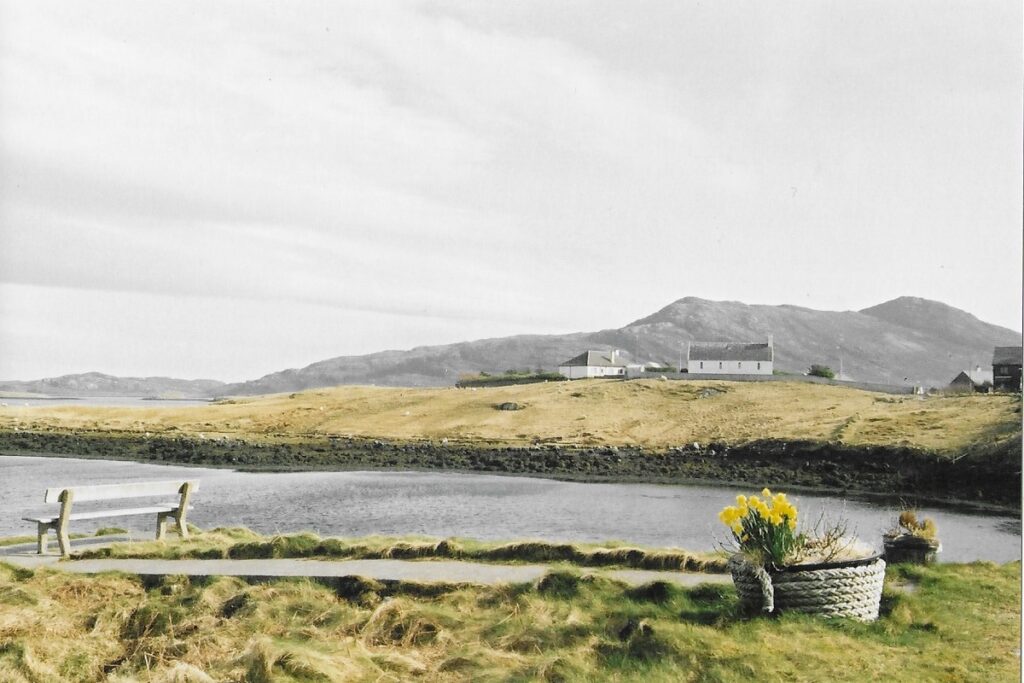
Right there and then, as I pushed on further along the coast line, I had a feeling of journey’s end; that this was as good or intriguing as it was going to get; that remote as the place may be, I was not likely to stumble across any more unexpected discoveries on this emerald isle. However, I rounded a corner and realised that there was the beauty and the illusion.
The shoreline was now strewn with rubbish; not just newspapers and carrier bags, but rusting tin drums and petrol containers. I walked for a further mile along this stretch, hoping that this threat to Orkney’s natural beauty would soon recede. In the distance I could see a farmhouse at the top of some fields. I stopped by a burnt out car and viewed the building through my binoculars. I could see a man and three children coming down the hillside from the farmhouse, heading towards the shoreline. I carried on walking, hoping that our paths would cross, just so that I could pass on my observation that it must be infuriating to have their splendid view of the sea spoiled by environmental vandals. They were wheeling a couple of carts down the slope and descended to sea level. I looked through my binoculars again. It was all hands on deck for the family from the house on the hill, as they set about emptying the carts of corroding metallic drums and other debris, and hurling this junk onto the shore.
I turned around and started the trek back to Stromness. Even another two-hour bulletin on the Queen Mother would make more welcome viewing than this.
(With the exception of Orkney Wireless Museum leaflet, all pics are author’s)
Damian Rainford
(July 2002)
Back Home to theancienthighway.com
Further information:
This is Orkney http://www.orkney.com ;
Orkney 3 day travel itinerary https://www.adventuresaroundscotland.com/scotland-travel-blog/my-3-day-orkney-travel-itinerary
Travel blogs
https://www.oursocalledlife.co.uk/
