India travel writing; Journey Christmas Day 1999
East of Eton
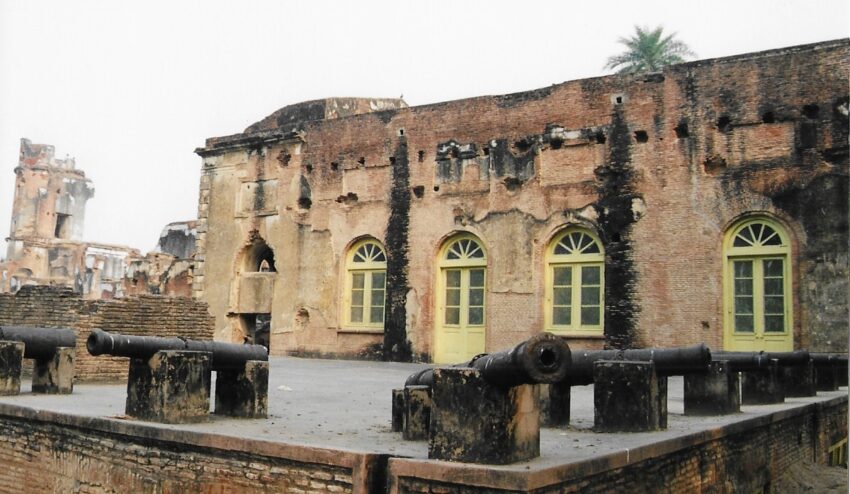
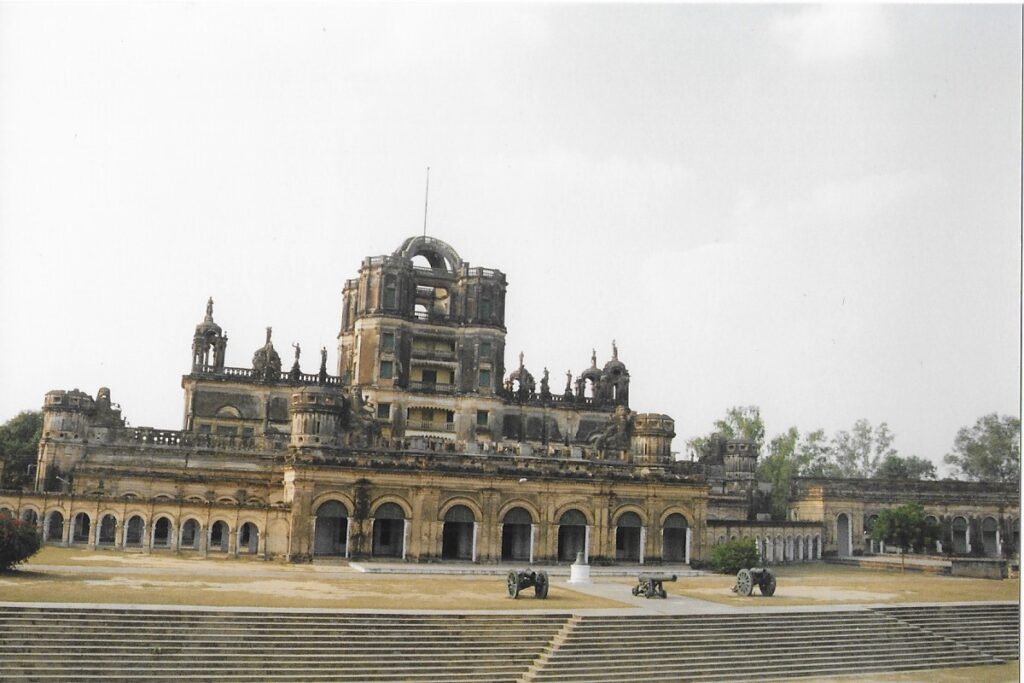
La Martiniere Lucknow: On the outskirts of Lucknow stands a chateau like building, which has become a symbol of the city. It was built as a palatial home by Major General Claude Martin a French soldier and adventurer. Martin later joined the East India Company, the British colonial trading empire. The fortunes he subsequently made from indigo enabled him to commission the building of this chateau. He died in 1800 before completion of the residence, but left instructions that it should become a school
La Martiniere remains to this day an exclusive public school in the finest colonial tradition. Residing within six hundred acres, it is the Eton of India and very anglophiled in attitude. The building is a bizarre amalgamation of different architectural styles, from Islamic to Gothic, flanked by sweeping walkways, Greco-Roman figurines on parapets, gigantic heraldic lions that gaze across the grounds and a trio of large bronze canons that jut into your face as you mount the top step to the front entrance.
Martin is buried in the vaults of the school and so the place doubles up as a rather kitsch funerary monument — Lucknow’s colonial answer to the Taj Mahal.
Lucknow, Uttar Pradesh, India
On the Outside Looking In
As the cycle rickshaw driver turned down the long slip road that led to the distant school complex the only sound was that of our tyres on gravel. We were far removed from the hustle and bustle of downtown Lucknow
Making my way up the steps to the main doors, I stopped after a couple of strides to read the carved inscriptions at my feet. Etched in a range of fonts spanning this two hundred metre wide staircase were the names of countless old boys, accompanied by the dates across the nineteenth and twentieth centuries on which they graduated.
The region’s rulers during the eighteenth century, the Nawabs, had established Lucknow as a major cultural centre, where the greatest minds of the day were to be found. Under their rule the city became a magnet for poets, artists and writers.
The Nawabs with their cultivation of literary pursuits may have gone, but here it seemed was a two hundred-year-old montage of graffiti, which, as the years went by, had translated itself into a work of art. These last day autographs in stone of former pupils did not detract from the grandeur of the building, but instead seemed a natural extension of its tradition.
So eat your heart out H. Smith 1897, R.T. Collins 1905, F. Hamilton 1921-28, A. Parks 1927 and R. Webster 1944 – Just some of the many Anglo-Indians whose signatures now appeared before me.
It would have been interesting enough to just gaze up at the building’s lavish façades. But the role this academy played as a feeder into India’s ruling establishment made more curious about events on the other side of its doors.
On any other day I would not have hesitated to walk straight through the main entrance, hoping that at some point, someone would step out of the shadows and provide an illuminating anecdote. However this was one occasion when such an occurrence was completely out of the question — It was Christmas Day and everybody had locked up and gone home.
I sauntered in isolation through colonnaded walks and came to a notice board which contained the names of pupils who had won the house prizes in a number of leisure pursuits, including debating, academics and cricket, with a bit of boxing and shooting thrown in for those who preferred it rough. A neighbouring board contained a collage of careers posters, the most prominent proclaimed ‘On guard with the Indian Airforce!’ — a kind of ‘your country needs you, young man.’
As I started to make notes of these calling to vocations, the sound of a violin and piano struck up in unison behind a glazed door with thick-laced curtains. I loitered, hoping someone would step out and invite me in for a rendering of Handel on this Christmas morn, or something like that. The violinist stopped playing, a stool dragged and the pianist followed suit. A third person gave the duo a round of applause and cried out ‘Bravo, bravo!’, the clinking of cups on saucers followed.
I remained the invisible curious on looker
A man and woman in their early twenties came out of another side entrance, skipped their way down the steps to the slip road and climbed up the opposite embankment which led to a raised rail track, where horses now pulled traps along sleepers. I followed in the couple’s tracks, determined to speak to someone before I left the school’s grounds. Having climbed over the rail tracks, there I found them, in some undergrowth. However, asking any questions about La Martiniere wasn’t an option; they were after all having a Christmas afternoon frolic, roll me over in the clover Lucknow style.
It was time to leave the school grounds. This place wasn’t going to give up any of its secrets. It was after all a piece of stupid planning on my part. What teacher or pupil in their right mind would have contemplated putting in an appearance on 25th December, even for the odd game of cricket or spot of debating?
‘Very interesting, Yes?’ Inquired the rickshaw driver, as we retraced our way along the slip road.
‘Who knows?’ I replied.
Learning by Celluloid and God Save the King
As we passed one of the annex buildings, a shout went up. A youth came running towards the rickshaw, had a brief conversation with the driver and then turned to me.
‘Sir, my father is a retired principal teacher at the school and still lives here in the grounds. He is sitting in his garden at the moment and would very much like to speak to you about the school. Would you kindly join him for afternoon tea?’
I looked at my trusted rickshaw driver of the last couple of days for an assurance that this wasn’t some elaborate scam; no dope in the Darjeeling or anything like that. He nodded his assent ‘It’s no problem. No need to hurry back’. Well he would say that. I was after all paying him by the hour.
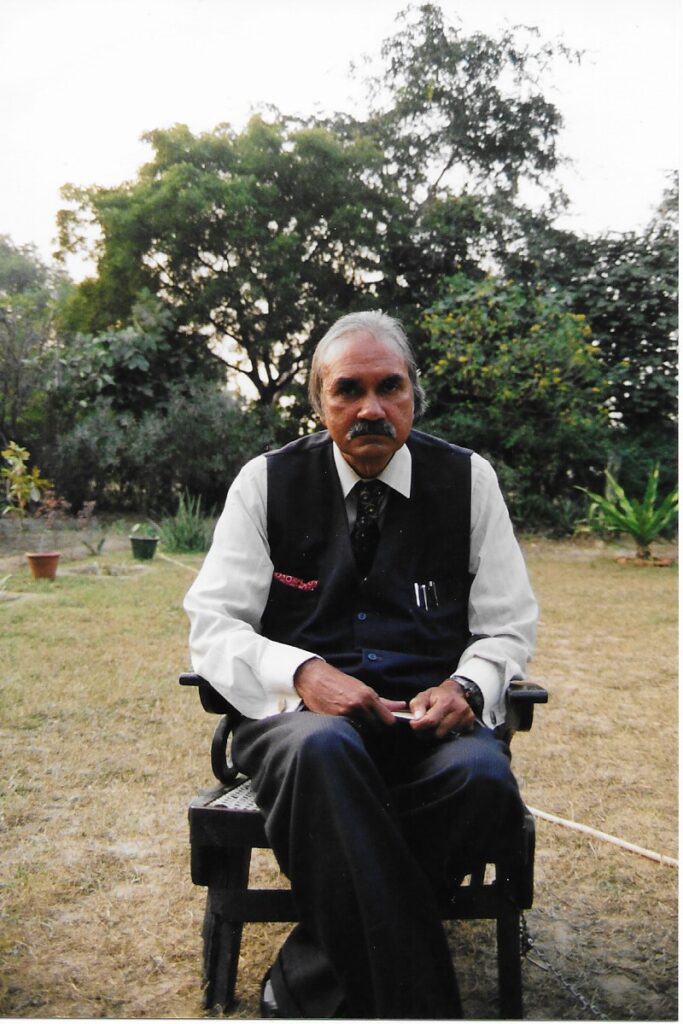
Braj Agnihotri sat on the grass verge in front of the living quarters that his family rented from the school. He was sixty years old and had been living within the confines of the school grounds for forty-three years, either as a pupil or teacher. His pail complexion was that of an Anglo-Indian – an Indian subject who was created with help of a chromosome from the Western world and his hair was of a receding silver matted appearance. He had a thickset mustache and wore a navy blue waist coat, with a silk handkerchief poking out of one pocket. Underneath the waistcoat shone a virgin white shirt and school tie.
None of these items were particularly striking, but they conspired to give an overall impression of someone who once upon a time had belonged to the officer class. More noticeable than Braj’s physical features or attire was his impeccable English, which he spoke with a distinctly upper crust accent. Well I suppose if one had been searching for an accent like this in Lucknow, then the grounds of La Martiniere would have been a good bet, Christmas day or not.
His style of speech captivated my attention for the next hour and a half. I found myself in a time warp, thrown back to the days of the Raj. Indeed, through out our conversation he seemed to be longing for a return to this era, where he would have blended in effortlessly. At least he wouldn’t have then looked as glum as he did now.
“Please come, do sit here. You will take some afternoon tea and biscuits with me?’
‘Forty three years living in one house is a long time,’ I suggested, ‘but now you do not teach anymore?’
‘No I had to retire last year, before I was sixty. You see I had what people might call a nervous breakdown.’
He paused for thought, leant over towards me, smiled wryly and asked, ‘So what do you think of my English then? Is it good?’
‘It’s very upper-crust,’ I told him. He took this as a complement. ‘That’s one hell of an accent. How did you acquire it?’
‘First there was my father. He certainly knew a thing or two about English. He helped to recruit 2,000 Indians for the British war effort. He eventually became a colonel in the army and was involved in trying to destroy Gandhi’s movement of independence from the British.’
‘Then, as a young boy of seven years, I asked papa to arrange some private English tuition for me, but not being a wealthy man he could not afford the fees. So he bought a television set instead. I would then watch the English news broad casts twice a day every day from the BBC, you know’
‘And that’s how you came to speak like a 1940s newsreader from Great Britain?’
‘Partly, but I did not just learn from the BBC. Just as interesting were the black and white films of the day that I was able to watch on television, especially those with British actors.’
‘Any particular favourites?’
‘Actors like Peter O’ Toole and Alec Guiness, to name but two. I used to admire and study their performances, mannerisms and speech very closely. Tell me are they still alive? It was a long time ago when I used to watch these films and they were not exactly young then.’
I did my best to bring him up to date with my patchy knowledge of the biographies of these stars from another generation. He was delighted to hear that Alec Guinness was now a ‘Sir Alec’ and that quite a few of his role models from yesteryear were, I thought, still in the land of the living.
Braj was in full flow now, reciting lists of films and actors that had fired his imagination during his formative years, ‘…. John Guilgood, Bridge Over the River Kwai, Night of the Generals…’, there was no stopping him. I envisaged him several decades ago with his ear next to a short wave radio, listening to a crackly BBC broadcast of Brain of Britain or maybe even as a contestant on the show.
He saved his favourite until last, ‘And of course there is my most cherished movie, Goodbye Mister Chips.’
Well how could he have chosen any other film than this 1939 portrait of an English teacher reminiscing about key stages of his life and career. It was an apt, if somewhat corny choice.
‘I learnt a lot from these actors,’ he continued, ‘not just from their speech, but their style of dress, their various characteristics, how to behave and so on and so forth you know. But today’s actors only seem to be linked with violent scripts. So I’m afraid we have the TV switched off most of the time now and just listen to the news on the radio instead.’
‘But, from the BBC of course,’ I quipped.
‘Naturally. But on occasions we also listen to German, French and Japanese English broadcasts. However, their English is very rotten you know. It’s very poor and improper.’
And after you had become fluent in the King’s English?’ I asked.
‘Then my father sent me out to work in a Government department, where I learnt much about time keeping, spoke politely, and gave due respect to my colleagues.’
It was difficult not to feel sorry for him. He was locked in the past, and not just the recent past either, having spent most of his life immersing himself in an era which had passed him by. In many ways that era was now redundant – things move on, things change. Or maybe no one had ever told him that Independence had arrived some fifty odd years ago.
Maybe he wasn’t the only teacher from La Martiniere with this kind of outlook. This Eaton of India hardly had its focus locked in on Asia. It was more like a processing factory; a finishing school that sought to churn out little Lord Faultelroys or their Indian equivalents.
‘So how did the arrival of independence affect the school’s Westernised tradition?’ I asked
‘Very little,’ he said. ‘Before 1947 they used to sing God save our Gracious King every day at assembly. Now they just chant the Indian National Anthem instead. Until recently all our scholars were chased into the chapel everyday for Biblical hymns . These still take place and are accompanied by Gospel readings. However it is now acknowledged that there are other religions and there is provision for these as well.’
…. ‘We have continued to render a good service to the nation. Of course the vast majority of our pupils go straight onto the top universities or become officers in the armed services.’
Caste Wars and Fascism
‘Surely only upper-caste people can afford this standard of education?’ I asked. If an untouchable was found walking around the cloisters here, they would quite likely be picking up litter or sweeping out the toilets, rather than reading Chaucer.
But he disagreed. ‘It is now public policy that a large proportion of places, maybe a third, are reserved for lower caste pupils. I think they call it positive discrimination.’
He then showed his true colours. ‘Of course this means that there aren’t enough places for those from the upper caste. Such a system of reserving places has ruined India. All our talent now migrates to North America instead, where they do an excellent job. Yes, these days many wealthy parents just look for scholarships outside of India for their children. It is all wrong. Entry to this school should be based purely on merit.’
‘And your own caste?’
‘I am a Brahman and come from an aristocratic background. We used to have a lot of land, but this has since been taken over by criminals and we don’t have the money to fight a case in the courts. Besides, civil suits in India can take decades to resolve. If you take one out, you often do so realising that at the end of the day it may only be your grandchildren who benefit.’
…… ‘Brahmans believe that they descend from an Aryan race, just like Nazi Germany, and that when our future is threatened we must retaliate at any cost. It is important that you believe in your caste’s cause and stand up for it. My father always believed in swift action. If you have the ball in your court, then kick it, was his philosophy.’
Cheating and the Bandit Queen
Whilst he was expanding on his suspect philosophy, I decided to throw in another bleak consideration for him to ponder. One year ago I had read about the action taken by certain pupils at La Martiniere, against a teacher who had tried to stamp out the practice of cheating at examinations. Quite understandably they went round to his living quarters and shot the poor sod dead. Serious stuff these exams.
‘Do you know whether any cheating at exams takes place here?’ I asked, feigning ignorance.
He sat bolt upright with a start, ‘Yes it most certainly does. I personally tried to stamp this out the other year. Afterwards the culprits came around to my house and shot all the windows through. It was a terrifying ordeal for my family.’
Maybe I had got it wrong – Was Braj the chap I had read about and he hadn’t ‘bought it‘ after all, just been given a jolly good fright. However he then followed this up with, ‘Why two years ago one of my colleagues was shot dead in a similar situation.’
‘How common is this cheating?’ I asked.
‘Oh it’s very common’ recently there was a thorough check at one of the exams and it was found that twenty-three out of fifty pupils had in one way or another been cheating. I wanted to have another go at stamping all this out, but when I approached the Head he just said ‘Mister Agnihotri, when in Rome, do as the Romans do.’
I was still trying to figure out whether La Martiniere was a training ground for up and coming members of the establishment or just a finishing school for young Mafiosi, when Braj asked ominously, ‘Do you know of Phoola Devi?’
‘Sure I do.’
‘Well it feels like a lot of the pupils adopt her as their role model.’
His reference to this modern day Boadacea, India’s Bandit Queen, champion of the down trodden, seemed apt. Phoolan Devi: Member of Parliament, the women who once had a king’s ransom on her head and who was personally responsible for a score of murders, not to mention kidnappings. Copies of her autobiography were now to be found in abundance on the shelves of bookstores across India. And now it appeared that it would not be out of place as a standard text on the La Martiniere curricula.
Body Tremors and the School Bounty
At the start of our conversation, Braj’s left knee and right hand had been shaking. These tremors hadn’t receded as I neared the end of my stay. Rather they started to get more vigorous as he started to rant about all the differences of opinion he had had with the Head Teacher.
Heated arguments with the Head Teacher? Nervous Breakdowns? Early retirements? There seemed some kind of link somewhere.
I did not want to probe any further about his differences of opinion with the school. He seemed rattled enough about them. Although his one about Claude Martin’s missing millions would have been a juicy one to flush out. ‘When Claude Martin died he left several core of rupees to the place. But where has it all gone. I know it has never been spent on the school. Yet the interest on that money alone must now be phenomenal. When I raised this at a staff meeting, the Head told me that I must not dare ask questions like that and he severely rebuked me. You see, as a teacher I was always popular in my unpopularity.’
North and South
I steered him away from corruption to more convivial matters, like my next port of call, the foothills of the Himalayas. He gasped.
‘Oh Lord. That brings back a few memories. When I was in my twenties I travelled with a former pupil from La Martiniere. We went on a mad motorcycle dash all the way to Katmandu. That was a hellish experience. My accomplice’s name was Harry Ridge and he still comes over from Sheffield, England to see me every couple of years. He’s 84 now though, but he still keeps in touch. I don’t suppose he dashing round too much these days on that old motorcycle.
‘Have you ever been way down south?’ I asked him.
‘Hah, hah, hah,’ he said. ‘Just once and that was even more hellish. It was a two day train ride and the carriage was over booked. I had to spend two days stood up in the toilet. Kind of put me off going south again.’
As I departed, we shook hands and he thanked me for taking the time to talk to him.
‘No. I should be thanking you’ I said. ‘Goodbye.’
…. Good bye Mister Chips, indeed.
Damian Rainford
(Header & feature image: Pixel Free Photos; Al other pics are author’s)
Back Home to theancienthighway.com
Further information
https://www.lamartinierelucknow.org
http://Lucknow Travel Blogs, Photos and Forum
https://www.india.com/travel/lucknow/articles
