India Travel Writing; Journey November 1992
“Big fire near here yesterday!”, proclaims the student, as he wafts a copy of The Times of India in my face. I catch a glimpse of the photograph attached to the headline story. The image of the burnt-out building is enough to stop me in my tracks.
The young man continues, “Many people killed at this temple. You must come now. It is only a short walk; I will show you.”
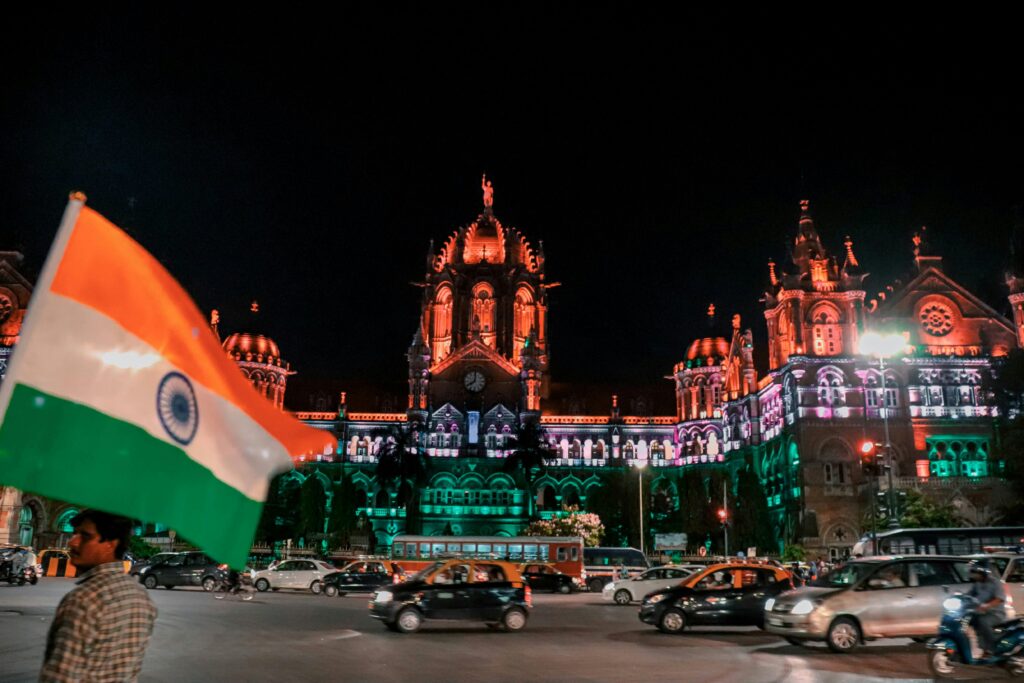
To satisfy my macabre curiosity, I agree to go and survey this sight, which surely must have made international news, when I was in midair enroute to Mumbai from the UK. The Crawford Food Market, further on along Mohammadali Road – my original destination – can wait until later.
After a few minutes walk, I follow him through a gateway into a large yard, where logs of all shapes and sizes stand piled up against the walls. In the centre of the yard are the remnants of a fire, its dying embers now struggle to give off any glow. The student takes me down to the bottom of the yard into a large workshop, where a woodcutter is weighing logs onto a large set of scales. He then explains that this is a crematorium, and that the woodcutter is weighing so much wood for so much weight of dead body.
Of course, there was no big fire at any temple yesterday. This is just a ruse to get me to follow him to an alternative site, after which he will demand a tip for the dubious pleasure. Heaven knows what the photograph on the newspaper is, but I have certainly fallen for it.
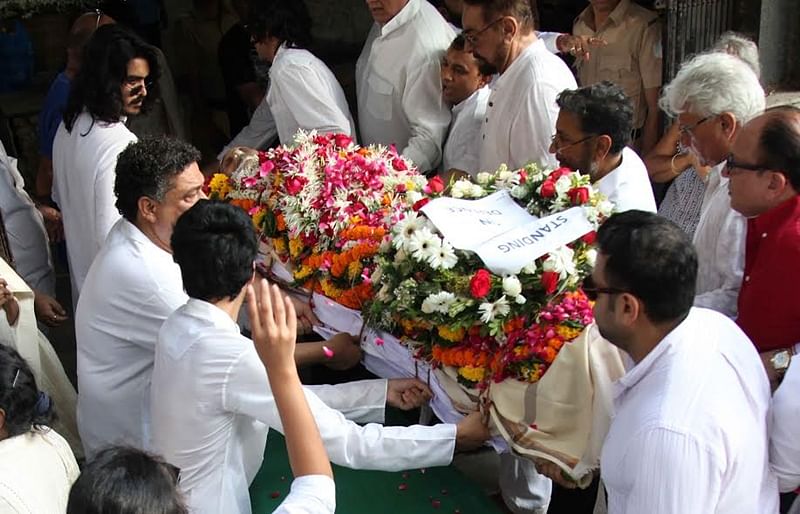
The student then starts to show me around this open-air crematorium. However, we are interrupted by the next appointment to pass through this processing factory. A body carried on a stretcher, draped in garlands with the head, hands and feet still clearly visible, enters through the gateway, accompanied by a procession of mourners. This throng of people heads in our direction, where a nearby funeral pyre has been assembled. As the procession draws close, the student grabs my arm and in the one sincere gesture of our short acquaintance hauls me to attention. We bow our head as the body and trail of mourners pass by.
The mourners than form a circle around the pyre and, still carrying their dead relative, revolve around it several times.
The events unfolding before me are somewhat different from those that I had anticipated a few minutes earlier as I stepped over that threshold into the yard.
Burning time, it seems, is now uncomfortably imminent. If I am forced to witness this late afternoon cremation, the student will say goodbye to any tip, of that I am certain. Perhaps sensing this, he clutches one of my sleeves and leads me out of the complex before the burning of the body commences.
Under Hinduism, it is believed that cremation releases the soul from the body into the next reincarnation, and for this release to occur swiftly, the burning usually takes place within a day of death. Despite my desire to exit this scene as a matter of urgency, the setting still holds a certain fascination, knowing that the corpse hiding beneath those garlands, had but a few hours ago, shared the same incarnation as myself; and that within the next few days, if not hours, the ashes of the deceased will quite likely be scattered along an auspicious river.
As we reach the gate, I glance back to see the dead person being placed on the pyre. More wood is now positioned on top of the body. The mourner who had led the procession now stands with his back to the construction of wood, flesh and bone, with a lighted taper in his hand.
With a shiver, I make the final transition back to my previous existence of a few minutes earlier. Back on Mohammadali Street, we have a five-minute heated argument about whether I really owe the student anything.
‘But I have gone out of my way to show you this site,’ he protests.
‘You conned me though. Where is the burnt-out temple?’
‘Look, I showed you something you did not know existed.’ At
the back of my mind, I found it difficult to disagree with him on this point.
And of course, he persists, following and arguing with me every step of the way, until after five minutes I cave in, slip him a few rupees and as fast as he appeared on the scene, he is gone, cash in one hand, college books in the other.
Well, I will know better for the next time, I think. The next time, as it turns out is only five minutes later, along the same stretch of road.
‘Hello. How are you? Which country are you from? What is your name?’
A smartly dressed man in his fifties tries to make my acquaintance. I am on the verge of ignoring him and walking right past, when he informs me that he works for the Thomas Cook travel agency in Mumbai. This immediately grabs my attention — a natural reaction as my father worked for Thomas Cook for most of his working life.
‘Really? Where is their office? What kind of work do you do?’ I ask, hoping that he may be the genuine article.
Alas, believing he has won my confidence, he then blows his chances. Sensing that the time is ripe for the kill, he waves a newspaper in front of me.
‘Look, big fire at temple near here yesterday. Many people killed.’
‘I don’t think so,’ I say, cross over the road and leave him in my stride.
Damian Rainford
November 1992
(Header image: Pixels Free Photos)
Back to Home theancienthighway.com
Further informationhttps://www.wanderlust.co.uk/destinations/india/
