
India travel writing; Journey December 1999:
Across the tracks
I climbed down the steps of the overnight train from Lucknow, lowering myself onto the rail tracks. It was 6.30 am on a December morning. The start of the third millennium was less than a week away. At Kathgodam Junction, dawn was breaking. A guiding hand helped me across the tracks. It was my prospective taxi driver, who had mounted the carriage steps even before the train had come to a stand still. As we crossed, I looked down the misty line and across at the other side. Crossing several lanes of sleepers in this manner wasn’t exactly a deviant activity – hundreds of other silhouetted passengers were doing the same, humping baggage across the rails. The atmosphere tasted acrid, laced as it was with diesel fumes. I got into the shared taxi, with four other passengers, who like myself were bound for Nainital, sixty kilometres away – a ninety minute ascent through a series of hair pin bends, into the Himalayan foothills.
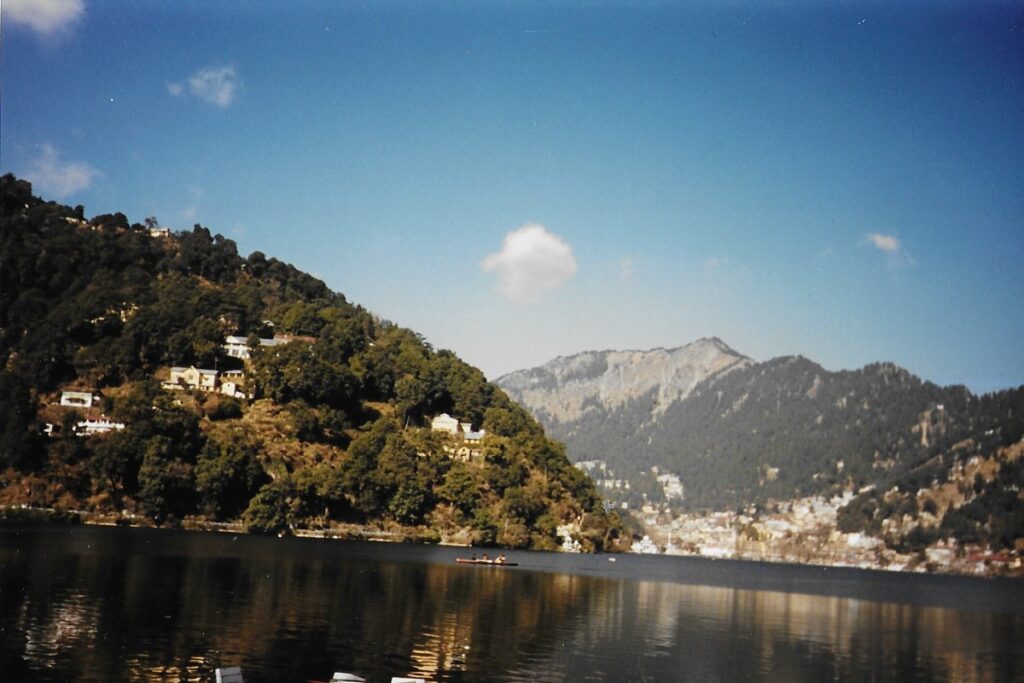
Nainital and its two kilometre long lake are set in a mountain hollow at an altitude of two-thousand metres, established in the mid-nineteenth century by the British. It was added to their list of locations that provided a summer retreat from the sweltering plains.
Surrounded by steep stepped terraces and houses that rise in increments against the mountain sides, the place could be showcased as a honey mooner’s paradise, a summer’s idyll, except that it was now winter
https://www.youtube.com/watch?v=0ZpjUIlM9NI (Second approach road to Nainital)
Checking in at the Lakar
Outside my chosen hotel, the Lakar, the taxi driver climbed the steps with me. I shuddered. Was the air really this cold or was I just being soft? Behind the reception counter sat the manager shrouded in heavy-duty blankets. Shivering and with a sharp intake of breath he raised his head slightly and muttered, ‘You want room huh? Hold on, I’ll call my boys.’
Two junior members of staff appeared. At first glance they were made of stern stuff, with not a blanket in sight, but then they wilted. ‘Brr,’ they shivered and before they picked up my bags, gave their hands a good rubbing. ‘ooph,’ they sighed, with visible breath.
A five-minute cameo with the taxi driver followed. Here is a condensed version:
At Kathgodam, I had already agreed a price for the ride. The other Indians who had got out before me on the edge of Nainital had, I noticed, paid significantly less. Add to this my failure to shake off the driver at the bottom of the hotel steps – a bad move which almost certainly meant that he would get a thirty-percent hefty commission from the hotel manager on my room price, a discrete inclusion in the quoted room rate for my accommodation – and well I was not in the mood to go paying more, not even for the sake of a couple of quid.
It came time to pay the driver.
‘And now you must pay me 180 Rupees.’
‘Hah, I don’t think so. We agreed 140 remember.’
He span a yarn about his extended journey past the town gates – an extra fifty metres to the hotel steps. ‘Look, because I passed through that entrance, the gatekeeper charges me a toll when I leave.‘
‘Yeah sure. Funny how we did not pass a gatekeeper on the way in.’
‘OK, 170.’
‘No 140. We agreed, remember.’
OK, last offer. 160 you must pay me.’
I went for a change of tact, ‘OK, my last offer to you, 300.’
‘Uh?’
‘Sorry, too late. OK, last offer 100.’
Another confused expression, ’Ah, so you are joking, I see.’
‘Yes, but now I am not.’ I slapped the 140 Rupees on the counter, ‘Take it. I am not paying a Rupee more.’
‘Oh come, please. 160 you really should pay me. This is my special discount rate.’
And so I was forced to resort to a well-known anglo-indian colloquialism, ‘Bollocks, that’s all you are getting. Now clear off.’
My turn of phrase translated well. He laughed, threw in the towel, slapped me on the back, picked up the cash and opened his cigarette packet and said, ‘Here take one.’
Then he disappeared, no doubt to return later for his thirty-percent commission.
The manager’s helpers laughed. ‘That was funny,’ they said, ‘Well done.’
I climbed the steps to my chalet room, which overlooked the lake, closed the door and sat down on the bed. Its interior did not feel any warmer than outside and then I realised why – there was a gap of about three inches between the bottom of the door and the ground, enabling me to experience from the comfort of my bedside, the perishing Himalayan breeze, as it glided down from the foothills across the large serene lake and into my living quarters.
Soaking up some winter sun had to be a warmer option and so I donned a couple of extra layers of fleece clothing and went for a brisk lakeside walk.
A winter’s idyll
It was 8.30 am. The sun was up. The day by the lakeside had started. Boatmen called out from their moorings, touting their trade at Indian tourists who were promenading along the Mall – Nainital’s main drag.
I headed for the other side of the lake, which ran parallel with the Mall.
I sauntered along this mile long stretch observing the setting across the water-lilly strewn lake. Pockets of low lying mist still hung over the water; through which boatman emerged in their sleek rowing vehicles. Against the steep bank of houses on the other side, I could pick out my chalet room, and beyond these terraces, snowcapped peaks.
Scenery wise, this was probably as close as I would ever get to the volatile State of Kashmir.
Well what more could one want, you ask? A winter’s idyll, tranquillity personified.
But now I have to qualify this. Small enough as it is, the Nainital rush-hour traffic was reaching its peak on the other side of the lake.
Even in isolation, on this side of the water, I was not immune to the constant tooting of horns and revving of engines. So for the umpteenth time during my jaunts around the sub-continent , I reflected what a truly beautiful land the country must have been before the invention of the internal combustion engine – one of its principal ruinations.
Dorothy’s Seat and Cliff
I walked the length of the lake and came to its north end, Mallital. There, at the bottom of a track which led up into those snow-capped foothills, I met my escorts for the next three hours, Pradesh and his two horses.
‘Please sir,’ shouted Pradesh from his position high up in the saddle, ‘Get on my other horse and I’ll take you up the mountain side to see Dorothy’s seat.’
‘Who the hell is Dorothy?’ I asked. And what’s this about her seat.? Are we talking garden furniture here or maybe even a piece of her anatomy?’
“Pradesh dismounted and tightened the other horses saddle. ‘Please get on,’ he said.
Well what to do? Down here at the lakeside, there was a constant promenade of ice cream licking, Pepsi Cola swigging, tonga riding Indian tourists. It had the semblance of an English coastal resort in winter, but one which had not shut up shop, the substantial number of visitors still giving the place some vitality, even if it erred on the side of tackiness.
So it was a case of either immersing myself in this tackiness – which for all the location’s natural beauty gave it a tinsel town feel – or galloping up to see Dorothy, or rather her seat. We negotiated a price and I hauled myself into the saddle.
For the first five minutes, we trotted along and upwards at a slow pace, ducking under this low hanging branch, threading our way around a series sharp rising bends.
At frequent intervals the horse skipped over and around an array of small boulders, and if she steps on one of those rocks by mistake, I thought, both of us will roll down a steep embankment.
This was not my only cause for alarm. Even when we only moved at a gentle canter, with each stride, my nether-nether regions were lifted off the saddle by several inches, and then reunited a second later at a not inconsiderable force – well I was not going to be of much use to Dorothy at this rate.
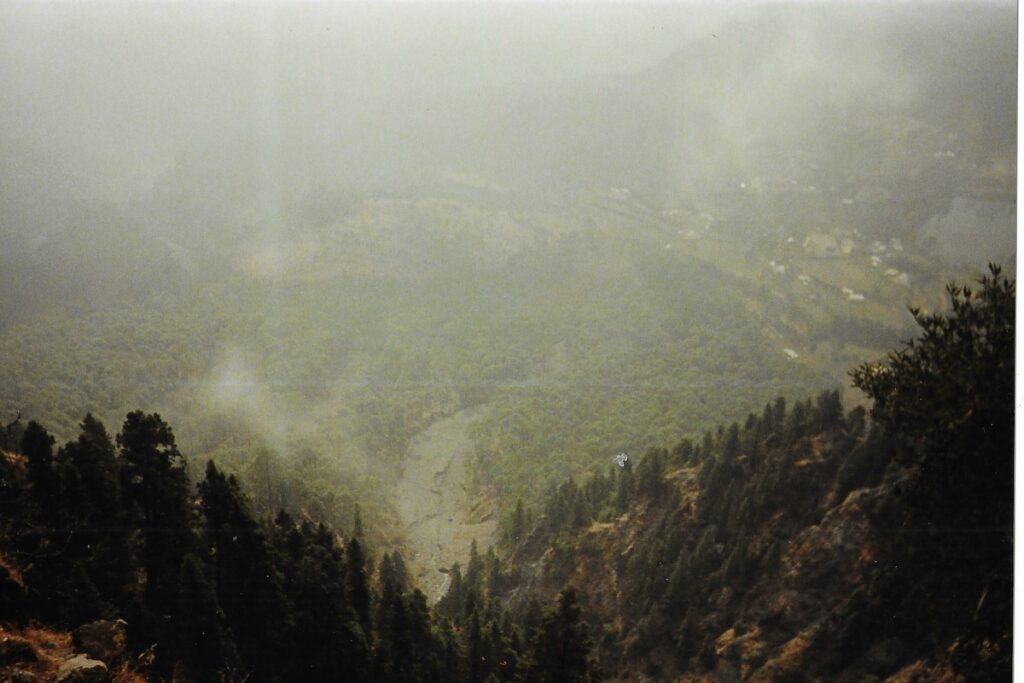
An hour and a half later, following our five-hundred foot ascent, we reached a plateau. Down at the ground level the climate may well have been warming up, as mid-day approached, but at these exposed heights, the clouds drifted past a matter of metres below our feet, revealing every couple of minutes a aerial glimpse of the lake below.
Way down there, no doubt taxis and rickshaws belted up and down the Mall, sounding their horns and emitting a fair amount of carbon monoxide, but up here there was just a whistling Himalayan breeze.
‘OK, so where is she?’ I asked.
‘Ah see, over here.’
We walked for another minute. And there it was, a stone bench, dedicated by Dorothy’s husband, to the memory of his spouse, one Dorothy Kellet, whose misfortune it was to have died from septicaemia in 1936 whilst travelling back by boat to England to see her children. She had spent many a happy hour painting the surrounding peaks from this vantage point.
Nearby was a cold drinks wallah. I purchased a canned drink, sat on this memorial and there, whilst swigging ice cold Pepsi, both our seats were finally united as one.
Both Dorothy and I were several thousand miles from our real homes, a green and pleasant land that is forever England. But suddenly, as the drinks wallah slipped a cassette into his ghetto blaster, this chasm did not seem so wide. I waited for some sitar music to accompany my drink, but instead was treated to Cliff Richard. ‘We’re all going on a summer’s holiday,’ sang the effervescent artist – a picture of innocence in this tinsel town. Yes, there was no escaping the tackiness, it had permeated its way up from the lakeside.
Fire at the Embassy
Back at ground level, with the onset of dusk, the temperatures started to plummet. I went back to my chilled room, shut the door – for what it was worth – thought about having a hot shower but only cold was available, took my fleece jacket off, placed a couple of towels around my shoulders for extra warmth, put my jacket back on, wrapped my torso in the thick quilt which lay on the bed and hid my hands beneath these layers.
I sat down to plan my itinerary for the next couple of days with the help of my guide book, but did not want to expose my bare hands to the cold temperatures. Hell, could all the holiday making Indians really be enjoying their break in this type of environment?
To make matters worse, I now found myself succumbing to a dose of diahorea which was to plague me for two weeks. I stripped off my layers, went to the loo, put them back on, risked exposing my hands and flicked through a few pages, went to the loo again and then decided to go for a walk along the Mall.
It was now dark. The glowing amber lights of the Embassy restaurant looked welcoming. A winter warmer of sorts had to be waiting inside. However, when I stepped across the threshold, my glasses did not mist up. As with my hotel room, there was little difference in the climate either side of the door.
The restaurant was about a third full with diners who, like myself, were draped in layers.
I ordered a mughlai mutton curry, which when it arrived, despite only staying warm for five minutes, did wonders for my pallet. However, to really enjoy a meal in this establishment, being served a sumptuous dish was not the key factor. Nor was it getting a table with a view of the lakeside and one of Town’s colonial institutions, the boat club. No, to really enjoy a meal in this place, you needed to commandeer the establishment’s sole electric fire. So, in one corner of the restaurant sat a family, warming their toes a matter of inches away from the glowing appliance, whilst the rest of us waited with anticipated visible breath, for our turn.
Piped sitar music ebbed away and I longed for the management to turn proceedings into some kind of pass the fire party game – keep passing that appliance down the line until the music stops. Yes, here is your chance to win sixty seconds worth of toe warming . Sadly, I never did get my sixty seconds worth, before I finished my meal went to the toilet (again) and left.
I ambled back to the hotel juggling in my mind with a number of itineraries that I might tackle before the commencement of the global millennium ball in four night’s time. I had travelled up to these heights to explore, over a two week period, a number of Himalayan hill stations, stretching out as far away as Dehra Dun, a nine hour bus ride away. For the moment my more immediate plans were to spend several nights in the neighbouring outposts of Ranikhet and Kausani.
A convenient excursion
I had envisaged the next day to involve waiting an eternity for the local service bus to show up, followed by a several hour-long tortuous journey in which the vehicle stopped every few minutes. The drawn out journey between these towns not so much affected by distance as by the twisting and climbing necessitated by the region’s topography.
As I neared the hotel steps, a travel agent was locking up for the night. ‘Sir you are looking for excursion tomorrow?’ he asked. ‘We have a trip to Rhaniket, Almora and Kausani, which includes a night’s accommodation and some meals. Our price is good, only 350 Rupees. Only three seats left.’
At around six pounds sterling, this sounded alarmingly cheap and of course it offered a convenient way of exploring some of those towns that I had planned to visit, although I did not hold out much hope that the hotel would be offering much luxury, though surely it could not be that bad, a coach load of holiday making Indians had also opted to take the plunge. What the hell, it should include a fair element of surprise, if nothing else.
So with a sense of adventure, I counted out all of the small amount of cash I had on my person, which left me with about fifteen Rupees coinage in my pocket.
‘Well I should have time to go to the bank in the morning before the tour bus sets off,’ I said to the agent,’ with a touch of resignation.
‘No sir, the bus leaves at 9 am. The banks only open between ten and two. But you will have chance to change money in Rahniket. After that there are no money change facilities on the journey.
Back at the hotel, still wearing thermal and fleece layers, I got inside my sleeping bag, threw the heavy quilt on top and turned a few pages of my route planner. After a minute my hands felt too cold to leave outside the covers for much longer, so I decided to call it a night. However, I still had one last task left. With a cough and a splutter, I got out of bed and went to the toilet for a lamb mughlai clear out. I got back into hibernating position, shielding myself completely from the outside world. The wind whistled around the base of my door. I fell asleep.
Reversing over the edge
The next morning the conductor scrutinised my ticket and pointed to a vacant seat in the middle of the vehicle’s back row – the centre isle position.
So what trials and tribulations was this excursion going to have in store. I did not have to wait too long to find out. Of all the journeys I have been through, of all the close scrapes I have endured, particularly on the Indian road, the next couple of minutes have to have been among the most harrowing.
We departed Nainital. The road narrowed. The coach chugged away. After a minute a shout went up from the conductor as he got half way down the coach. The driver had forgotten to call at the last hotel on our exit from the town. Two passengers still needed to be picked up.
We were on narrow tarmac road, barely two lanes wide. Along the other side of the road ran the base of a rocky incline, which rose up into a mountainside. On our side, on the outer edge of the tarmac was a smattering of gravel a few inches wide. After that there was, well, nothing, just a plunge down onto the roof tops of houses a hundred feet below.
So what was the driver going to do now? Pull over to the roadside while someone legged it back to fetch our missing friends? Drive instead to the next roundabout a few minutes down the road, and then do a U-turn? No instead he decided to attempt a three-point turn on this narrow strip.
He slowly pulled over to the right, and stopped when the front wheels reached the rocky embankment on the other hand side of the road.
And so at this point, we had thirty seconds advance notice of the looming catastrophe. As each of these precious seconds passed, the trepidation levels on the back row rose considerably.
This was not going to be the usual death in a flash on the Indian road – a spot of overtaking on a blind bend for example, and before you know it, a big bang; No quick explosion and then goodnight Vienna. Rather, we had a condensed moment to ponder about how well we had done in this world and to contemplate how sweet or cruel life had been.
The count down and the dawning realisation of what was in store for us began; that maybe if the driver persisted with this near suicidal mission, we wouldn’t have to wait until the next temple visit before meeting a deity of Hindu gods.
With the front right hand wheel touching the base of that mountainside, our appointment with fear commenced. Thirty, twenty-nine, clutch to the floor, gear stick into reverse, twenty-eight, twenty-seven. Has this driver got a death wish or something? Twenty-six, twenty-five, the vehicle starts to edge its way backwards towards that precarious drop. Hell, isn’t this guy even going to lean out of his window? Perhaps one of us should volunteer sharpish to go round the back and guide him.
Sitting next to me on the left, were a couple of newly weds up from Mumbai. On my right another honeymoon couple, also up from Mumbai. Further down the coach was Veenu and her parents, whose acquaintance I was to make later; and their home town? Why Mumbai of course. Indeed it felt like the whole coach was reserved for Mumbaites, but no one had told them it was only a one way ticket.
Fifteen, fourteen. As we got closer, the people on the back row, who by definition would reach that cliff edge before the rest of the passengers, were getting very edgy. Both couples had now snapped out of their smooching mode and sat bolt upright, peering out of the window to the ground below.
‘Is this driver crazy?’ barked out one of the brides, which was confirmation in itself that even by Indian safety standards this was a reckless moneuvre.
And so here we were with eleven, sorry I mean ten, seconds to go. The back wheel is nearing the left hand edge of the tarmac strip, a few inches after which the narrow band of gravel commences, only for it to disappear twenty-four inches later into thin air. Beyond that there is nothing, Scotch mist.
Nine. Eight. Seven. My stomach is turning over. One of the grooms shouts, ‘Hey, stop driver!’ He bangs on the window, hoping the noise will reverberate down the side of the bus, catching the attention of the man behind the wheel.
It feels like its time to start saying a prayer, although it’ll have to be a quick one.
Four, three, the back of the bus where we sit is not so much level with the start of the big drop, as a couple of inches past it.
Still at three. The coach does not move. The driver has stopped. On the back row, we stay motionless, suspended in mid-air as it were. And then we realise that the back end of the coach, against which our backs are pressed, must extend past the rear wheels by a few inches.
From our seats we can’t see exactly where the wheels are positioned. However one hour later, after we had completed our U-turn and headed back for the missed hotel, we came to our first pit stop. I inspected the degree of over hang from the outside and had to conclude that the vehicle must only have come to a halt, on that cliff edge, about five inches before gravity would have took over.
It had been a horrible minute. And one that stayed with me for the next couple of hours – a major palpitation, compressed into a few seconds.
Banks and Saliva
Outside the Alka Restaurant in Rhaniket, we were granted a forty-five minute lunch break. Please be back on board by then, announced the driver.
I walked for five minutes down the high street and I climbed the steps to the State Bank of India, crossing its threshold with a fair degree of optimism, having noted the smattering of foreign currency exchange stickers in its windows.
The town basked in sunshine, but at these heights, the air was distinctly crisp. Inside the bank, staff were warming their hands over braziers. Behind them hung a sign that read ‘Spitting in the Bank is impolite’.
I held up my travellers cheques.
‘No sir, ‘ said the clerk, ‘we only accept American Express cheques. You need the Bank of Baroda, just five minutes further down the road.’
I walked briskly for ten minutes, but could not spot any other bank. The forty-five minute lunch break was now ebbing away. I went back to the first bank for more precise directions.
The counter clerk called for the manager, who beckoned me round to the other side of the counter to discuss business. There I sat behind a brazier, joining him in his hand warming ritual. I explained my plight and status – that of a Rhupeeless foreigner in Rhaniket. The Manager said, ‘Sir we only usually change American Express TCs , but because you have no money we will make an exception, but this is most unusual for us you understand.’
‘Thank you very much,’ I said, wanting to add, ‘But please, I promise never to spit in another bank again if you can process this transaction quickly – my forty minute lunch break is running out.’
In the event I was out of the bank within ten minutes, which still left plenty of time to get back down the road to the coach, maybe even time to have a quick nibble at the restaurant.
Missing luggage and the Advani Three
I marched purposefully back to the restaurant and there on the forecourt was, or should I say was not, my coach – gone, vamoosed, left fifteen minutes early, apparently. But surely the honeymooning couples on the back seat must have noticed my absence, if no one else.
In the boot of the coach was my baggage containing a multitude of accessories. The second palpitation of the day started. Sure, I still had my valuables with me in a shoulder bag, but the missing baggage was still enough to cause me grief, containing essential clothing, a sleeping bag, medication, used camera film and various mementos purchased along the way.
I made enquiries at reception. No tour group had been there, that day they said. Let me be the judge of that, I said, now where is your restaurant. I was directed up a flight of steps. In the spacious restaurant a further two members of staff agreed with each other, ‘Sorry sir, no tour groups in here this lunchtime.’
‘Shit,’ I said.
‘But you are welcome to eat here,’ they added, as though in consolation.
The sound of a chair scraped; the pitter-patter of feet came in my direction.
‘Hello, good afternoon Sir, how are you?
Veenu Advani had come to me in a particular moment of need and offered her hand of friendship. I recognised her immediately as a fellow passenger from half way down the coach. My relief must have been visible. ‘Please don’t worry,’ she said, ‘All the other passengers wanted to go to another restaurant a few minutes further down the road. So the driver has taken them there instead. Papa, Mama and I agreed to stay back here, eat and wait for you. Please come and sit with us. I looked over to the far side of the restaurant and indeed there they were Papa and Mama Advani both sat on a bench, both smiling at me, both giving a slight wave, both finishing off their lunch.
We wandered over. Veenu sat in between her parents – a position from which she seemed inseparable over the course of the next two days.
I ordered a coffee and took it up to the roof top terrace, where I was captivated by the bright vista – a panoramic view of the start of the Himalayas, with snow capped peaks rising up to eight-thousand metres.
Hijack
On one corner of the terrace, a radio broadcast emitted the two o’clock pips. ‘Good afternoon, this is the voice of India,’ spoke the news broadcaster with a clipped upper-crust accent, ‘The plane hijacked whilst flying from Kathmandu to Delhi on 24th December has now taken off from Lahore with 176 hostages aboard. It is believed to be heading for Afghanistan.’
I was now joined on the terrace by Veenu and family, who were keen to listen to any update on the siege. The hijackers had initially flown from Amritsar, with their human bounty, into Pakistan, where they had been granted landing space at Lahore. Now, to the frustration of the Indian authorities, the air craft had been allowed to take off, Kabul bound.
There was a strong suspicion within the mass media that the Pakistan military government, which had a matter of weeks before, seized power from Enezir Bhuto, was behind the hijacking, and the (suspected Kashmirian) terrorists’ demands for cash and the release of several Pakistan prisoners held in Indian jails – a case of state sponsored terrorism on the part of India’s beloved neighbour. And so the debate raged. Should the Indian government play it with diplomacy or go for the jugular, launching air strikes at the Pakistani capital?
At the point of hijack, I had been sixteen hours down the line, on the plains in the city of Lucknow. It was Christmas Eve. The next day, I bought a copy of the Indian Express newspaper, to catch up on the crisis and to see what message of good will the publication could provide on this last Christmas morn of the second millennium. And so what earth shattering news, what feature of direct relevance to world stability, could the biggest circulating Uttar Pradesh newspaper splash across its front page – perhaps a ‘Hijackers release women and children’ or maybe even a tacit ‘Peace on earth, good will to all men.’ But no, I’m afraid it was something much more perverse than that, ‘Two men nabbed with tortoises’ quipped the headline. The clipped upper-crust tone of the article – ‘a fair cop guv,’ and all that – seemed somewhat out of touch with the volatile events taking place in neighbouring nuclear warhead owning Pakistan.
It wasn’t as though the Indian Express was a cheap rag, an uninformative tabloid of a provincial newspaper. Nor did it only have a potentially small audience – Uttar Pradesh is the most highly populated state in India – home to over one hundred and fifty million people.
Well good for those tortoises. To compare and contrast, I bought a copy of the Times of India. Its headline was somewhat more sobering, ‘Hijackers of Indian Airline plane with 176 aboard kills passenger – Army seals Lahore airport.’
For the record, the terrorists demand for cash were dropped and the Indian authorities released a number of the specified prisoners from its jails. In Afghanistan, the hijackers were allowed to disappear into the ether. What a spineless Government, raged Hindu right wing organisations.
Whenever I think back to this particular excursion, the clamouring for news by fellow travellers on the latest actions of the hijackers, springs to mind. Anyone who was lucky enough to have obtained the day’s newspaper was expected to pass it on down the coach when they had finished, particularly as discovering an up to date edition in these backwaters was no mean feat.
Stale news from the South
Which reminds me: Madurai, Tamil Nadu, India’s deep south, another world away from our current location, December 1995, I bought a newspaper, walked a hundred metres down the road, glanced at the front page only to discover the publication date was three days previous. I returned to the vendor. ‘Please madam, there seems to have been some kind of mistake, the newspaper you sold me is three days old.’
‘Pah,’ she chastised me, ‘But you did not tell me you wanted today’s! You should have said so.’ And she duly handed me the latest issue. No hurry, no worry ….but back to the current journey
Mama Advani
Before you marry a girl, the saying goes, take a good look at her mother, because this is what the young lass could turn out to be like in a couple of decades of time, not just in terms of looks, but in her general demeanor as well – I make no judgement, merely to say that I have heard this proverb a number of times and I am afraid the omens were not good in Veenu’s case. Over the course of the next couple of days, her mother meant well, but the monosyllabic orders that she continually barked at me proved to be an irritant. Papa, by contrast, remained as quiet as a church mouse.
And so, for example, on that roof top terrace at the Alka restaurant, I started to gulp my coffee, in order not to be late for the coach. ‘Slow!’ rasped Mama. Two minutes later with our departure time getting close she uttered a ‘Drink!’ and then when there really was no more time to delay, followed this up with a ‘Come!’ and then a ’Walk!’
A Himalayan Kaleidoscope
The coach started its evocative journey to Kausani.
How not to lapse into clichés and glib adjectives when describing this ride, which provided a three hour kaleidoscope of vivid images. Words cannot convey accurately the magnificence of the 360-degree panorama of snow capped peaks and ridges. And the annoyance that comes with longing to stop and absorb such beauty, but too late, as the coach turns sharply around another hair pin bend, the image is gone.
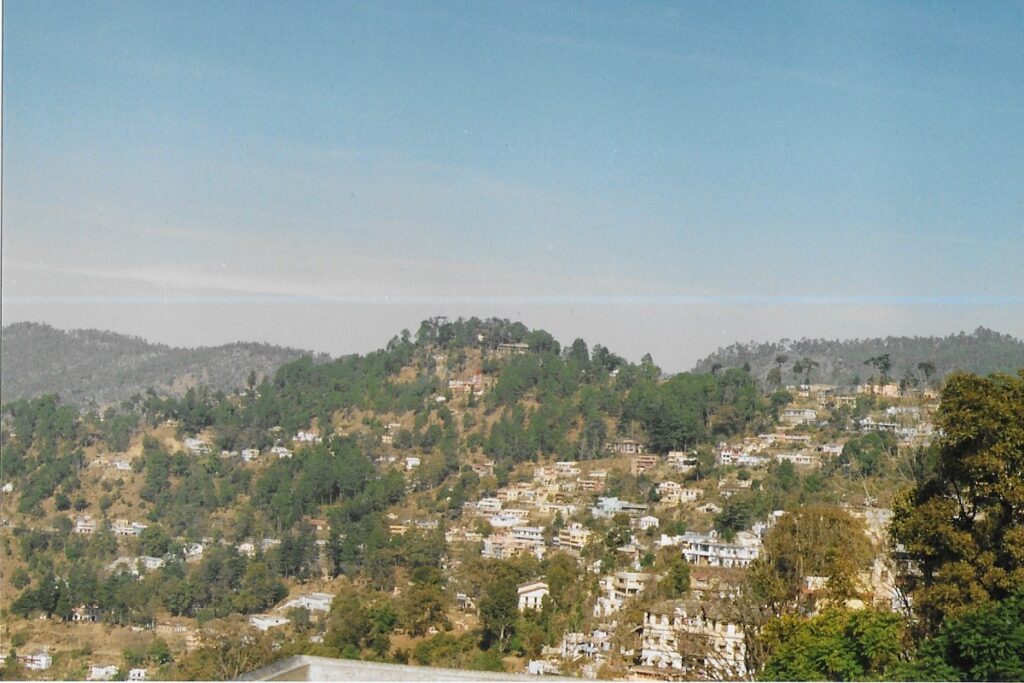
And at a micro level some of the finer details that contribute to this landscape: Rivers and streams – dried up rivers; gushing rivers; boulder strewn river basins, sprinkled with fallen logs and trees; rivers in which clothes are being washed, before being placed on the boulders to dry. A half-hour climb through several hairpin bends, and then looking back down into the plunging valley, in its basin is the glistening twisting path of the same river. And then as we near a mountain peak, over the other side are more valleys, with wide or narrow basins; vistas for tens of miles; the stepped green levels of tea plantations, which from on high look like patch work quilts. And passing through villages which surround these plantations, the proverbial assortment of cows, oxen, sheep, pigs and goats frequently block our path, finally allowing some time to absorb the features of this undulating landscape from a stationary position. And against this backdrop, the routine physical features of village life seem anything but ordinary.
… Stone houses; wooden pastel houses with precarious hung balconies; houses constructed from corrugated sheets of metal; bundles of firewood leaning against the outside of houses, juxtaposed with plant pots and haystacks constructed in a wigwam like shape; and even at these crisp heights, orange and lemon trees and cactus plants dot the landscape; ramshackle bicycles, satellite dishes; women with earthenware pots walk down the side of the road in single file; skipping past them are trails of children in uniforms who have just got off the school bus.
… Take your pick from the road safety notices that are placed at intervals along the road side – ‘Life begins at 40, make sure your speed ends there,’ was a particular favourite of mine, having just turned that age a matter of days before, or how about ‘Dangerous driving is bad for your health.’ Yes, nothing like stating the bleeding obvious.
Mountain Peaks, Veenu and Astrology
We pulled into our destination for the evening, Kausani – a small town even by hill station standards. A place for some quiet contemplation; Mahatma Gandhi spent time at the ashram here in 1929, before the place had vehicular access, taking inspiration, so he said, from the awesome Himalayan views.
And indeed before we got decanted at the Hotel Himalayan, the driver stopped at a nearby restaurant with a roof top terrace, from which we viewed the sunset turning the surrounding mountain sides and peaks a shimmering picture-post-card crimson. It was a dramatic sight and the whole entourage was due to assemble here at 5 a.m. next morning to watch the sun rise.
Our lodging house for the night, the Hotel Himalya – was a very primitive affair. Well you get what you pay for. But at least it was clean.
My room consisted of a boarded up glassless window, a sink with ice cold running water, a stone floor, a hard bed – a thin matress on a board, a twenty watt light bulb, a statue of the Hindu god, Garnish on my window sill, a candle with matches and one cracked mirror.
I wondered out onto the roof terrace to witness the last rays of sunlight. I was joined shortly after by Veenu, who in a rare moment of freedom had been released by Papa and Mama.
Veenu, who had worked in human resources at a range of banking establishments after obtaining her Master of Commerce.
In her late twenties, she featured in the middle range of her parent’s off spring, but unlike her siblings was as yet unmarried. I did not ask why. She stared, at the cloudless sky and started outlining to me the various formations amongst the hundreds of twinkling stars in the clear Himalayan night, but then kind of lost my drift as she slipped into astrology mode and read out loud her perceived future from the patterns of the glowing diamonds above us.
And so Veenu, I wanted to ask, what’s in the stars for me? Will I make it up in time for sunrise? Will the bus finally go over the edge on our return journey? Will I cope with the cold for another two weeks? And most important of all, will you sneak out in the middle of the night from the room you are sharing with Papa and Mama, creep across the corridor and knock on my door?
‘Damian she said,’ jolting me from my fantasy, ‘where are your gloves? You need gloves in these temperatures. And Damian, you need something for your head – you need a monkey hat, like one of these see.’
‘Oh, a balaclava you mean?’
‘Yes, you should have brought a monkey hat to wear in bed. Your head will get cold without it. I am taking you down to the shops first thing tomorrow morning, before sunrise, to buy one.
She was starting to sound like her mother – you, tomorrow, me, hat, come!
Oh well, at least her thirty minutes of freedom was over. The silhouette of Mama appeared in the open corridor and Veenu hurried over. I went back to my room.
Silhouettes, showers and the man who came to dinner
Moments later I was plunged into total darkness as the proverbial power cut arrived. I lit the candle.
There was a knock at the door; a black shadow spoke, ‘Sir, you want hot water in the morning; five Rupees a bucket, very big bucket.’
I gladly parted with the money – this was a trapping of luxury not to be passed up.
‘I knock on your door with water at 4.30 in the morning, just before sunrise,’ said the shadow.
I groaned – luxury at a price.
Five minutes later, another knock at the door. Three more dark shadows. ‘You! Dinner! Walk!’ it was the Advani Three, my evening meal escorts. We sat in the dining room, the short corridor that ran off it was open fronted, making it well ventilated, to say the least. I faced my escorts across the table, with Veenu occupying centre position.
She handed a pair of fingerless mittens and a monkey hat to me. ‘You may borrow these until we go to the shops tomorrow morning. Please put them on now, it is very cold in here.’
An icy breeze streamed in. ‘You’re not kidding,’ I said. I put on these additional items of clothing – well I wouldn’t have been dressed for dinner without them. And with the monkey hat smelling like it had been impregnated with some alluring perfume, it was quite a welcome addition to my attire.
The food arrived. Dinner by candlelight commenced. I picked up a freshly baked chapati and used this leavened bread to take the chill off my fingertips, whilst keeping the gloves on to scoop up the dahl and vegetable curry. I was offered seconds and did not need asking twice, as much to warm my hands as anything else.
Dinner came to an end and within half an hour all of my fellow passengers had retired to bed. It was 8 pm. I started out for an evening constitutional in Kausani village, a pitch-black stroll. After five minutes, I came to the first twinkling of lights, a hardware shop, but was forced to turn around by the ferocious sound of barking dogs. Back at the hotel I paced around the roof top terrace, marvelled at the stars, and tried to interpret them – Well would she visit me in the small hours or not? Reveille was only a matter of hours away. I called it a night.
For the love of Veenu
Still wearing the scented monkey hat and mittens, I slipped into my sleeping bag, pulled the heavy quilt over me and with a quick whiff of Veenu’s impregnated headgear dropped off to sleep.
A tap at the door, a gentle squeaking of hinges, a shadow glides towards me across the floor, a waft of scent drifts in my direction, the quilt is turned back.
‘Ah, so glad you could make the short journey’, I say.
‘More room, now.’ speaks the shadow.
I edge over a few inches.
‘Me, love, make now.’ She whispers.
‘Streuth Veenu,’ I say, ‘you are starting to sound like your mother.’
‘What do you mean “starting to sound like your mother”, ’ came the swift retort, ‘This is her mother. Now get on with it.’
I woke up in a cold sweat.
Outside at 5.15 am. It is still dark. There is a large log fire fire in the centre of this terrace. Perched above the fire on stilts is a two metre high cylindrical container. A nozzle and pump handle juts out from its side. Silhouettes of diminutive figures – boys with buckets – scuttle around this patio, their outline made prominent by the fire. They draw water from the whimsical boiler, and ferry it to people’s rooms for their very early morning showers. I join the queue.
Following a rather hot wake up shower, I descend to ground level with Veenu and walk to the town’s bazaar in search of a clothing shop that might be open at this unearthly hour.
Bartering, it seemed was not just an expected ritual carried out between Indians and foreigners. Whilst choosing the right size and colour of clothing for me, Veenu proceeded to engage in a spot of vigorous haggling. ‘Pah, she exclaimed at the end of the transaction, ‘just because they know, I’m from Bombay, they think they can rip me off.’
The magical mystery tour
Back in Nainital later that evening, a magical story at the lake’s north end, from an open fronted restaurant, one of the few establishments that were still open at this late hour. I sit at one of the benches. A friend of the proprietor joins me.
‘Very nice that you come to visit our town,’ he tells me. Where are you going after here?’
‘Why to bed of course.’
‘Yes, but where else in India.’
‘I’m not sure yet. How about yourself?’
‘I live in Nainital of course. But I am from Jaipur, Rajahstan originally. You really must go to Jaipur. It’s a beautiful city.‘
Yes, I know it is. I’ve been there, more than once. ‘
‘Well you must go again.’
‘Sure, maybe sometime.’
‘No maybe sometime, you must go in two days time.’
‘Uh? Why the urgency?’
‘You must go in two days time, because then I can give you a lift. I am going back to my birthplace the day after tomorrow.’
‘What are you going to do there?’
‘I am going to visit my relations and to also pick up a number of musicians.’
‘Musicians?’
‘Yes, you must come with me to meet them.’
‘How do you know them?’
‘I am a professor of music at the University here in Nainital.’
‘Small University I guess.’
‘Yes, it’s one of the smaller universities. I am a sitar player as well as a professor and in two weeks time I am flying to France to play with my fellow musicians – several of them live in Jaipur. We are appearing at an international music festival at Lyon University.‘
He retrieved a bundle of well thumbed documents from his inside pocket, and proudly displayed a series of correspondence between Lyon University and the French and Indian authorities,. These communiques sort to obtain an extension to the professor’s visa, and those of his entourage, to enable them to play out their full complement of concerts.
‘So you are taking many Sitars with you?’
’Yes, but also lots of other instruments and not just instruments.’
‘Oh? What else?’
He pulled out other pieces of correspondence from his bundle.
‘You see, I am also taking my car. The organisers in France have agreed to pay the transportation costs. I made it a condition of us appearing in France. No car, no play, I told the Universities. That way I can drive between the venues across France. I like to drive.’
I read the letters, which outlined his demands and the replies from France sequestering to his wishes.
Well it seemed a convincing story, judging from the evidence. The prospect of riding in his vehicle sandwiched between his fellow musicians had a somewhat surreal attraction to it. Although it would have been more surreal if the journey had been in reverse, from Jaipur to Nainital; driving up those mountains with the full complement of – maybe itinerant – musicians, sitar rehearsals taking place on the back seat, maybe a whisky bottle being passed down the line, not to mention the occasional joint. It would certainly beat Cliff Richard – not so much ‘We’re all going on a summers holiday’, as ‘The Magical Mystery Tour’.
But anyway, back to reality. The 5 a.m. early start I had had that day, the bloody inconvenient diahorea and my Himalayan induced coughing and spluttering all prevented me from making an instant rational decision. So I just said maybe.
And of course there was always a chance it was just an elaborate scam, but still looking back, it felt like a dreamy scenario that could have come off the pages of a Salman Rushdie novel.
Death on the plains
I wheezed my way through the chilly night. Influenza or maybe worse, pneumonia, could not be far away at this rate. Sticking it out at these heights and in these temperatures for another two weeks was not really an option.
My last Indian jaunt at this altitude, had been one month short of three years ago. The temperatures were not a problem then, but my what a difference a month makes. It was time to return to the plains. I decided to catch the bus for Delhi the following morning.
And come the morning, I was to find out that I had company on the eight-hour coach journey. Waiting at the bus stand for the same vehicle were the Advani Three. However, as we reached the half waypoint of the journey, the scene that came into view was quite a sobering one – making lunchtime anything but a magical mystery tour.
We were driving through the town of Moradabad, our meal break was half an hour away. The coach slowed down as we came to the town’s main thoroughfare lined with market stalls and then we came to an almost complete standstill. The road ahead had narrowed, but not because of its physical construction. Immediately ahead of us on the driver’s side stood a group of motionless men looking at the floor.
There was something erie about their lack of movement, as though they were pondering over something. The driver waited for the oncoming traffic through the narrowed single lane to recede, so we could continue with our journey. He revved his engine. Fumes belched out of the coach’s side in the mens’ direction. We edged forward. As my window drew level with the row of men. I joined them in looking down at the floor. In front of them lay a young child, a toddler, in a purple dress with a white ruffled collar, a large patch of it now red. Like the onlookers she was also motionless and had her eyes closed. Her head rested in a large pool of blood. Set back from the roadside, sitting on a wall were three women. One of them – probably the mother – was wailing inconsolably.
Quite how this accident had happened, I could not say, but it was clear to me that I was looking at a fatality. The inactivity of the onlookers and the wailing woman seemed to confirm this – they had long since given up the ghost.
The wheels of the coach moved slowly, a matter of inches from the child’s body. I had expected other passengers in front of me to be transfixed by this roadside scene, but the event outside did not seem to be of any interest to them. It was as though they had not noticed. I half turned my head, to gauge the reaction of Veenu and her parents. Veenu and Papa had their eyes closed, Mama just stared straight ahead.
Another half-hour down the road, we pulled over at a restaurant for lunch. I was going to mention the accident, but wondered what the Adavani’s reaction might be. : Accident? What accident? They might have said. OK, OK, We know that road safety standards over here leave a lot to be desired, and maybe we do place too much faith in this fate thing to get us through in one piece, but most of the time it does seem to work. And anyway what’s one death out of a billion plus population? Young or old, we’ve all got to go some time.
I kept stum. The food arrived, but I had lost my appetite.
Damian Rainford
All pics are author’s, except header and feature image.
(Header image: Pixels Free Photos)
Back Home to theancienthighway.com
Further information
http://Travelshoebum.com/tag/kausani-travel-blog
Nainital, India
Almora, India
Kausani, Nainital, 263136, India
Ranikhet, Almora, 263645, India
