
India travel writing; Journey November 1996
Quiet Rides and Fiction
My three days in Amritsar in the north western state of the Punjab had been quite vibrant and I was expecting my next stopping off point, Dharmsala in the foothills of the Himalayas to provide a more serene atmosphere, if the meditative life style of its most famous resident, the Dalai Lama and his disciples was anything to go by.
I changed buses at Pathankot, from where the ascent to Dharamsala started in earnest. As we pulled out I realised that the three hour trip was going to be truly luxurious. I say this, not because of air conditioning, on board service or well upholstered seats. No, the key factor was much more basic – the seat next to me was empty. Indeed so was half the bus. The situation I had anticipated was more akin to having to put my rucksack in the boot and stand up all the way, alongside one hundred other sardines. This was a rare find indeed – an Indian bus on which I could sit down and place my rucksack on the seat next to me, where I could caress it when ever I so desired (you see it was a new rucksack). The Dalai Lama’s vibes were reaching out already. This was going to be a tranquil journey up into the snow capped foothills, oh yes!
So picture it if you will, the lengthy seven-thousand foot ascent to Dharmsala, one long series of hair pin bends , constantly switching back on each other. There was not a robust crash barrier on the road’s edge in sight, to stop vehicles plunging down a hundred or thousand feet depending on the particular bend.
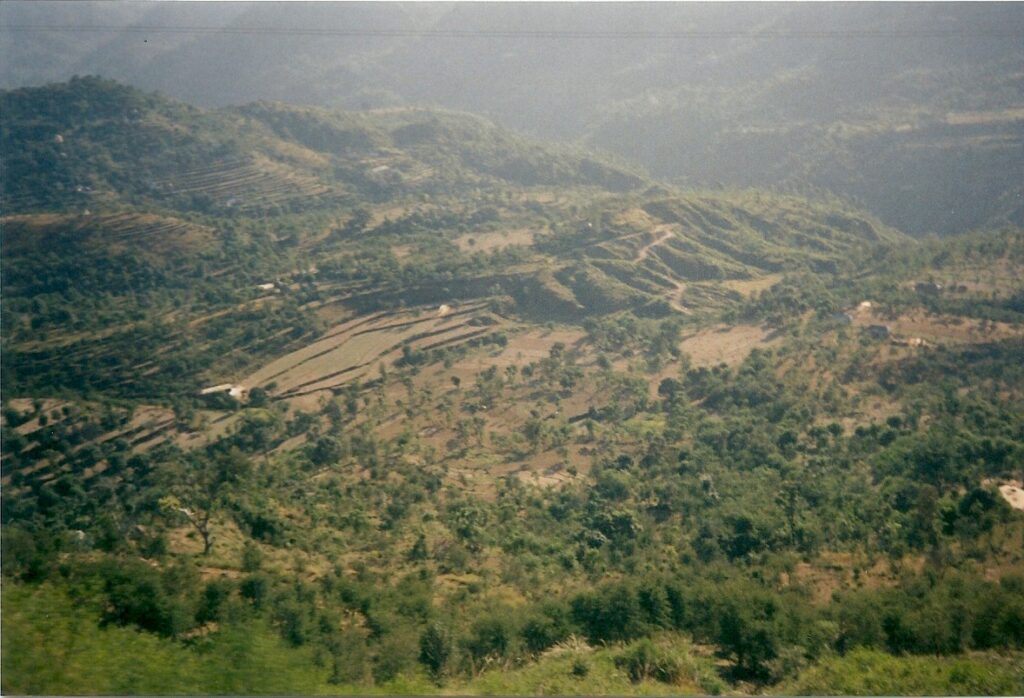
I had already been in India one week, but this was my first serious journey by bus. However it was only a matter of minutes before I was reminded of that undying Indian faith in the concept of fate, particularly when applied to the twin notions of destiny and something called reincarnation. Put simply, it’s already written in the stars when and how each of us is going to depart this earth and the life form in which we shall return to it. So to hell with all this obsession about road safety – if you were meant to say cheery bye in a rather undignified manner, you’ll go that way, and if you weren’t, then no matter how much the bus driver tries to throw his vehicle of that cliff edge, it simply won’t happen.
So on our ascent, it was a case of foot to the metal. Forget the brake- the horn is an effective substitute. No worries that the next hideous bend is but a few seconds away – plenty of time to over take that truck and if we cause a horrendous accident in the process, then we won’t have to account to anyone in this life, as chances are we’ll be the ones who have gone over the side, aided and abetted by a driver with a death wish.
Near misses became the order of the minute, or if that feels like a bit of an exaggeration, then of the five minutes at most. In each case, as the zenith of our existence loomed, the driver pulled away from the edge, or finally launched into emergency stop mode, with what felt like a split second to spare.
For quite a while it really did feel like this fate thing was spot on. I did not know whether to thank the Lord or convert to Hinduism.
The good news, when our luck finally ran out, was that we were on the inside. Another bus came hurtling round the bend. As the opposing driver went to hastily correct his alignment, I thought ‘no way he make it this time’. Well he did, but by default, savagely scraping down the side of our bus, leaving it with a series of large dents down the side, shattering a couple of windows and not even stopping to inspect the damage.
Back on Top
Sauntering to a halt at a road side in the middle of no where, it was obvious that the collision had wreaked havoc on our engine. ‘Everybody off’ implied the driver, with an indifferent shrug of his shoulders, as though it was an every day occurrence, an occupational hazard of sorts, as easy as falling out of bed, or off a cliff should I say. Maybe they could turn bus baiting at these heights into a regional sport.
So the vehicle’s occupants found themselves waiting for the next passing bus in some isolated spot. Isolated, we may have been, yet a small captive audience of three people seemed to have appeared from under a cabbage leaf. I found myself talking to one of these spectators, a man in his sixties, who I shall refer to as Mr 65.
Just as I was beginning to think, ‘Looks like we are going to have time for a very long conversation’, a bus comes around the bend, and is flagged down. Alas, crowd wise, it’s a typical Indian bus – crammed full. No way can I stand up in this mass of bodies and still keep my ruck sack on, besides I’d probably feel a bit of a prat. Put it on top, the conductor indicates. So I go round to the back of the bus, put my foot on the first rung of the ladder, hand a shoulder bag containing my valuables to Mr 65 for temporary custodianship, and climb onto the roof of the bus. I whipped a heavy duty chain and padlock out of my pack and started securing my luggage to the rack.
Now, either the driver did not know I was up there, or if he did he thought I was made of sterner stuff, because one minute into lashing my gear down, the bastard drives off. I grabbed the hand rails on either side of the rack, just as a cry from ground level reminded me that I was still a bag short.
I looked down and there was Mr 65 doing an impression of running the 100 metres. Sliding across the top of the bus, I gripped the top of the ladder and lowered myself down a couple of steps. I held a hand out and just in time caught the strap of my bag from Mr 65, before the bus seriously picked up momentum. And then, well there was only one place for it, back onto the roof.
A five second delay in trying to snatch that bag and my Indian trip would have come to a calamitous halt. Wot no passport, malaria tablets, cameras, seriously heavy duty first aid kit with syringes and blood transfusion accessories, address book, airline tickets – the list was endless.
So fine it seemed, in situations like this was the dividing line between success and failure, recovery and loss, equilibrium and catastrophe, and yes, life and death, that I started to think about that fate thing again. Maybe lady luck was shining on me after all.
What, I wondered afterwards, would Mr 65 have made of his new found bag of goodies. For him they would probably have been a curiosity, but for me, life without them would have been absolute buggery.
The ride was now both novel and scary. A bird’s eye view of the Himalayan foothills, with us climbing higher and higher through every hair pin bend. However the temperatures at this level were much cooler. Given that dusk surrounded us, it was getting icier out on top by the minute. The prospect of turning into an icicle long before we got to Dharamsala was not appealing. Just as worrying were my strong body movements, as the bus lurched around each bend, threatening to throw me off the roof top and down a rather long drop. This ride was a bit more demanding from the one that I had envisaged a few hours earlier as I sat down and plonked my rucksack into that empty seat. Hold on tight.
Every five minutes the bus would stop to let someone off, but there was never enough time to shimmy down the ladder. However after about half an hour, as we pulled into a large village, the opportunity did present itself, and I transferred myself from the crispness on top to the somewhat searing temperatures of a crowded inside.
Amnesia and Taxi Metres
Dharamsala is split between two levels – an upper and a lower town. The upper town, where most of the hotels were located, was a further twenty-minute ride up into the hills from the station.
I opted to stay at a place recommended by the Lonely Planet guidebook. This Tibetan owned hotel was on the outskirts of town at the bottom of a steep bank. The taxi stopped on a roadside overlooking the hotel, some eighty foot below. I found myself ambling down the steep muddy slope in pitch darkness, either gingerly on my feet or backside.
Some twenty minutes later, having completed the formalities of registration, I found myself in a spartan clean room with pine furniture and an ensuite shower which pumped out water to match the temperatures of the snow capped mountains outside. I jumped in the shower and jumped out again, dried myself and crashed out on the bed. I started to day dream about what I might do the next day and read chapter and verse from Lonely Planet on the subject. Another half an hour of this and I found myself sinking into the land of serious Dharamsala dreams as my eyes became top heavy.
Suddenly a knock at the door awoke me. It was the Tibetan proprietor, gesticulating wildly and talking quickly in animated fashion. He kept pointing to my shoulder bag of valuables, but I could not figure why the hell he was so excited.
Finally, completed exasperated, he drags me round to the side of the hotel and points up to the top of the steep embankment – and there it still is, my taxi. The penny drops. I had asked the driver to wait, with my rucksack in the back, while I slid down the bank to check out the hotel.
I had become so enamoured with my accommodation, as to doss down and forget about the vehicle ticking over on the road side above. Meanwhile one taxi driver and a rucksack continued to wait and wait and wait. So not for the first time that day someone who I had placed in a position of trust with my baggage and who could have quite easily legged it, did me proud. In the taxi driver’s case, waiting for fourty-five minutes was not a problem, rather patience was a virtue.
Tibetan Food and Freakiness
One hour later, I ventured out in search of food and discovered a modest Tibetan run restaurant off the main drag. This establishment consisted of a few ramshackle chairs and a couple of trestles – unpretentious to say the least. It was made more inviting by the swirling steam, that emanated from a cauldron of soup, misting my glasses up on entry. One of the trestles was occupied by family members and friends, who were passing the evening chatting, playing cards or doing homework – I was the only diner.
One young man got up and handed me a short menu for perusal. Having inspected this, I asked him to describe the soup. In his best pidgin English, his description went something like this (to be read slowly):
“Eet ees…erm …. erm”
‘yes?’
“Ay….erm….ay … erm ….erm”
‘Come on now’
“Kiyynnd….auf … erm”
‘Yes? yes?’
“Fud!”
Well that’s a relief I thought, better order some.
On serving up the soup, another affable young chappy made a pertinent comment, although I did not appreciate its significance at the time.
“Hello sir, I just wanted to say that we (i.e. all of the establishment – his family, his mates whoever else) think you look typical English.”
I wondered if he was he referring to my pale western complexion. The following morning, in the clear light of day, all became apparent. Yes, I know that Dharamsala has a bit of a reputation for being a mini-Kathmandu, but never having been to Kathmandu, I was not exactly sure what to expect. But there it was, an extremely diverse range of motley hippie characters from the western world. It would seem that there were not many parts of the visible body which were not susceptible to piercing. Add to this all manner of bohemian hair styles, braid skull caps, hair plats, flower power clothing and so on, and you’ll understand why I, with a slightly conservative appearance, felt rather out of place.
Just when the Tibetans at the restaurant were starting to assume that all westerners were of this appearance, along comes a ‘normal’ conventional Englishman – well I do my best.
Wot No School Bus
I had nothing against this diverse bunch, but I had not come all this way to be surrounded by hippie types in search of escapism, so I headed out into the foothills beyond Dharamsala. Despite the cooler climate in these foothills, the steep climb soon had me sweating. I stopped on a number of occasions to reflect on the valley below.
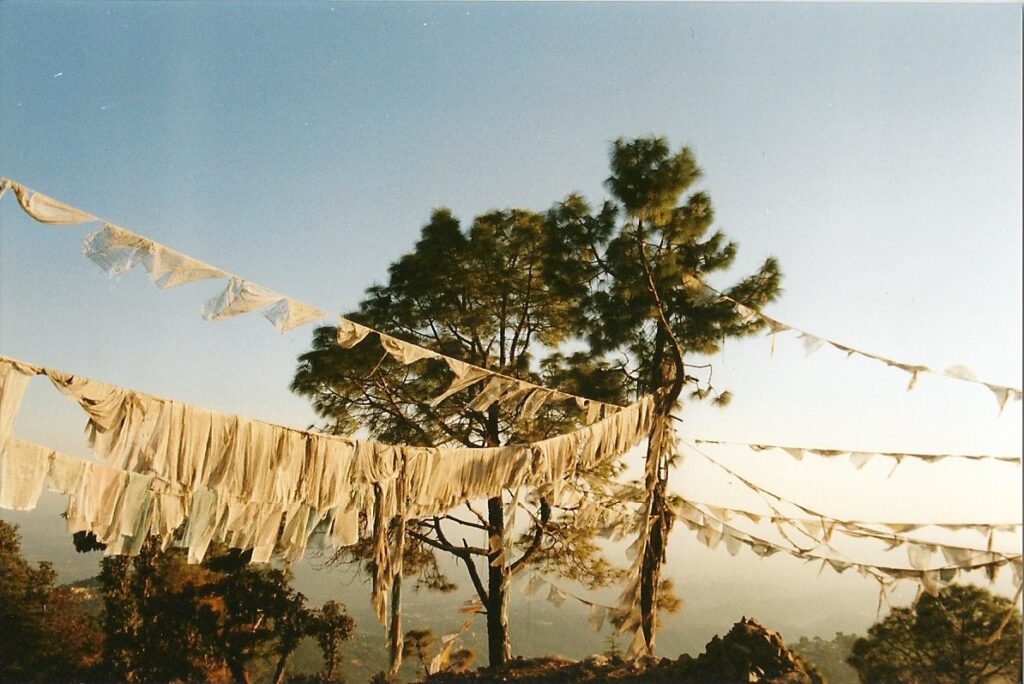
One convenient resting point was an hour away from Dharamsala. Here, I stumbled on a set of strangely elegant Tibetan prayer flags that looked like several strings of severely shot at and faded tea towels. These radiated out from an eight-foot high central pole to a number of surrounding boulders and buildings.
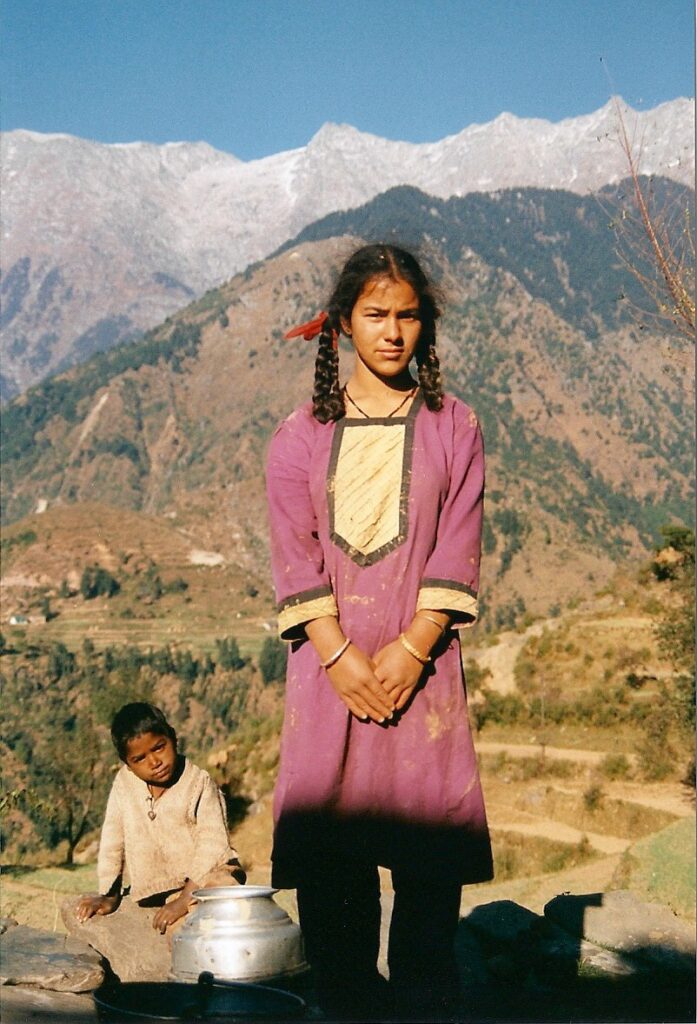
I did not think that I was walking particularly slow, given the testing gradient, but I soon found myself being overtaken by two school children, who were on their way to afternoon classes. These kids must have been all of ten years old. As they went to go past, they stopped to say hello and to inspect my camera. They took their school bags off their backs for a moments rest and handed one of them to me. I gasped at its weight, which felt heavier than my rucksack, now resting against a bed way down in the valley below and which contained my home of sorts for a month – yet here were these two diminutive characters scuttling uphill for an hour or whatever, with what felt like half of Delhi’s Central Library in their satchels – and all this without breaking sweat.
“Oh well,” they muttered, or something like that, “we must be off. Can’t wait all afternoon for a slow duffer like you. No hurry, No curry.”
And with that they left me in their stride. Little gits.
Afternoon Tea and Paradise
Another fifteen minutes and I passed the school. A further half mile on I came to a small serene village. Here, the few streets, or rather tracks, consisted largely of pastel wooden houses, decked out in the fauna and flowers that flourish at these heights – a setting beautiful enough to send any visitor into contemplative mode . Add to this the fantastic backdrop that is the snow capped start of the Himalayan mountain range.
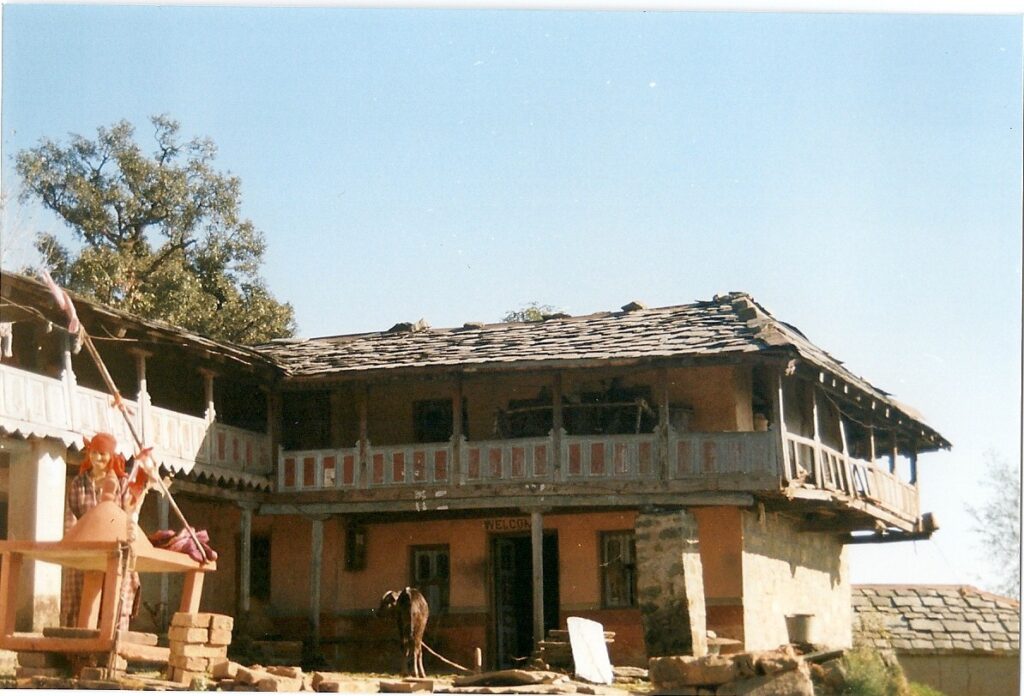
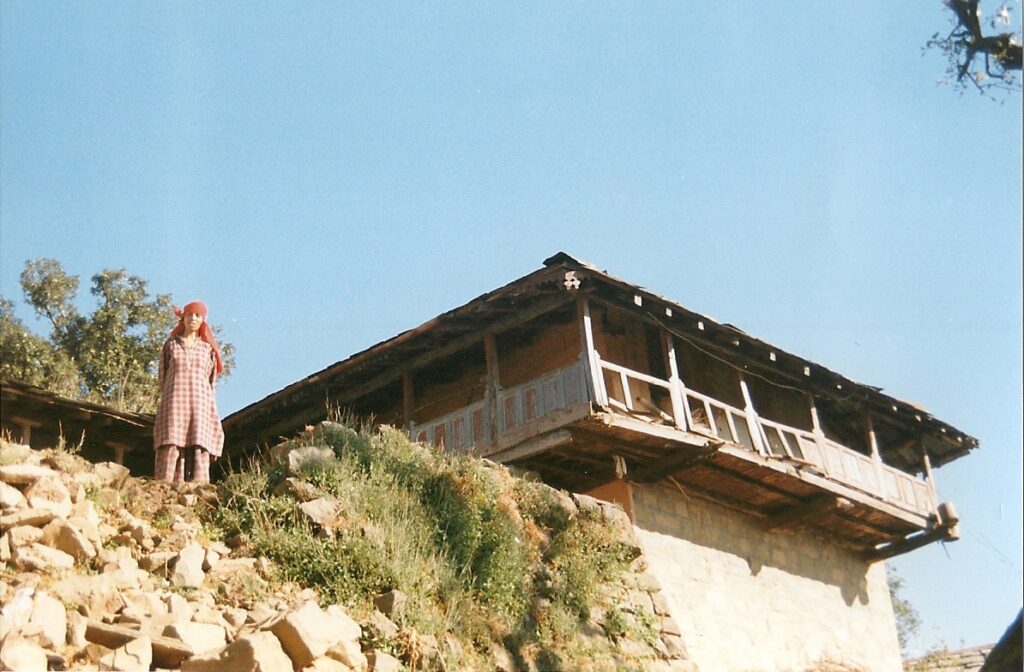
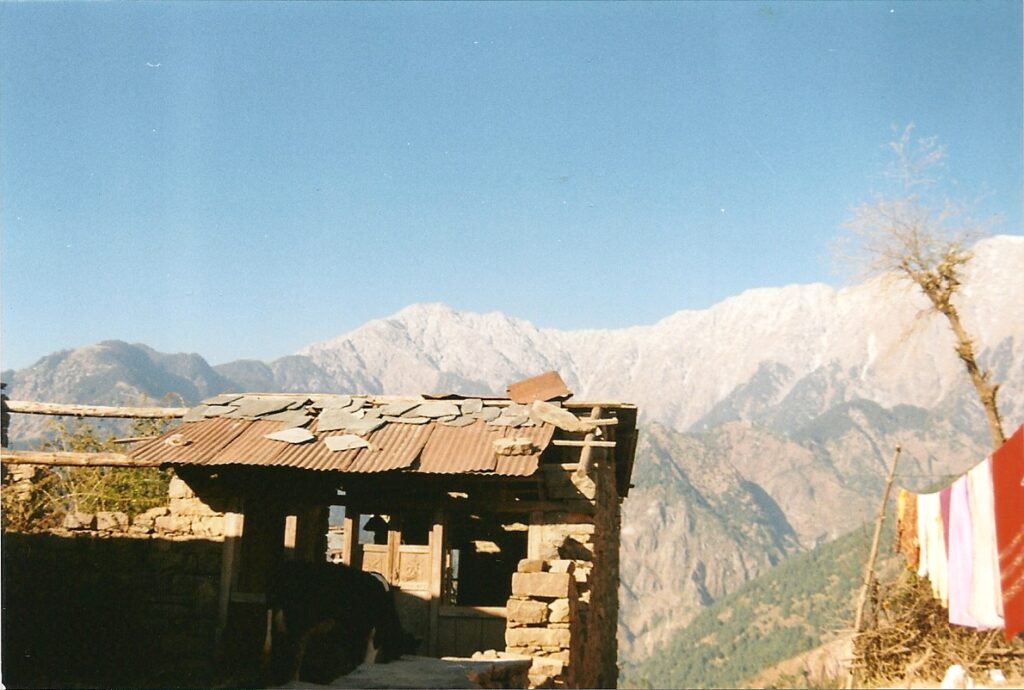
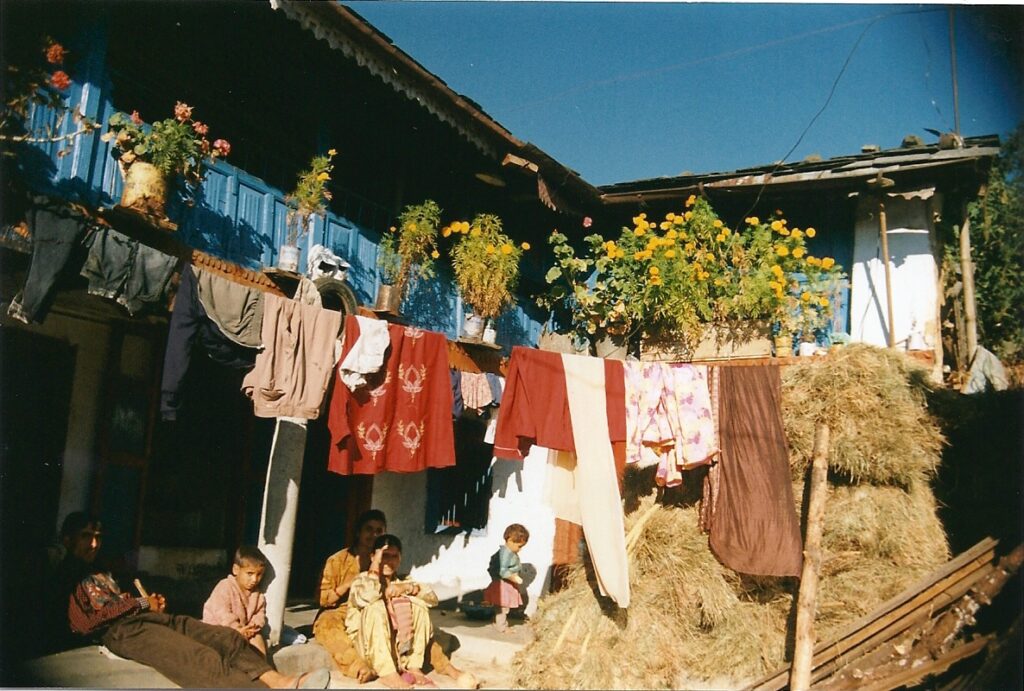
I put my camera away and sauntered along not staring at any particular house or person, trying to look like someone without a care in the world. My hope was that sooner or later someone would come out of a doorway or lean over a balcony and shout “Hey, mister? Where you from? You want chai?”.
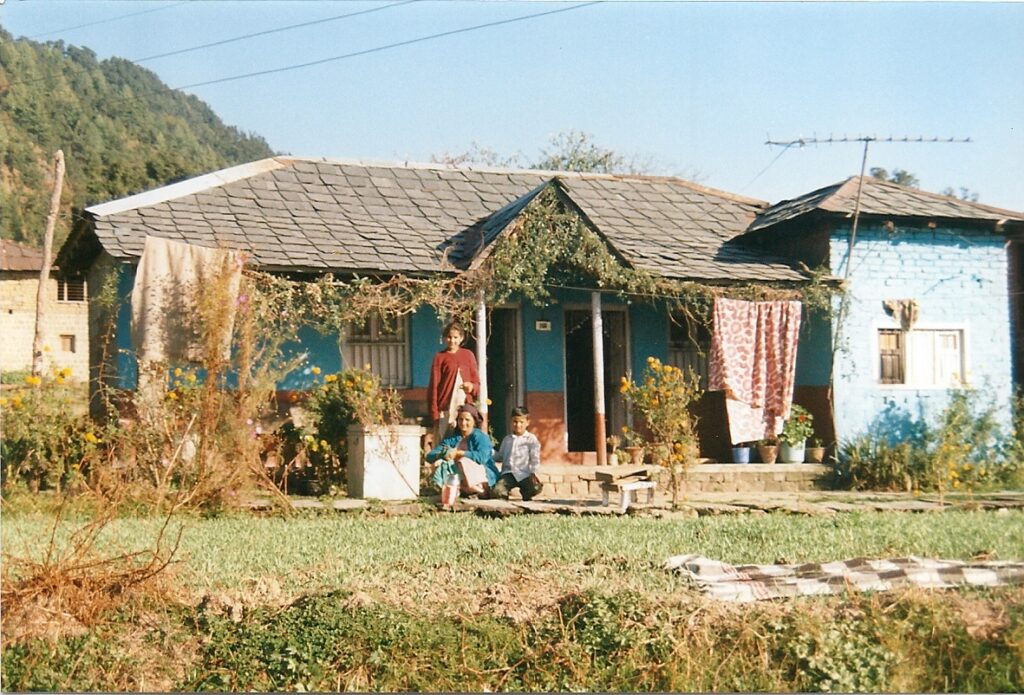
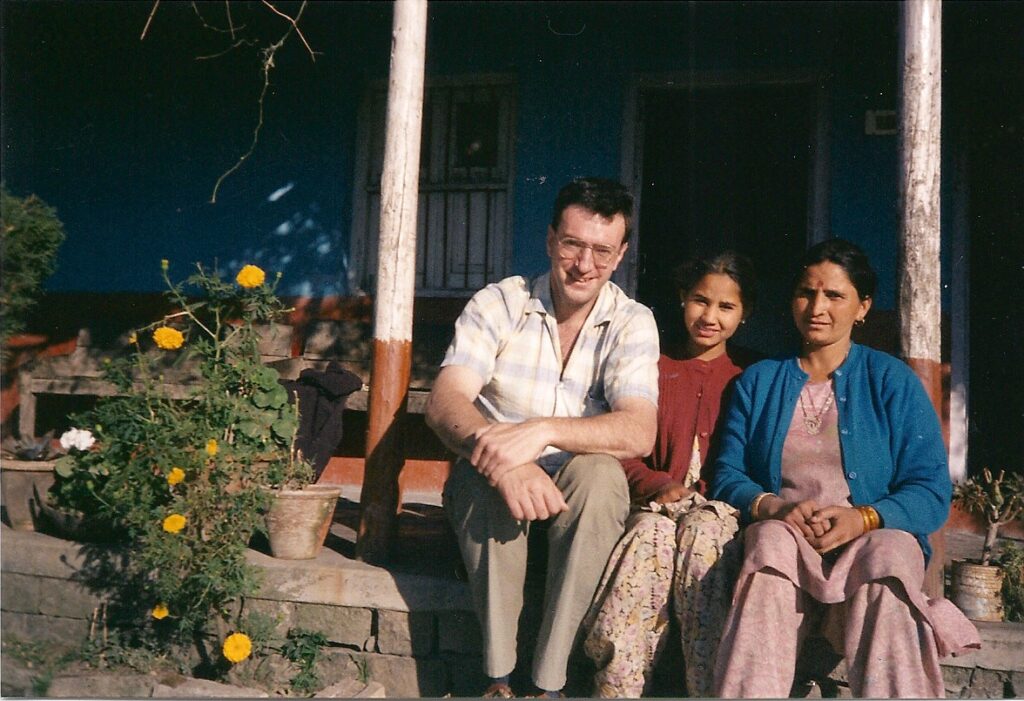
Five minutes later I found myself sitting on a doorstep with a mother and her two daughters. The mother boiled a pan of water on the patio in front of us and baked a nan bread for me. In between rustling up these refreshments, she gave me an tour of the frugal interior of her two roomed bungalow. Her pride and joy were the framed photos of relatives that adorned one wall. We retired back to the doorstep for an hour. Conversation was difficult but the feeling of hospitality strong and the view of the valley below and the snow capped mountains behind, bliss. I had found my own form of meditation here, just outside of Dharamsala – no need for all the nose piercing stuff to be able to appreciate this.
Maybe the interior of the house had been spartan, but with the all round views that were on offer, who cared? Doubtless my host would have been horrified to have to eak out an existence in some suburban uniformly drab housing sprawl, where the best view was of the frontage of another uninviting house a few feet across the road.
Of course I could not leave without taking some group photos, both inside and outside the house. My host jotted down her address in Hindi. On my return to England, I put copies of these snaps into an envelope, pasted her jottings onto the front and wrote underneath …..” Near Dharamsala, Himachal Pradesh, India.” I truly hope that she received this, and who knows, that one of these pictures now hangs on that wall six-thousand feet up into them foothills.
The Road to Simla
Another morning, another obscenely early 5.30 am rise, in order to catch the first bus down to ‘lower’ Dharamsala. The day’s objective, to board a coach to the neighbouring hill station of Simla, without having to sit on the roof. Neighbouring, that is, by Indian hill station standards – a mere 10 hour hop away.
I located the empty coach with one hour to departure, climbed onto the roof top, slammed my pack town and out with the chain and padlock. Inside the coach, five minutes later I picked the seat with the most leg room and sat down looking like a right smug bastard – baring disaster nothing or no one was going to get me out of it until Simla.
Five minutes later, a cry from the coach door, “Hey Mister, are you going to Simila?”
“No bugger off, you can’t have my seat! There are sixty others for you to chose from.”
OK, of course I did not say this. Instead the other chap indicated that he was a driver for another bus company which was leaving for Simila in five minutes time from the other side of the station.”
So it was a case of back onto the roof, retrieve my gear and race across to the other side of the station. I started to shimmy up the ladder of the new coach, but paused for thought, turned around and muttered to the driver, who was stood below, “Just don’t you dare drive off whilst I up here. That’s all! OK?”
Inevitably, he was another kamikaze driver, but at least there were less hair pin bends. We had done most of our climbing the other day. After a few minutes, the journey took on a truly beautiful complexion. For almost every mile of this ten hour journey, there were views of multiple mountain ridges, small canyons, plunging streams, rivers, tea plantations and fauna. It really felt like I could have used two rolls of film in as many hours and I surely would have done, but for the bumpiness of the ride. Oh well, there will be plenty of stops along the way thought I. Sure enough there were, but unfortunately these were in small town bus stations, where the few surrounding buildings conspired to block out any panoramic view. Maybe the alluring scenery was not the most spectacular to be found across the mountains of northern India, but it sure beat the hell out of anything on offer back in the UK.

About three hours into the ride, a grey haired man of around sixty-years boarded and sat next to me. He looks like a wise chap, thought I. And so it proved to be, as he unleashed his considerable knowledge of the region’s topography and people. It appeared that he was eminently qualified to appraise me of such details, being the author of a couple of books on walking in the Khullu Valley and the environs of Simla, which he now displayed to me.
Inevitably, several hours of close proximity and initiation into local cultural matters, led to the pressing invite to stay with the author and his family for the duration of my visit. Having diplomatically declined his generous offer, he handed me his calling card, just in case.
The impromptu sweet stalls at the stations along the way, with their gift wrapped boxes of goodies, gave a colourful festival feel to the journey. My accidental timing of the trip to Simla had been impeccable – this was the three-day countdown to the big bang. No, not India V Pakistan, rather the Festival of Lights, or Diwali, as it is more commonly known.
Delhi, India
simla, Devprayag, Tehri Garhwal, India
Dharamshala, Dharmsala, Kangra, Himachal Pradesh, 176200, India
Amritsar, Punjab, India
Life’s a Gas
The former summer capital of British India, Simla loomed, so step back in time for a moment to the turn of the century.
Every summer, at the height of the Raj, huge baggage trains would cart all the necessary trappings of government up from the intense heat of Delhi, so that the efficient running of the country could continue amidst cooler surrounds.
But this was no ordinary seasonal relocation of desk space, as Charles Allen found in his series of 1970s interviews with surviving participants from this bye gone era.
“The headquarters of government used to move up to the hill stations, taking with them all their files – an annual migration (and not a motor car in sight – my italics)……… If government moved up, a lot of officers had to move up and so there was social life. Wives moved up …., and of course other wives were not going to stay, so they all went. There was a considerable attraction to this exodus and they managed to have a pretty gay time.”
This relocation of a substantial community led to attempts to recreate a little England of sorts. On arrival visitors found a
“….jumble of houses of every imaginable semi-suburban British kind, perched on top of the ridge – houses with a sort of English feeling about them. The smell was English, the houses were furnished in a much more English kind of way and there were fires in the evening.”
Inevitably, this led to a life style, which had a certain British panache:
“We used to reckon on 3 – 4 dinner parties a week and the same with luncheon parties. It was whirl of entertainment, interspersed with some quite gorgeous ceremonial and pomp, particularly in the Viceroy’s house.” (Ian Stephens)
“My record was twenty-six night’s dances running, at the end of which I could hardly keep awake, but I had to attend an official dinner that my mother was giving and was severely remanded for falling asleep in the middle, when talking to a woolly old judge ….. We were always meeting the same people. Everyone knew rather too much about everyone else’s’ affairs, and it was a staple topic of conversation – what was going on, who was going out with so and so. If there was a very big party you always knew about it and if you had not been invited you took that very seriously.” (Iris Portal)
And in between the knees ups
“Another popular source of entertainment and a major feature in Simla social life was amateur theatricals. The Simla Amateur Dramatic Company, composed of officers and their wives and sweethearts and anybody who aspired to act, put on five or six productions each summer. The plays were put on at The Gaiety, an enchanting little theatre, beautiful, like a little tiny jewel of a theatre in some small German principality. Everybody came, including the Viceroy, the commander in Chief and the Governor, who all had their special boxes.”
But its real notoriety and something not quite in keeping with British conservativeness:
“Within this marked holiday atmosphere and absence of officialdom, wives often got very bored with their husbands and flirtations were inevitable. Those who went after the ladies were known as ‘poodle fakers’ and were said to come down from the hills fighting rearguard actions against the husbands coming up.”
Old Simla, the Bazaars and Prophetic Words
On arriving in Simla, I settled myself down at the large Hotel Merva. This stood next to Christ Church, a building erected in 1857 which could have easily stepped into a Constable painting. I showered, crashed out onto the bed for a while (no taxi drivers to pay off this time) and reflected on the exhilarating ride. If ever I was to make the same journey again, I told myself, I would do so by taxi, enabling me to stop at will along the way whenever real beauty beckoned.
But for now, I wondered if tomorrow would reveal a town still alive with testimonies to British rule or was the best I could hope for, an obscure decaying relic of the Raj, down some side street?
Simla sprawls along a crescent shaped ridge, with its suburbs clinging to its slopes. Along the ridge runs the Mall, from which the British banned vehicles and until World War Two, all Indians. The cool light of day revealed a town centre which felt like a cross between Camberwick Green, the Cotswolds and a well preserved medieval settlement – the post office and Ye Olde Town Hall, to name but two buildings along the Mall, could have been transported from a Bavarian hamlet from the middle ages.

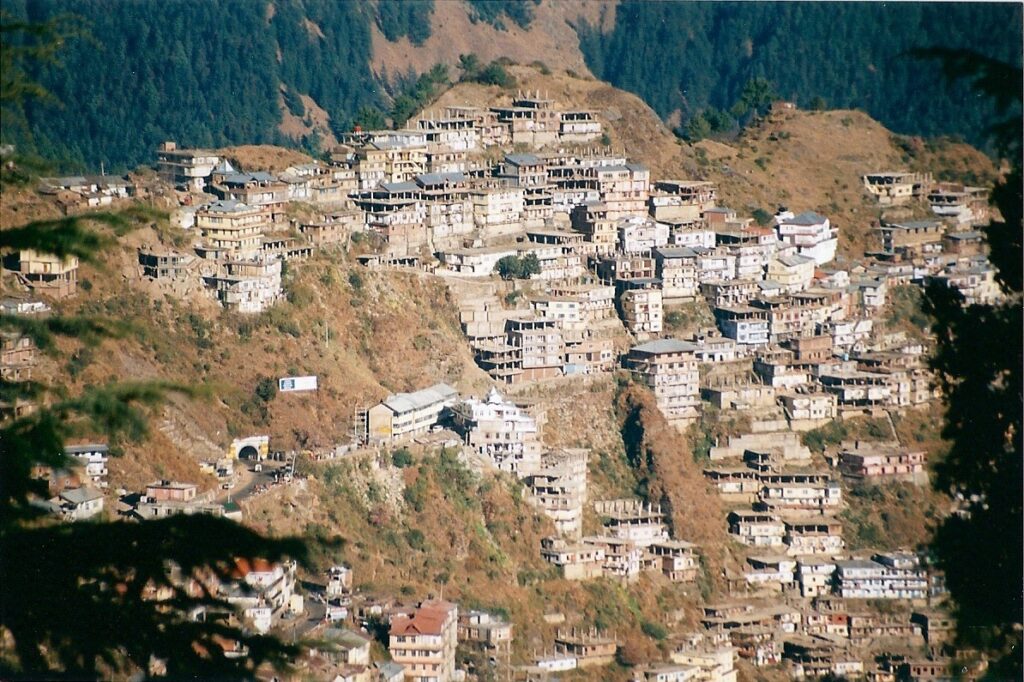

Below the Mall ran a series of streets each separated by a very steep set of steps. These contained the Upper, Middle and Lower Bazaars, which sold all manner of food, spices, clothing, junk and of course don’t forget those Diawali explosives and gifts. The frantic activity along these stretches was interspersed with the zips and zaps of occasional fireworks. As I sauntered through one of the Bazaars an aerial bomb (at least that’s what they were called when I was at school) exploded a couple of feet away. I cupped my ears in agony, a bit like closing the door after the horse had bolted.
Wiith my ears still ringing furiously, a stall holder attempted to speak to me.
“Sir” he said “If you thought that was bad, just wait until two days time – Diawali night. You’ll have a very hard time then. Guaranteed!”
Relics of the Raj
With this warning in mind, I strolled for a mile or so to the Rashtrapar Niwas Observatory (Institute of Advance Studies)’ – a high flouted title this may sound, but fifty odd years ago something much more regal was housed here – it was the Royal Residence of the British Viceroy – Many decisions affecting the destiny of the Sub-continent were made within these walls.
Could this six floor gothic like fort invoke serious memories of the Raj? Just viewing the building from the exterior was not going to shed much light on the matter, so I joined a guided tour along with a smattering of Indian tourists and was duly rewarded by its first port of call – a state room, where in the final days of British India, discussions took place and decisions were made that would determine the country’s geographic and political future. Framed photographs of these key meetings hung on the walls – deliberations immortalised in time; games of cat and mouse at the table between the likes of Jinnah (representing the Muslim League), Nehru (soon to be first Prime Minister of India) and of course at the heart of it all, Viceroy Mountbatten with his wheeling and dealing.
Not wishing to dwell for too long on this era, after a couple of minutes the tour moved on. It now started to take on the proverbial description of minuscule details – ‘This part of the ceiling was painted in such a year’, ‘This book case can hold so many publications’, ‘The wood for this part of the stair case came from such a state’ and so on. Personally, as is often my want, I merely wished to imbibe in the building’s aesthetics with one swift gulp, rather than being forced to look under numerous micro dots. I detached myself from the party and resigned myself to surveying the building from outside.
Was this monument a faded relic of the Raj? There was nothing wrong with the bricks and mortar and the upkeep of the interior. The only faded matter, it seemed, was the affection the Indian tourists had for yester-year. They were more concerned with the building in its current role as the Centre for Advanced Studies. What happened fifty years ago was history – nothing more, nothing less. Colonialism was dead.
As I walked away down the road there seemed a definite irony to all that had gone on in the mid 1940s in this tinsel town setting. The British Government had set itself a deadline for withdrawing from India and a principal architect for designing the new map and simultaneously addressing the settlement and resettlement of Muslims, Sikhs and Hindus was Viceroy Mountbatten. With the intractable nature of the situation in mind, the deliberations would have been conducted with a view to minimising any violence and loss of life. However, in the event, the biggest migration in history, of these religions to their new homelands, whether this be in Pakistan, the Punjab or other parts of India, resulted in ethnic carnage on a grand scale.
So the irony that sprung to mind, as I left the Viceroys residence behind me, was surely the key participants at those meetings in Simla knew their decisions, whatever way, would result in a large loss of life – Yet here they were, in this very genteel, safe, relatively small community with its honeymoon atmosphere, up in the mountains – a world away from the plains that were inhabited by many of the thousands who were subsequently butchered to death during Partition.
It was hard to imagine that this tranquil town once presided over such monumental decisions.
China and the Trade Descriptions Act
Despite the many closed-in compact streets that attached themselves to Simla’s slopes on a multiple of levels it’s epicentre could not hold my attention for more than a matter of hours. I decided to strike out for the environs of the town on a day excursion. The tourist information office offered an interesting option. ‘See China’ the bill board screamed out at me, returning the same day and all for less than 150 rupees you know. Quite naturally, I snapped up a ticket for the following morning’s early departure.
Two hours and one pit stop at a Hindu temple later, we drove into the grounds of swish restaurant, which sat proudly on top of the ridge and offered panoramic views of the surrounding valleys. What better way of passing a lunch time, than to sit outside al fresco, with a plateful of exotic grub. Looks like there will be a clamouring for those outdoor seats I thought. But no, this was November and whilst I might have felt as fresh as a daisy in my T-shirt, it was near enough the winter season in India, even more so at these heights. For the indigenous passengers, more used to the dense heat of the plains, there was only one place for it – back inside. Nor were they intent on staying for any longer than it took the chef to rustle up a few lashings of dahl. Whilst I might have been content to splash out on a banquet and admire the stunning vista, my fellow explorers were more concerned about getting on with the journey.
For most of this posse, the travelling itself, rather than any stops along the way, or indeed journey’s end, was the most important part of the excursion. In contrast, for most of the eight hours we spent moving that day, I found myself catching up on sleep – philistine, they must have thought.
As we reached our final destination, the driver pulled into a village, escorted us along a narrow street, came to a cluster of buildings and pointed down an alley. Way off in the distance was a series of multiple ridges, with a larger mountain rather prominent at the end of the clear stratosphere.
“There” he muttered, indifferently “Past that mountain is China.”
In all probability, I would guess that the peak in question, was in the region of fifty miles away. But yes, if China existed just the other side of this piece of rock, then the Tourist Information Office could not be prosecuted under the Trade Descriptions Act – Hats off to them for their astuteness. I had after all seen China. Couldn’t grumble for 150 Rupees, and anyway my Cantonese was never up to much.
Not that any of the other tourists were thinking about grumbling either. Bugger China – Those of them that had walked as far as the alley only stared for twenty seconds before heading back for the coach. It was the long ride for which they had really come.
No doubt if British Rule had had a profound effect on this bunch, they would have lapsed into a loud rendering of ‘It’s a long way to Tipperary’ before we reached the next bend.
Post Colonial Migration and Jewish Prostitutes
The guide books don’t hold back when trying to plug Simla, whether this be through extolling the romance of its setting or its infamous past. Given this, I expected to spot a fair number of non-Indian holiday makers in town. But after two full days in Simla, I appeared to be the only one. Perhaps its out of the way remoteness knocked it off a lot of people’s travel itineraries.
I was just as curious about the absence of any full-time white residents in the town, whether these be the off spring of the Sub-Continent’s turn of the century rulers, or who knows, maybe even the original blighters themselves. Nor did there seem to be any evidence of ‘Anglo-English’, the term the British gave to those of mixed European/Indian race. It was as if the British community, previously so well developed and entrenched here, had at the stroke of independence, got the hell out. Not a hint of any stiff upper lip accent down the bazaars here.
I can only recall one instance, out of the passing conversations I had with residents, when the subject of colonialism was raised. It felt like an irrelevant matter.
It was interesting to read Richard Dalrymples account, a couple of years after returning to the UK, of his impromptu flight up to Simila from Delhi, in search of two elderly English spinsters about whose existence he had heard a rumour – it would appear living ‘relics’ of the Raj were in very short supply in the capital. When he finally tracked the couple down, they had quite clearly gone gaga, barricading parts of their mansion off to prevent Jewish prostitutes from coming down the chimney or up through the floor boards.
“Phyliss Haxby was a frail old women with mottled brown skin and thin, tooth pick legs. Her tweed skirt was extravagantly darned and her thick brown stockings were shredded with a jigsaw of tears and ladders.”
(Phyllis) …… “We want to sell up ….we’ve been through a very bad time, There are prostitutes living all over the place making life hell for us. They say we are English and shouldn’t be here. After seventy eight years! ………. She (her sister) had a fall today. The prostitutes put dope down the chimney . They are trying to drive out us you see. …………When we are asleep they put stuff in our eyes to make us go blind.”
Dalrymple visited Simla about three years prior to my visit. Where the spinsters still pottering about, I wondered in retrospect, when I was in town? If so what would they have made of the Diawali night celebrations which lit up the night time sky and which no doubt gave their floor boards a good rattling – a conspiracy amongst Jewish prostitutes, if ever there was one -Clearly payback time for their colonial sins.
Diawali Night – Russian Roulette, Bereavement and Monet
The following afternoon proved to be a very serene affair with families and courting couples out for their Sunday constitutional stroll along the Mall. It was hard to imagine any of these people conspiring to make the surrounding valleys shake under an Armageddon like rumble in two to three hours time.
I was not expecting the explosions to be any more thunderous or colourful than your average bonfire night back home. However, true, whilst Simla couldn’t hope to compete with the likes of Delhi, it’s 100,000 population represents a darn site more than your average British settlement and as we moved towards midnight, it felt like all of it’s residents were contributing in some way.
I went strolling down the myriad of side streets leading off the bazaars. Each clutch of houses it seemed was having its own party. It soon became apparent that safety standards were on a par with those adhered to by Indian bus drivers. The first inkling I got of this was when several youths tried to engage me in a game of catch the banger – I politely declined.
More gross safety transgressions followed. These included:
1. Dancing with rip raps – come on everybody get down into the grove (but don’t try this at home now) – gather round in a circle with your mates – place several rip raps on the floor (you know, those ones which go zip bang, zap bang, zip ping, zap ping – whilst catapulting their way around the deck.
Light the blue touch papers, only don’t stand back. As these little demons roar into life, zig zagging all around the circle you have just formed, rush at them and stamp them out. You’ll have to learn fast – this is a lot harder than it sounds and it does take practice. If you don’t get burned, then well done, you have lived to fight another day. Just add it onto your latest score. It’s a bit like conkers really. You’ll soon get the hang of it.
So after three then ……… it’s in, out, in, out, stamp the bastards out.
2. Launching that most popular of fire works, the conventional rocket. Well conventional, the firework may have been, but it’s general launching was another example of crass recklessness, or maybe they still have to grasp the fundamentals of geometry in this neck of the woods.
Find a long street with a fare number of people at the end of it, get a bottle, place the afore mentioned rocket in it, stand the bottle upright, no sorry I got that bit wrong, rather place it in a horizontal position one foot off the ground, pointing down the end of the street, and ignite.
Well of course people may get hurt, but that’s all part of the fun isn’t it and if they don’t like it, what the hell are they doing out on Diwali night anyway? You pays your money and you takes your chances.
3. Either through my invites into houses and shops or through sneaking glances into open door ways as I ambled passed, I caught glimpses of rooms containing trunks brimming over with fireworks – they must have been storing these goods up since last Diwali. Nothing wrong with a bit of forward planning. However what I observed on a multitude of occasions was a street party, seemingly having exhausted its supplies after a prolonged assault on the multicoloured sky, dashing through the nearest door way and retrieving another large batch of fireworks from an open trunk. One errant spark would have been enough to jettison the building to Mars and back.
4. Another street, another party. Suddenly I had an apparition. From the end of the row, emerging through the smoke, came three police men, patrolling the joint with their lathis. Having observed some very lax safety procedures they decided to intervene and, amidst much protestation, confiscated the fireworks on show. They quite clearly hadn’t got the hang of Diwali. Talk about a forlorn task, as soon as they had disappeared, the locals simply rushed indoors again and dipped into their endless supply of explosives.
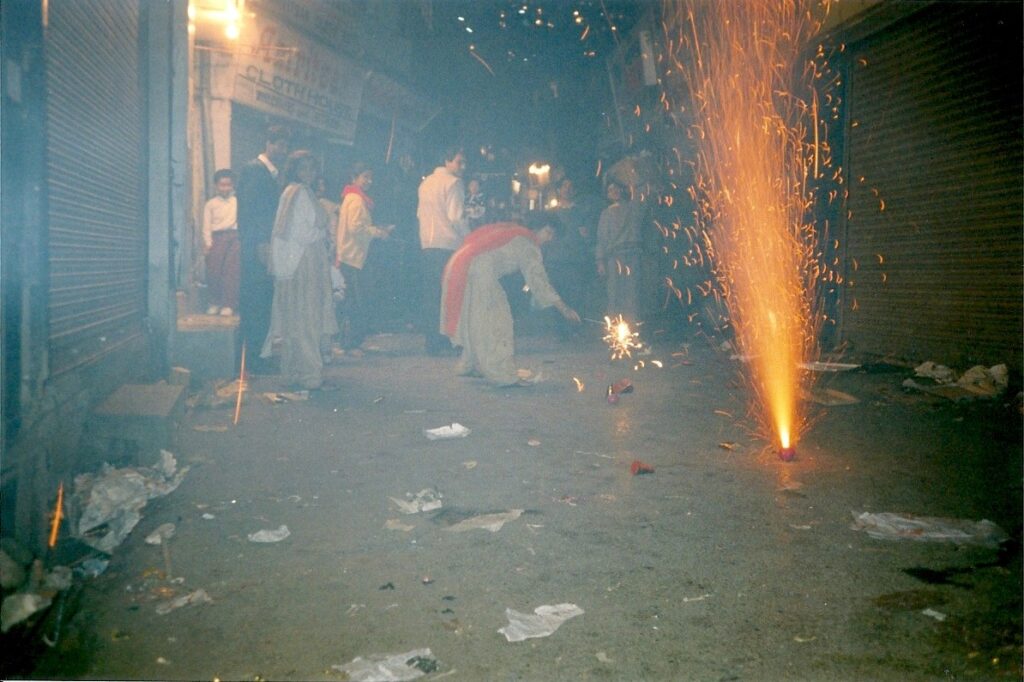
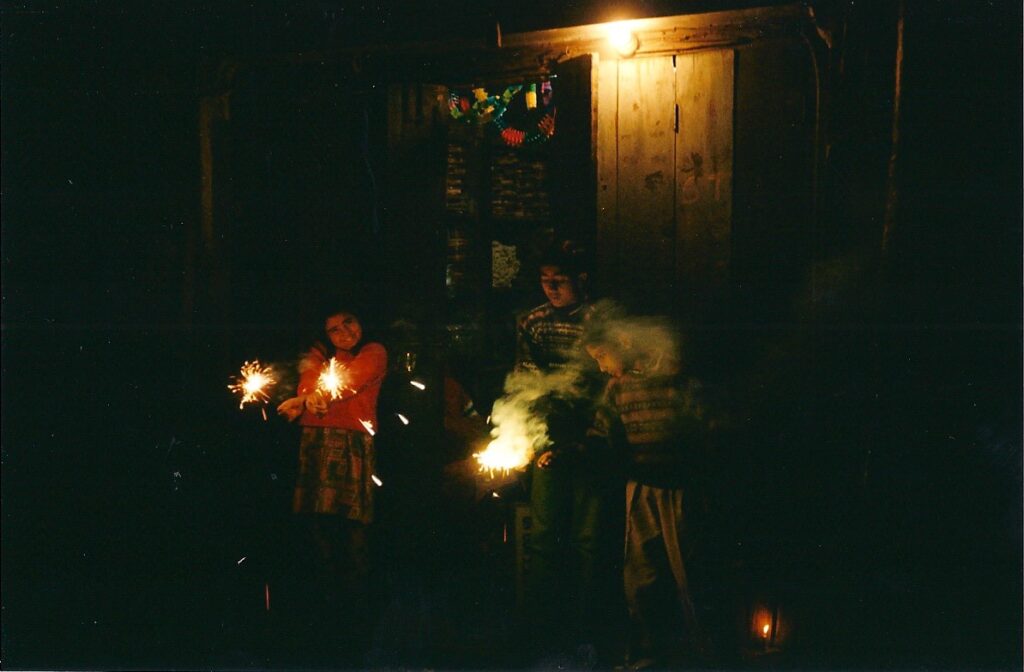
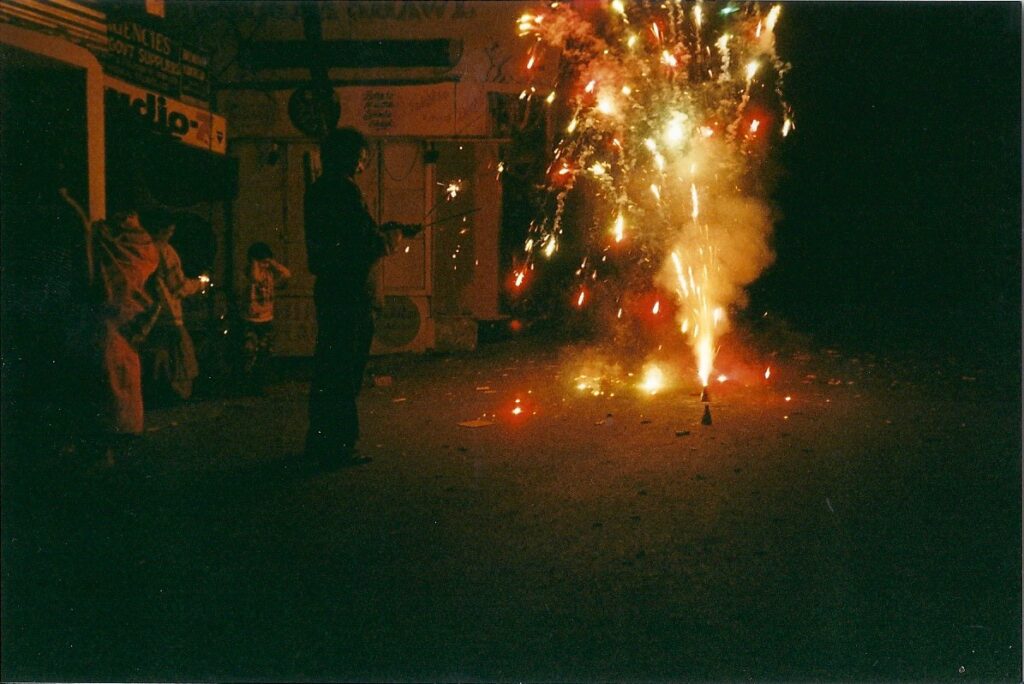
Surely, not even the complete deity of Hindu Gods could turn the town into an accidentless zone and so it proved to be. More meanderings took me past a house where the Simla fire brigade were present. The roof and an upstairs room were ablaze and the emergency services were assisting a family with their efforts to climb down the ladder from a first floor window.
By now the words of that stall holder from two days ago had a prophetic ring about them. No doubt about it, my ears were having a very hard time. The decibels, were amplified by the enclosed narrow streets – not exactly an open expanse from which the din could escape. I made the ten minute journey back to my hotel, inserted my ear plugs and returned to the heart of the matter.
A shop keeper stood in front of his store in a semi drunken manner, shook my hand and wished me a happy Diwali. A pressing invite to join him inside, and meet his brothers and assorted offspring followed.
“Do you want a drink? Come, have some whisky!” he said.
I intimated that I was not a spirit drinker, although maybe a beer wouldn’t go amiss, if he had one handy. A bottle of the stuff was duely rustled up.
‘Have you a glass?” I enquired
My host fell about laughing and with a large circular sweep of his arms, the shop keeper drew attention to the shelves that surrounded us. These brimmed with all manner of glasses of one design or another. Glasses were his business.
“So what size you want then?” he asked “big, medium, small, fancy, plain?”
Five minutes later, I was alone inside the shop with the owner, whilst his other relations played outside amidst the dense colour and noise.
He proceeded to relate how 1996 had been a very sad year for his family, relations and neighbours, due to the deaths of his wife, a brother and other faithful departed from the street. The rest of the family were at that moment dancing and laughing outside, and long may they continue to do so he added, but he could not switch off so easily. He took another gulp out of the whisky bottle, picked a souvenir key ring off a shelf and dropped it into my shoulder bag. “Happy Diawali” he said. Ever since, this small gift has been lurking inadvertently in the bottom of this piece of baggage – I completely forget about it, until the next time I remove the padding out of the bottom, whilst in Malaysia or some other far flung place, and there it is still gathering dust, this talismanic key ring.
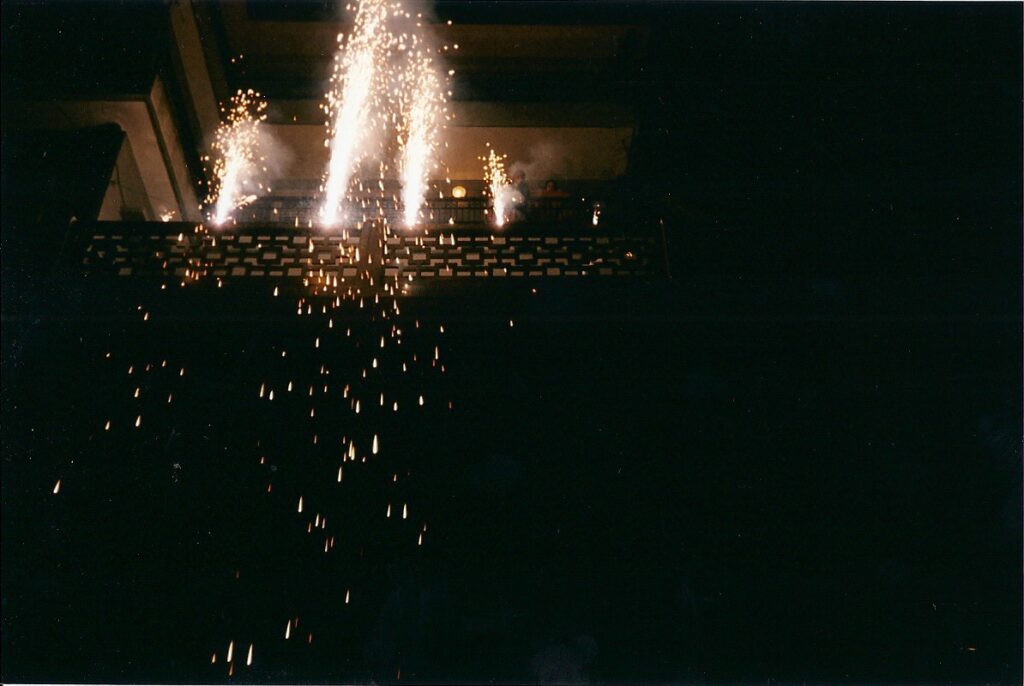
I had been on the prowl for four hours now in this cacophony. Strolling back to the hotel through a side street, I stopped to look up at a clutch of adjacent houses. Families from the neighbourhood were sitting out on their first floor balconies. The ledges, behind which they sat, were lined with tens of flaring mult-coloured ‘roman candles’, with the smiling faces of children just about visible through the exotic sparks. I resisted the temptation to whip out my camera and snap these joyful gatherings. Not that there was ever any chance of blending in like a native. If I had taken a photo though, I think I would have set the camera to a slow shutter speed and hoped for a finish comparable to a pastel like painting by Monet, with a hint of beaming faces peering through the daisies.
Midnight back at the hotel. Time for sleep? Not a cat in hells chance! The ballistics outside were not abating. In addition to the explosions down at ground level, every few minutes there would be a woosh going past, or coming to a halt just by my window. In short, judging from the distant rumblings across the mountains and the decibel level in the streets below, it felt like the town was under siege.
Trying to nod off, even with the ear plugs in, was a hopeless task. Instead I did a good impression of being a pleb, and resorted to watching Star TV on satellite. Eventually I stumbled across the BBC news from the UK. In the middle of this broadcast, I dropped off for a while …….
“This is the BBC, some well to do news reader said, with a stiff upper lip.”
“Really?” I said “But I thought you’d all been kicked out in 1947”
“Ah yes, but we still come back to haunt you in your sleep old chap.”
“Yeah sure. How do you manage that then?”
“Oh, we either come down the chimney, after we’ve poured some dope down it… or we come up between the floor boards.”
As dawn arrived, people finally cottoned onto the fact that Diawali was over for another year. I removed the ear plugs, for what they had been worth, staggered over to the window bleary eyed, and pulled back the curtains. The balcony outside was covered with a smattering of stray rockets – perhaps being one of the tallest buildings in town the offending articles couldn’t find a way past the fifth floor into the night sky- well at least they didn’t make a forced entry through the window.
Toy Trains, Tabloidism and a Mid-Air Apocalypse
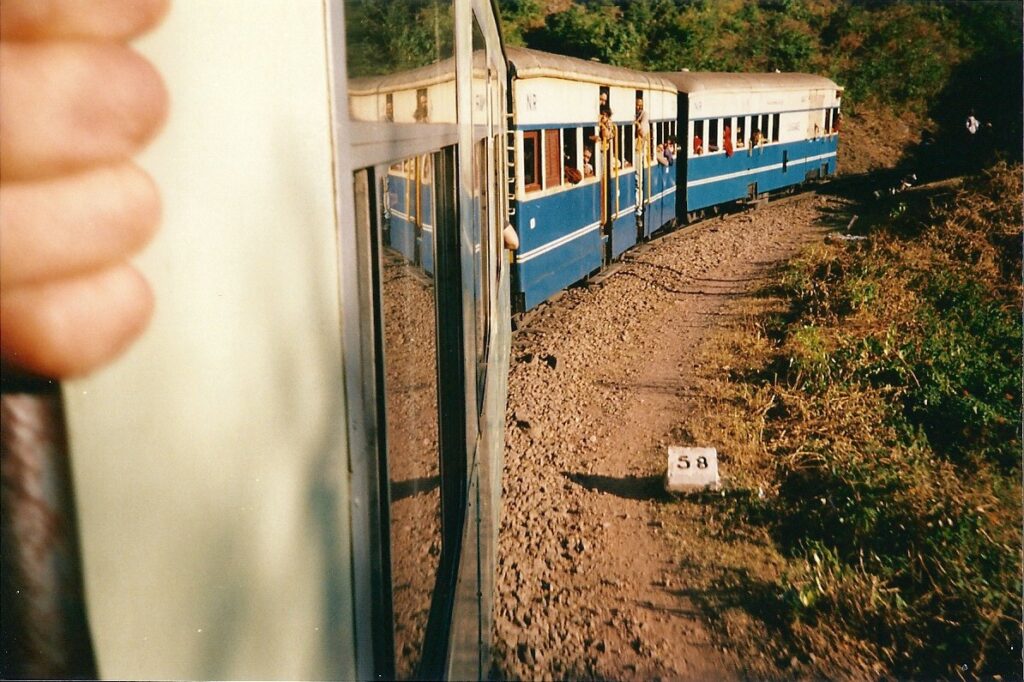
Later on that morning I caught the toy train to Kalka, from where I had to change for Delhi. This contraption could have walked out of a Thomas the Tank Engine scene – the only part missing was the Fat Controller. Six hours of clinging to the mountain sides followed, gently going into one hair pin bend and then out of another, passing through a variety of small stations, where even if the engine did not come to a stand still, it was still moving slowly enough to be able to jump off, buy some food from a platform vendor and then hop back on. Now this would have been a roof top journey to behold.
The following morning I went out in search of an airline ticket to the Rajahstani city of Udaipur, with its splendid lake side temples, many of which have long since been converted into five star hotels.
The travel agent invited me to take a seat, made me a drink of tea and promptly sent the young boy he employed as ‘gofa’ to hot foot it over to Indian Airlines with all the necessary ticketing paperwork. I sat down at a coffee table and picked up the morning’s Times of India. Time for some meditation – no standing in line for ever and a day at the airline office; rather a comfy seat in an air conditioned room, a soothing drink and a spot of intelligible reading at my finger tips – what better way to relax and look forward to the journey to Udaipur later that evening?
The smoking black and white photo that accompanied the lead story was the first item that caught my gaze. The headline leapt out – ‘World’s worst mid-air collision’. I was thousands of miles from home, but was unable to escape from major global events – hardly surprising as the Saudi jumbo jet and Turkish freight carrier that suddenly met head to head, had done so about thirty miles outside Delhi. The kalka-Delhi train that brought me back to the capital had passed through the same region a matter of hours before this fireball erupted in the night time sky.
A local and international tragedy like this was hardly an event to boost the air line sales of the office in which I now sat, but this was just another day for them. After all, what did I expect them to do, cut the offending stories out of the newspapers and incinerate them?
‘Life goes on as normal’, was also the motto of the on-board Indian Airline staff, as I took my seat on the Delhi-Udaipur flight that evening.
“Would you like a newspaper sir?” they asked, as the pilot started his engines. And of course, what better way to take one’s mind off any imminent dangers that lay ahead over the next hour? Under the circumstances though, this was a most unsuitable offer – quite naturally the papers were full of the horror story from a few hours earlier, accompanied by no shortage of photos.
This dominated all of the Indian national and provincial newspapers I bought over the next two weeks. Journalists berated the Saudi Airline staff at Delhi’s Indira Gandhi International Airport for not dealing with queries from the victims of relatives in a more sensitive manner. The scribes also launched scathing attacks on the many voyeurs who had since turned up at the crash site. This was somewhat hypocritical, given the multitude of gory photos that filled these pages – relatives identifying bodies at the makeshift morgue was one theme. Morbid enough, except the photographers didn’t focus on the living beings, rather close up shots of charcoaled bodies were more newsworthy.
The written style of reporters lent itself to drewling over macabre details – graphic descriptions of the bodily states of individuals since identified by next of kin was quite popular. One of these, which stretched the imagination, concerned the appearance of the Saudi pilot. Identification was possible because he was still wearing his headphones and also because of, apparently, the look of horror portrayed by his wide staring eyes. This fixation, believe it or not, occurred moments before the plane fell out the sky and stuck ever since.
Amidst the torrent of hysterical tabloid style reporting that had found its way onto the broad sheets, it was possible to find the occasional piece of objective reporting. This often concerned the severely antiquated system of radar control operated at Delhi Airport – it was not so much primitive, as non-existent. Flight ‘A’ ,it seemed, had to radio in with his current altitude; Flight ‘B’ would do like wise; if they were on collision course, the man on the ground would tell one of them to change their height by so many hundred feet. Ah simplicity itself, you might think, how could it go wrong? but try managing this system, when the number of aircraft circling the Delhi night sky, reaches into the latter half of the alphabet – ‘Flight ‘C’ please move up by 800 feet immediately. You are too close to Flight ‘W’.
An editorial in The Times of India reported the results of a recent survey of the International Airline Pilots Federation. This concerned the perceived safety standards of airports world-wide. The final score awarded by each pilot was an aggregate of a range of composite ratings. Delhi was bottom of the pile – an accident waiting to happen, concluded the Editor.
Damian Rainford (1999, Journey 1996)
References
Charles Allen, Plain Tales from the Raj Images of British India in the Twentieth-Century, 1975
William Dalrymple, The Age of Kali, 1998
(Header image: Pixels Free Photos)
Back Home to theancienthighway.com
Further information: https://www.wanderlust.co.uk/destinations/india/
