Ecuador travel writing; Journey March – April 2001.
Quito’s crater
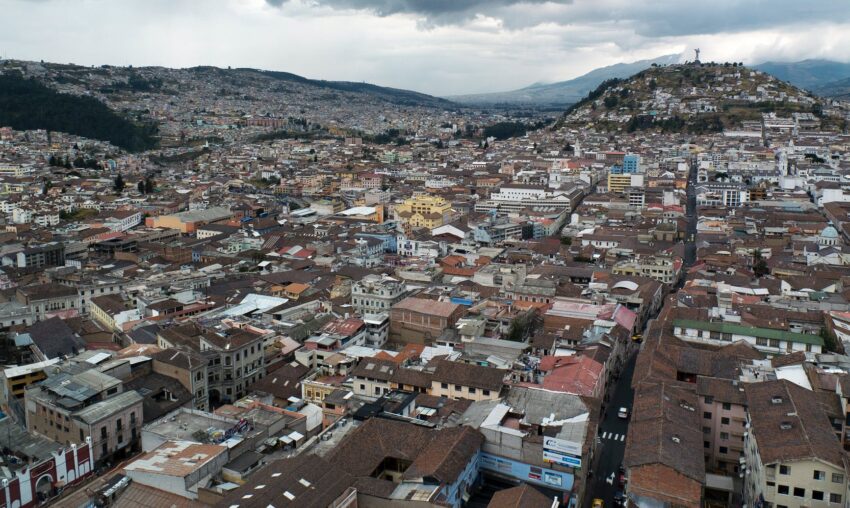
So where to start my story? I guess I need to step back a month to my arrival in Quito, capital of Ecuador. As the plane came into land at midnight, before flying low over the metropolis that is Quito New Town, we passed briefly over the Old Town, which is but a fraction of its modern counter part; the Old Town, a labyrinth of whitewashed houses on cobbled back streets, radiating and twisting off large plazas. The ambience is one of faded elegance, with many houses in varying states of dilapidation, whilst still retaining some charm. At the heart of the plazas, seventeenth century colonial churches, cathedrals, seats of government and religious art galleries; the Old Town, a Spanish conquistador gem, and as such awarded UNESCO* world heritage status in 1978.
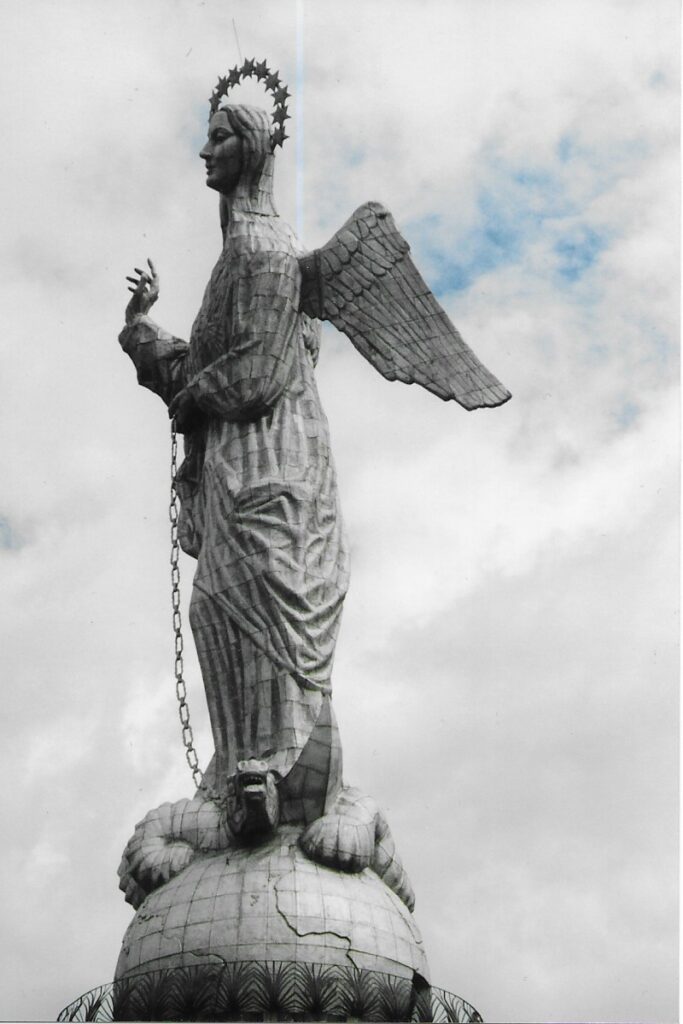
Quito sits in a volcanic crater, and so the winding streets of the Old Town don’t so much meander their way off the plazas – they meander their way off and up to the rim of this volcanic basin. And looking up one of the Old Town’s principal streets, which traces a series of hair pin bends to the peak of El Panecillo hill, at the top perched on high is the giant statue of the Virgin of Quito. The colossal statue of the winged Virgin stands on an globe, with a serpent curled around her feet and looks down on the Old Town below and the distant newer metropolis. It is Quito’s most prominent and arguably most famous monument.
Whilst wandering around the Old Town, it is difficult not to continually gaze up at this strategically positioned colonial construction and imagine the awesome views that the Virgin must afford of the Capital.
Alas a stroll up to the Virgin is not really a feasible option. Firstly the series of steep mountainside bends make it a very energetic hike taking up to an hour in the equatorial humidity. Secondly and most importantly, travel survival publications on the city warn unsuspecting visitors that if they really are serious about getting up as high as the Virgin, then for heaven’s sake don’t go wandering up by yourself, in fact not even with a mate or two, for the trail is a notorious muggers’ route. If you want to visit without incident, either go in a rather large posse – the more the better – or preferably take a taxi, which between five passengers should not cost much.
And so as the plane coasted over the roof tops of old Quito, in the darkness, I knew that somewhere down below we had passed over the Virgin’s head.
Quito, Pichincha, Ecuador
Visiting the Virgin
The following afternoon at my hotel reception, I enquired, ‘Please, what is the best way to get to the Virgin of Quito from here? Is it possible to walk to the top?’
‘Catch a bus to the Old Town and if you are fit then walk from there. But you must not do this alone. It is too dangerous. First you must find a group of people to walk with you.’
‘Well, that’s not likely to happen within the next few hours.’
‘Or maybe,’ the receptionist added, ‘take a taxi from here. It’ll maybe cost twelve dollars, plus waiting time at the top, plus the fare back.’
‘Well I won’t decide now. Maybe one for further on in my trip.’
A couple of days later, I left Quito for a month and then returned. I had a week to kill in the capital and spent this learning Spanish at a language school on the New Town’s principal shopping thoroughfare, the Avienda Amazonas. Each day, with my tutor Alejandro Chamorro, I sat out on a fourth floor balcony overlooking this boulevard of financial institutions, Internet outlets, pavement cafes and restaurants. To my right, there was the dense jungle of cuboids that comprised the New Town’s high-rise. To my left, a couple of miles in the distance was the outline of the Virgin. Her lure had not quite diminished.
It was my penultimate day in Ecuador. Afternoon approached and my Spanish class had just finished. I floated the idea of a ride up to the Virgin with Alejandro. One hour later our taxi weaved its way up those snake-passes.
From the literature I had almost expected it to be a journey through bandit country, but it all seemed to be quite a sedate ride through clusters of small villages, with not a hold up in sight. Not that for one moment I thought the warnings were over exaggerated.
We reached the top. There were a couple of souvenir stalls selling religious memorabilia, but otherwise the site was deserted. We entered into the statue of the Virgin and climbed a winding staircase, through her womb, to the lookout position at the top.
It was a clear day. Or perhaps this is an exaggeration, because my time in Quito had taught me that, at least in the rainy season, there is no such thing as a clear day. The morning starts off bright enough. Then, by early afternoon, the clouds roll in, engulfing the volcanic peaks that dwarf the city, then the rain comes crashing down, but low and behold after an hour or so it stops and the sun comes out again. This is the daily pattern.
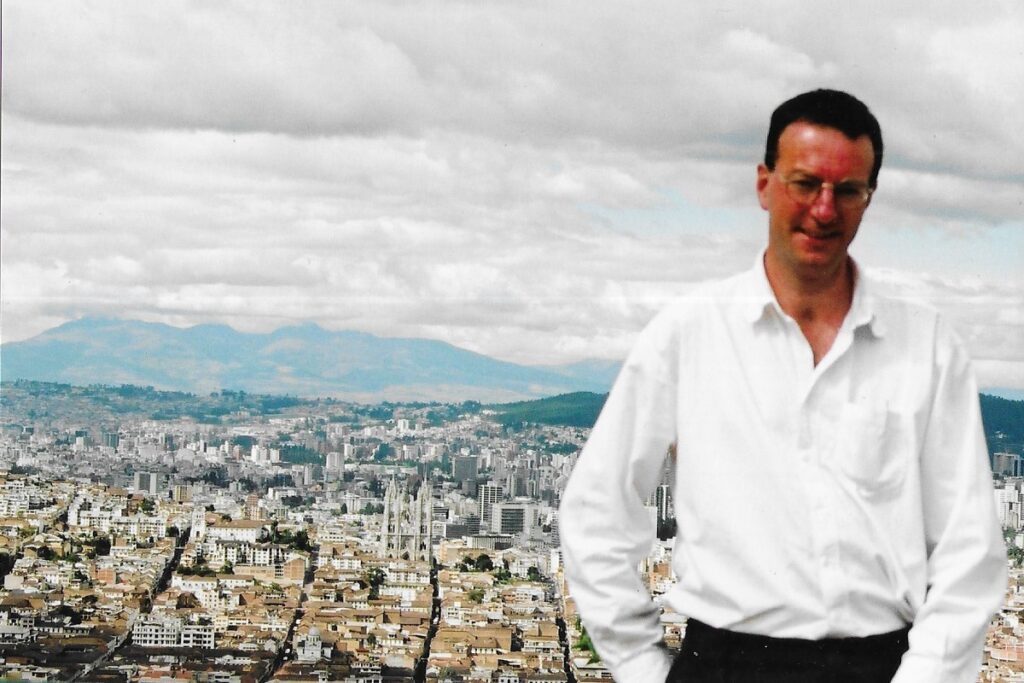
So, there we were at the foot of the Virgin, the rain had ceased some time ago. The clear view extended from the Old Town immediately beneath us across to the other side of the distant New Town. Down below, plummeting the depths, we looked onto the red tiles of whitewashed houses. We identified a handful of colonial landmarks that comprised Quito’s thirty-odd conquistador treasures, not least the Plazas Independentcia and Santo Domingo and in the distance Ecuador’s highest church, the gothic like Basilica del Voto National.
We picked out Avienda Amazon, which linked the Old Town to the New and the thin outline of trolley buses that belted along its length. And then around the other side of the Virgin, Alejandro pointed towards her family’s residential district and I could not believe that this was the first time that she had viewed her village from this vantage point.
The panorama brought it all home – this was the capital of Ecuador, a huge city of 1.5 million people. Before arriving I had just assumed that it was some tin-pot capital of a twinky-winky South American banana republic. But no, the heights of the office blocks in the New Town –El Norte – which sprang up in the 1940s extended for miles and miles. Hardly the size of London, but a daunting metropolis non-the less; one which if I had been able to view in daylight when coming into land, I would have swallowed and thought, You are going into that a complete stranger. Will you ever come out of that place again? Won’t it swallow you up whole?
Make the most of the view from the Virgin, I told myself; absorb it, photograph it, take your time, deduce how the Old Town has spilled over into and created its newer counterpart. You won’t be getting a view like this again.
Proof of life
The following evening:
Before leaving England for Ecuador, I had read reviews of a newly released film, Proof of Life. It received poor write-ups, which pitched it at the level of a banal melodrama. Starring Russsell Crowe and Meg Ryan, a substantial part of the movie had been shot on location in Ecuador, both in Quito and around Ecuador’s jungle mountains.
The film’s limited plot: Rich English businessman is kidnapped in a fictitious South American Republic by guerilla group, with millions of dollars being demanded as ransom. Enter Crowe, hired by London insurance company as an expert who specialises in rescuing kidnap victims. Into the heart of danger he goes, falling in love with the kidnap victim’s wife (Meg Ryan) along the way. At the end, at the point of rescue, they both agree to ‘leave it alone’.
It was my last day at the language school. During coffee break, a student says,’ I went to the cinema last night to see Proof of life. It’s shot in location in Quito.’
‘Yes, I know.’
‘It’s a bit of a boring film, but there are some nice views of Quito.’
‘Well if they are anywhere near as panoramic as the view from the Virgin, then they must be stunning.’ And on that basis, I decided to check it out that evening.
I had an hour to kill before the film and sat in the Parque la Carolina, near the multi-screen cinema. Low flying aircraft – the national carrier Air Ecuador, Avianca from neighbouring Columbia and American Airline flights making the five hour hop from Miami – passed over head at five minute intervals lining themselves up to touch down at Quito’s international airport three miles down the road.
Setback from the roadside, volleyball matches were taking place – league games, crowds, concrete terraces, contests played with a Latin temperaments, hotly disputed points, cheers competing with the drone of aircraft.
I contemplated staying wedged in between these spectators rather than going to what I couldn’t help but feel was going to be a corny affair – going to the cinema in a city, to watch what was likely to be the standard of a ‘B’ movie, shot on location in the same city. It felt like a rather predictable activity. The onset of dusk forced the issue. I left the volley ball players to their own devices.
A celluloid portrait
Would the cinema’s technology be as antiquated as that which I had encountered a couple of weeks earlier in the southern city of Cuenca. Gladiator was all the rage. Alas the sound system was muffled and the quality of the picture, well it looked like the entire movie was shot at dusk. And it took half an hour before I realised that it hadn’t. I walked out shortly after.
I needn’t have worried. The cinemas in Quito were evidently better than those in the country’s provincial outposts. This was a multi-screen complex with a state of the art sound system and not a hint of dusk anywhere. Also the film was being shown on the cinema’s larger show case screen.
I was surrounded by families, gorging themselves on giant portions of popcorn and bucket sized containers of coca-cola. Yep, a tacky start to a film which I had been warned was melodramatic. But hopefully they would soon show some interesting shots of Quito.
Alas, apart from a bomb exploding in a market place and some fleeting footage of colonial buildings there was very little to set the mind racing. Nothing that could really make me say, ‘Look there’s Quito; I’ve walked down those streets, dined in that restaurant, sauntered across that plaza.’ Rather most of the film was shot in jungle terrains.
The film reached its predictable climax. Crowe rescued the captive from the kidnappers and as the helicopter is flying them both back to Quito, he has to wrench himself emotionally away from the hostages wife (Meg Ryan) with whom he had over the previous weeks formed an attachment.
The first of the credits started to roll. Well at least my trip to watch Gladiator in Cuenca had given me more to talk about, in a quirky kind of way – Gladiator at dusk and all that.
I was sat halfway down the cinema. The audience started to stream out. I lifted myself slowly out of my seat.
The film then assumed an aerial focus, shot from the helicopter. It panned over the tops of misty jungle mountainsides, until suddenly at breakneck speed we were over Quito, descending and zooming in, until it was easy to pick out individual landmarks. The view roamed over and around the rooftops of the capital, shot with a filter which gave the slates and bricks a sharp outline with a golden glow.
And the people sat in the seats in front of me, who had moments earlier got up to go, remained standing, watching this celluloid portrait of their city. Accompanying this footage, through the speakers came the sound of a familiar Irish lilt. It was the Belfast drawl of Van Morrison, singing with fire in his belly.
The camera moved over the tops of red slates, down the Old Town’s meandering streets, onto the New Town, going along Avienda Amazonas which links the two and where I had spent a week at the Spanish school. We went over the roof of my hotel and then turned around and headed back across the roofs of the old town, over Indepedience Plaza where an assorted crowd of shoe-shine boys, women in traditional Andean costume with children securely tied to their backs with blankets, old men playing chess, courting couples, and mothers breast feeding babies – all of these people were now reduced to the size of ants. Past the towers of conquistador cathedrals we continued where I had spent many an hour sheltering from the torrents.
And then for the second time in a couple of days, I found myself up close and circling around the Virgin and her serpent.
It felt like some kind of nostalgic roller coaster ride, and I had only first clamped eyes on the city one month ago. What must it have felt like for those hundreds of Quito residents who were now amassed around me and who had not walked out as the credits started?
Indeed, as Van Morrison sang the last verse of his lengthy anthem I looked behind and saw a line of people at the back of the auditorium and pondered that they must have been the residents who were on the way to the exits as the film drew to a close, but who were stopped in their tracks as they realised the treat that was in store for them – a view of their city, their streets, their houses as they had never seen them before.
And then as the screen finally faded, cheers went up and there was the sound of loud applause from around the auditorium.
On entering the cinema, it felt like my visit couldn’t be anything other than a tacky and corny experience. But now as I finally headed for the exit, it felt very different from this. Yes, I sensed a kind of patriotic fervour coming on, or at least a strong sense of civic pride.
I jumped into a taxi, headed back for my hotel, and glanced once again at the silhouette of the Virgin of Quito way up in the distance, realising that the next time I saw her would be from several thousand metres up, in an aircraft the next morning as I exited the country.
Damian Rainford
*UNESCO (United Nations Educational, Scientific and Cultural Organisation)
(Header image: Pixels Free Photos)
Back Home to theancienthighway.com
