Journeys 2019 – 2022
An awakening
: One June Saturday morning in 2019, I received a random email from Sky Sports. Its author hoped that I was enjoying the cricket World Cup and invited me to sign up to Sky Sports Cricket for a reduced rate of £10 a month. Actually, I didn’t have a clue that the World Cup – already half-way through – was even taking place, so non-existent was my attention to cricket. But it did cast my mind back to an enjoyable two days I spent in 1999, when the same tournament took place, again in England. I was very fortunate, courtesy of an unmentionable wheeze, to have a friend gain me admittance for free to a couple of fixtures that featured a range of international stars.
But these memories had receded to the back of my mind, until that Sky Sport’s email popped up. Well come on, I told myself, it’s only a tenner, and you might even get some satisfaction out of it.
That day, I watched in wonder as Carlos Brathwaite swung his bat for the West Indies, nearly orchestrating a mesmerising come back against the Kiwis. I was staggered at the courage on display. He was like a tenacious whirl wind, who stared adversity in the face and didn’t bat an eye lid. No matter how much the odds are stacked against you, he seemed to be saying, stay calm and your natural ability will shine through. At the end, New Zealand breathed a sigh of relief, hanging on by the skin of their teeth. Cricket had resoundingly entered my blood stream. Oh Carlos, you have so much to answer for, I have often reflected since.
In the days and weeks that followed, the commencement of new tournaments – the Blast, the Caribbean Premier League, more England fixtures against New Zealand, to name a few- all ensured that I wasn’t going to cancel that TV subscription just yet. Cricket had made huge inroads into my leisure time.
I took the kids on a city break to watch a Blast game. We stood by the World Cup trophy. We watched Glenn Maxwell turn out for Lancashire and reverse sweep his way to 79. “Isn’t this amazing?”, I asked them. “When can we go back to the hotel?”, they replied.
I discussed fixtures I had watched, with old chums, who were test match purist. I spoke with an analytical emphasis that suggested I had always been fervent about the sport. Well, who was I trying to kid? They clearly didn’t approve of all the pyjama games (as they put it) I had been watching, and suggested that I accompanied them to a test match, played in traditional whites, to see how the other half lived.
The foe
But then, and now we get to the nub of the matter, my pals dropped a bombshell. They told me that serious plans were afoot to introduce an off-shoot of the sport, that would seriously undermine its fabric and structure. Look it up, they said. Type in ,’ The Hundred – Is it really cricket?’
Well I did type it in and was perturbed, maybe even horrified, at the impact these advanced plans would have on the traditional shape and features of cricket, across England’s counties and possibly other countries as well.
From my limited insight, it felt like this was a new brand of elitist sport, that might ensure that the game would never again be played against a background of sheep in the meadow, thrushes in hedgerows, warm beer and leather on willow. At least that was the utopian image I had always had of county level cricket.
Grass roots encounters
Lockdown arrived and seriously challenged my new found addiction. Then COVID restrictions started to ease slightly. I wandered down Shropshire country lanes with my wife, occasionally stumbling across a local league match. Are you going in to watch?, she would ask, but, from the top of the hedge, just watching a couple of overs bowled was good enough – it meant something.
I visited my Lancashire home town, Ormskirk, and walked past its cricket club. There was a match on, so I called in. Whilst watching proceedings, I went online to see which teams regularly visited here. I discovered that not many moons ago, Devon Conway, now top of the batting order for New Zealand, had spent time between the creases for the away team. It was quirks like this that I loved. It seemed to point to a sport that was still welded to a grass roots structure.
The Hundred dilemma
In my mind though, I was still going to take in some Hundred matches, not least because it looked like this would be the first format to allow unrestricted attendance once again. And yet, the more I read about it between the sheets of Wisden, the more perturbed I got.
Saving the game was a principal reason put forward by governing bodies and quite a few commentators for the introduction of The Hundred. However, everything else, it seemed, was having to be reorganised around it. A large proportion of participants in professional cricket, would, it seemed in the not too distant future get pushed into oblivion. Instead, the new focus would be on looking after the needs of a smaller, most talented, minority.
Yet, call me a self-centred bastard, but I didn’t care. I was online the moment The Hundred tickets went on sale for the first time in 2021. I bought the King’s shilling. I was just desperate to see a bat swung in anger, whatever the format.
Sound bites
In advance of turning up for this new tournament, I watched a couple of matches on TV. However, I found the marketing soundbites a bit much:
- “The Hundred, where every ball counts.” – Oh really? Didn’t it before? Was it all previously just a bit of a lark? How insulting, I thought to those batters who now found themselves excluded from the mix.
- “The Hundred Just keeps things simple. Why complicate things?” – Well it certainly didn’t seem any easier to understand. The screen was obscured by huge graphics and side bars, which had an adversity towards providing key information, like comparative run rates.
The Hundred adrenaline
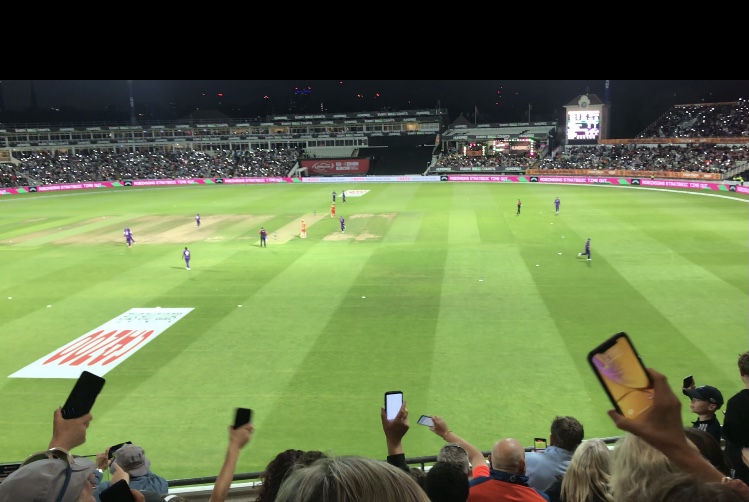
I turned up at Edgbaston, with my Hundred tickets. Local heroes made their mark; superstars fell short; participants from the women’s game who, days before Lockdown, played before eighty-six thousand spectators in Melbourne, now felt like they were in touching distance from me.
Against the background of a thumping party atmosphere, I witnessed pulsating climaxes to matches.
As I exited the ground, my adrenaline was surging. What had I just witnessed? It felt like a hell of a spectacle. So much to talk about. I felt a bit of a traitor, But yet, what a pleasure it had been.
Activities for the traditionalist
In the weeks and months that followed, I watched a procession of games of a more traditional nature. I went to Blast Finals day; I went to test matches; I went to County Championship contests; I went to Cardiff and saw Glamorgan pit their wits against the likes of Rashid Khan and Mohammed Rizwan; I went to Edgbaston and was privileged to watch Root and Bairstow engineer a mammoth comeback against India.

And yet, and yet, I sensed tricky decisions were only around the corner. Despite my dabbling with The Hundred the previous summer, it still challenged my sensibilities towards a sport that I had only embraced three years earlier. Now here it was again. I put my moral dilemmas aside and bought more tickets.

A marketing triumph
I turned up on an August Friday afternoon at Edgbaston.
I was in ambivalent mood, hoping that the corporate marketing campaign had failed, with the evidence pointing to The Hundred having to quietly going away after year two. All these guys would be permanently returning to the clubs they had come from.
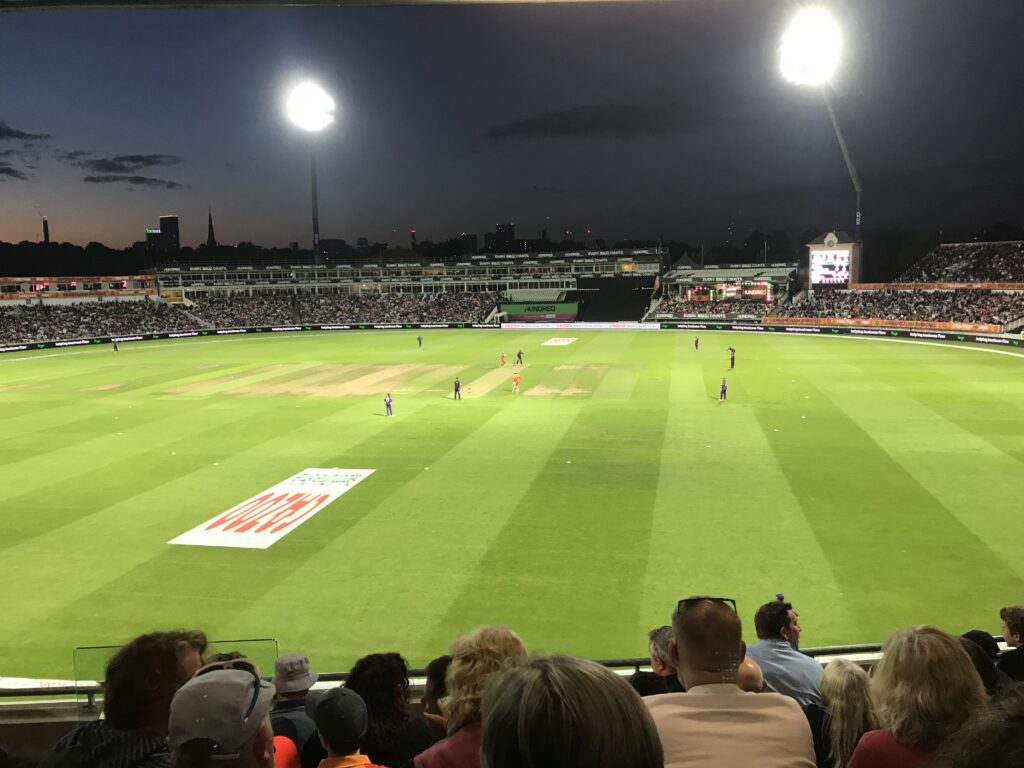
However, TV over the previous few days had demonstrated how well supported The Hundred is. As if to reinforce this, I sat with a record crowd to watch the women’s Birmingham Phoenix vs Northern Superchargers game. By the time the equivalent men’s game started, the stadium was packed. With attendance levels like this, The Hundred can only be viewed as a permanent feature. And so grudgingly, I had to say very well done to those marketeers – the game clearly has some kind of mass appeal.
To be entertained
There was nothing subtle about the play though. There didn’t seem to be much strategic thinking across the opening, middle parts and tail end of an innings. The emphasis was more on blasting the opposition out of sight as quickly as possible, in the knowledge that this also might induce a batting collapse.
But I doubt if other spectators were concerned with such trivialities. I joined them watching in awe as the hurricane that is wee Adam Lyth hit the ground running with a torrent of herculean sixes for his Yorkshire side, which he propelled in the general region of Row Z. Oh Adam, my heart murmured, may you be the propeller of a thousand sixes, and maybe he already has. This was shortly followed by strapping David Wiese, who carried on this explosive work. In the second innings, South African legend Du Plessis held onto a catch that by rights should have taken his hand out of the stadium.
I made my way with the throngs out of Edgbaston. Oh my, how you have just been entertained, I thought. Don’t feel guilty about it man! I glided the two and a half mile walk back to the station in a state of euphoria. Arriving back home in the small hours felt like a minor inconvenience for the spectacle to which I had just been a party.
When two hearts beat as one
And yet an inner voice still chipped away. Judas, it whispered. I knew though, that as long as The Hundred exists, I will keep popping in to watch this alternative rapid fire format. Maybe next year they will be playing with even bigger bats. Naively, I still hope that maybe two hearts really can beat as one. Deep in my heart, however, I pray that if it is about the undermining, obliteration even, of other formats, then it will be the thinking supporter’s version that will eventually triumph and that there is a way in which all cricketing counties can stay woven into our heritage.
Damian Rainford , Autumn 2022
(Header image: Pexels Free Photos; Screenshot image: BBC; All other images: author’s photos)
Back Home to http://theancienthighway.com
