
India Travel writing; Journey December 1999
I. THE SILENCEOF MANDU
The Road to Mandu
The taxi driver outside Indore’s small airport terminus was adamant, ‘Sir, the second half of the journey, you will find very bumpy, very bad roads.’ I had just flown in from Mumbai, with my final destination for that day, the ancient ghost city of Mandu, still another juddering three hours away. After ninety minutes, we turned off and headed upwards for this medieval settlement. The state of the roads started to deteriorate rapidly and motorised traffic was now mostly replaced by bullock carts, cyclists and camels.
Set against the rugged backdrop of the Vindhya hills, Mandu sits on a twenty-three square kilometre rocky plateau at an altitude of two-thousand feet. It is surrounded by a gorge, which plunges three hundred feet down to the vast plains of the Narbada Valley.
The final part of our ascent was via a narrow causeway. This formed a natural bridge across the gorge, carrying the road across and up through a series of sandstone arches, which punctured the plateau’s forty-five kilometre long fortified wall. The taxi finally pulled up by the most impressive of these, the Delhi Gate, which is formed from a series of five giant sculptured arches.
The gatekeeper to the town collected a toll fee for the vehicle’s entrance, although, given the absence of traffic, it was difficult to see how he could ever make a living from this occupation, especially given the pittance of a toll that was being levied.
Solitude at the Lodge
Another kilometre along the top of the plateau, the taxi turned into the lush sweeping driveway of the government run Traveller’s Lodge. Two members of staff were spraying its lavish floral gardens. At the bottom the manager came out from reception to greet us. A tour of the vacant chalets followed with the two gardeners putting down their hose pipes and coming along for the ride – I appeared to have some kind of curiosity value.
‘How many people are currently staying at the lodge?’ I asked the Manager.
Mandu’s remoteness knocks it off many people’s travel itineraries, and for the locals, the nearest sizeable settlement is, well, Indore one hundred kilometre down that rugged road – so I should not have been too surprised when he replied ‘None, you are our only guest. Welcome to Mandu. We will cook you good food, any time you like. Just ring the bell outside your room and we will come, eventually.’
I flung open the backdoor of the chalet and stepped onto a balcony which looked over into the valley below. The sounds seeped in; not the chaos of the city, but a gentle soothing cocktail of the warbling of insects, the chattering of children at the top of the gorge’s side tending to baying goats, the swishing of scythes as women cut the grass at the top of the valley down to size, the clanking of a cow’s bell and then to ruin it all, a distant car horn.
I spent a couple of minutes absorbing this pastiche, letting it flood into my mind, but was interrupted by the loud buzzing of my front doorbell. Somehow, this sound and technology did not feel like it was in keeping with the tapestry the other side of my balcony. It would have felt more appropriate if the visitor had just shouted ‘Hey mister!’, instead of resorting to this city-like battery powered invention. I opened the door and there was one of the gardeners carrying a silver teapot on a tray.
I sat out on the balcony with the tea set, eyeing a compact restaurant and chalet complex which was just around the gorge’s bend. Later that evening I wandered around to this establishment for dinner and was given the obligatory tour of its more modern accommodation.
The manager could not entice me to transfer chalets, either that night or the next, partly because I could not be bothered to repack, but also whilst this restaurant was more flash, there was something nostalgic about the crumbling walls of the Traveller’s Lodge and its sturdily built plumbing that could have been assembled at a ship builder’s yard. Also, after the teeming masses of Mumbai, at the Traveller’s Lodge I was surround by empty chalets, three attentive members of staff and a procession of non-existent guests – solitude was a virtue.
A novel menu
Light reading was on offer at the restaurant in the form of the English menu, which contained an array of wacky spelling mistakes. You could begin at the start of the day with an ‘American breack fas’, come back a few hours later for a mid-day ice cream in the form of a ‘trible special, and at evening time chose between getting high on ‘plane rice’ or going to sleep on a portion of ‘pillow rice’. Such howlers weren’t unique to this restaurant. They can be found across the Sub-continent, but on this particular evening, as the only diner, it provided a brief period of entertainment.
Oh No! Not the Parliamentary News
The waiter turned up the news broadcast on the television. A substantial section of this was dedicated to reporting the day’s proceedings in Parliament. Nothing too unusual here, except that the legislature’s routine business was almost elevated to headline status. This information tended to be conveyed in the most tedious of manners, describing in infinite detail the different stages that had been reached in the tortuous path of some technical bill, through a labyrinth of committees, subcommittees and working parties. It was a fusion of technocracy and bureaucracy masquerading as democracy. Frequently, the end of the item was reached, and the obfuscation left me clueless as what the hell it was all about. The boredom made me turn for some mental stimulus to a recent issue of the Indian Pioneer newspaper, but alas the lead item was in the same vein:
CWC acts tough with Sonia (New Delhi 13.12.2000):
“For the first time since the recent electoral debacle, congress president Sonai Gandhi encountered an assertive and perhaps mildly aggressive Congress Working Party on Saturday. The highest working party of the organisation sought copies of the 200-page report of the A K Attorney led introspection committee, which it was to deliberate upon.
A day earlier its twenty-one members had received only a thirty-three page summary of the report as the leadership had decide to treat the exhaustive findings of the committee as a classified document. According to party sources the demand has led the CWC to split its deliberations into two sessions. The committee, which began its meetings at noon, dispersed early afternoon to resume at 9 p.m. The copies of the voluminous report were reported delivered at the residences of the CWC member early evening.
A section of the party however viewed the demand for the report of the Anthony Committee purely as a technical issue. A party leader said ‘in all likelihood the members must have found it impractical to be content with deliberating only the recommendations of the committee and not its context, that is the causes.
Since the thirty-three page summary was exclusively prepared by the AICC secretary Mani Shanker Aiyar, nobody associated with the introspection committee could say the note supplied to CWC members was a summary of recommendations or an executive summary, that is covering all aspects of the report.”
And so it continued.
I started to doze off, when the parliamentary correspondent threw a couple of bullet points into her dispatch, each with a quirky turn of phrase.
First she told viewers in a deadpan manner that ‘MPS and Ministers paid their respects at the cremation of Madhya Pradesh Transport Minister Likhiram Kawre today, after he breathed his last yesterday.’
‘Breathing one’s last’ was I thought as mild an announcement of the visit of the grim reaper as you could get. Later that evening after the restaurant had pulled their shutters down and sent me back down the road to the Traveller’s Lodge, I read the day’s newspaper. There I discovered that Likhiram Kawre’s last breath had been anything but a peaceful affair. He had been stabbed and shot by suspected Naxalite insurrectionists outside his house.
The new reader’s second nugget concerned a topic that had been jostling for attention in the newspapers alongside tedious parliamentary reports, tales of multiple traffic deaths, famine and corruption. It was the likely impact in two weeks time of the Y2K bug.
Yet another Government subcommittee had been deliberating over how to get to grips with this, as the newsreader put it, ‘man-made problem’. It was as though all the other ills facing the country were down to a natural order of the cosmos. Population growth? A manmade problem? Not on your Nellie. It’s just a simple twist of fate really (‘Instead of cursing our growing population, we should be welcoming it.’, 13.12.99, The Pioneer).
My exposure time to this tortuous parliamentary bulletin was thankfully shortened due to a shortage of dosh. No, not an absence of Rupees in my pocket, but by the newsreader saying “Today’s Private Members Bill session was postponed due to a lack of money.”
The news broadcast was hardly informative or leisurely viewing and certainly wasn’t likely to generate any kind of ‘Ramyan’ like fervour. Over seventy-eight tumultuous weeks during 1987-88 India was gripped by the small screen adaptation of this ancient Hindu epic – a soap opera with costume. When power cuts interrupted transmissions, the offending power stations were set on fire by angry viewers; new MPs arranged their swearing in sessions so as not to clash with the latest episode; whole villages gathered around single TV sets; along railway tracks, express trains pulled up at unscheduled stations, so that the entire passenger and staff load could spill out and gather around the Station Master’s television.
Somehow I could not imagine the populace wreaking revenge if News at Ten did not come on the screens one evening, because of a lack of money, the resident parliamentary reporter breathing her last or maybe even just because of a power cut.
The coming of the Consultation Queen
The bombarding of viewers with parliamentary trivia reminded me of the 1970 comedy film, The Rise and Rise of Michael Rimmer. This stared Peter Cook as a market research consultant who came from nowhere and wrangled his way to the dizzy heights of Prime Minister. Cook’s manifesto was modeled around comprehensive public consultation on all government decisions. Nothing it appeared was too small or tedious to consult on. The people should, and would, be asked to make decisions on everything,
Cook and his cronies cruised in, and in no time at all had developed and installed the latest innovatory technology in all households. At a set time each evening citizens were requested – no instructed – to sit down, cast their votes on the nightly issues displayed on their TV screens and send their choice down the line from the devices strapped to their armchairs. It was a prototype E-government framework.
This would have been pretty engrossing stuff, if it had involved voting on profound matters like war with the USSR or capital punishment. Unfortunately in a matter of weeks, Cook’s model of government by total consultation had, by design, degenerated into the monotony of the width of the lines on the road, the standard height of grass in the parks and so on. The list of banal matters that people were obliged to make decisions on was endless.
Not surprisingly, the public soon got fed up with this compulsory-voting lark, which took up a not insignificant chunk of their leisure time each month. Several hundred consultations later, there were murmurings of discontent amongst the masses, which soon started to gather pace. Wishing to avert a riot, Cook then went for the ultimate – a consultation on consultation :
Do you wish to, ‘A’, continue with a government based on total consultation; or, ‘B’, hand over complete control to the PM and his cronies who will make all decisions on everything. In fact you won’t even be asked to vote in as much as a general election.
Option B. Option B, computed the masses from their electronic arm rests. There were not many abstentions. They were after all suffering from acute consultation fatigue. Cook assumed total control, moving from democrat to dictator in one easy sideways move.
I had visions of revisiting India in ten years time, and finding the world’s largest democracy recently liberated from excruciating news reports – News at Ten is dead, long live the Ramyan! The people poured out onto the streets, as another episode of their favourite Hindu epic drew to a close. ‘Bugger the News’ they shouted, ‘We’re off down the pub.’ The only trade off was that the parliamentary newsreader, having bored the hell out of everybody for decades had now swept to power as Consultation Queen. The world’s largest democracy had imploded and reinvented itself as a dictatorship, but still, at least everybody was now happy, and that’s what really counted.
A stage without actors
The next morning I hired a bicycle from the small cluster of shops that is Mandu’s town centre. The place was bustling – a bus had just arrived along the bumpy track from Indore. A long trail of people and goods came down its steps. I pedalled past it and ten minutes later had left all human life form behind.
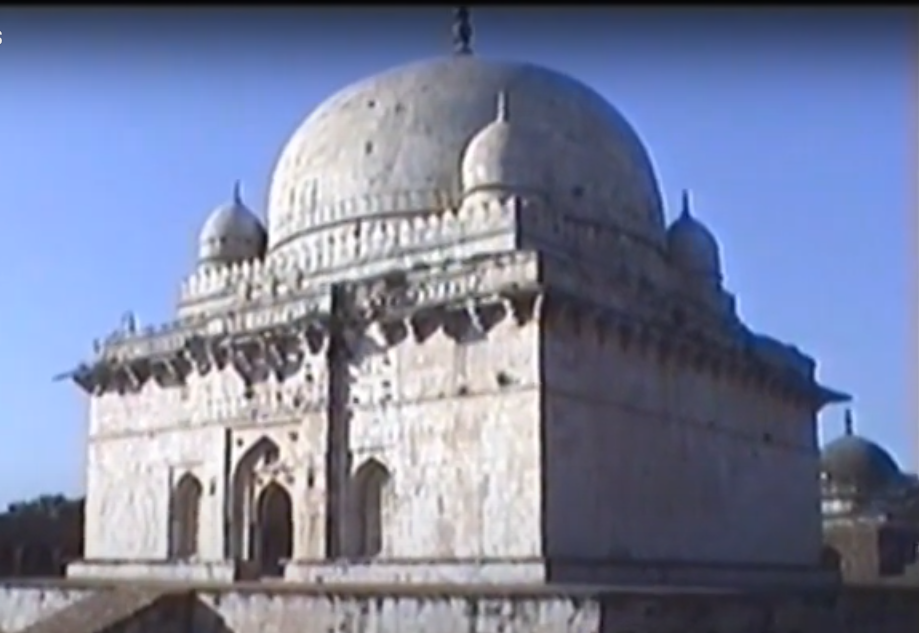
During its fifteenth century heyday, Mandu was ruled by an Afghan governor and thus now has the biggest concentration of Afghan architecture in India.
Dotted for miles around, both on the plateau and strewn across the valley basin are elegant Islamic palaces, arcaded pavilions, and onion domed mosques that crumble besides large medieval reservoirs. At its height, Mandu was a pleasure resort, its lakes and palaces the scene of extravagant festivals. So lavish and concentrated was its rich architecture that Mughal emperor Shahjehan sent his designers to the city to draw inspiration for the future building of the Taj Mahal.
Many of these edifices were situated several fields back off the road at the end of some dusty track. However, whilst the monuments would have provided a magnificent stage backdrop for some Hindu epic, there was alas no audience. I pedaled from monument to monument, through these fields and tracks. The occasional cow munched away at the base of these constructions, but over the course of the next four hours I did not see any sign of human life. Meanwhile several miles back up the road, no doubt life was continuing as usual, as they loaded the bus up for its return journey to Indore.
Indore’s weekend women
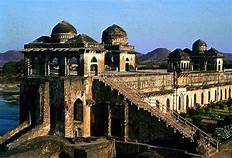
As dusk settled, I found myself at one of Mandu’s more famous monuments, surrounded by a lake and built in the shape of a ship, the Jahaz Mahal used to house the harem of the town’s rulers.
Finally, the arrival of the weekend was signaled by the approach of coaches containing holidaying crowds from Indore. My two days of near isolation was over.
As I stood on top of the Ship Palace, I was approached by several groups of these weekend visitors:
‘Excuse me mister!’ Three women stand along side me, a male clicks away with his camera. Asking wasn’t considered protocol.
‘Hey Sir!’ another bevy of beauties cried out ‘We too want to have our photo taken with you.’
‘Yeah, whatever’ I said to the Madam of the Ship Palace’s modern day harem.
‘Good evening Sir’, said another woman ‘But why do you come here? We are thinking that you must be some kind of reporter researching history.’
The following morning, with my celebrity status restored after a couple of days respite, I left town; left the harem, all those archways, parapets, crumbling mausoleums and whimsical menus, and went back to from where I had come.
II. THE ROAD TO BHOPAL
ID Cards and Dishevelment
Halfway through our journey, the taxi driver pulled over at a small petrol station. While filling his tank up he had a brief conversation with a dishevelled man who was loitering nearby. The driver got back in the car and the man in crumpled clothing wandered over and thrust his Madhya Pradesh State Police identity card, containing his photograph, through the open window at me. Out of the car, he indicated.
The photo sure looked like him, but with his down at heel appearance, he did not look much of a policeman. I stared straight ahead, sure that this was just a scam to extract a substantial amount of dollars from me. It was an uncomfortable few minutes.
‘Go!’ I said to the driver.
‘Uh?’ he replied
I continued to stare straight ahead
The man at the window tugged at my arm, out he indicated again.
More staring straight ahead. He pushed his ID card under my face. I pushed it back.
‘Go!’ I said, for a second time, signaling my wishes by leaning over and attempting to turn the ignition on. ‘Go, you dim wit.’
There followed another brief conversation between the driver and the man with the warrant. Another series of gestures from the man at my window, indicating that I should really get out.
More staring straight ahead on my part, as though to indicate obliviousness to his presence and a lack of intention to lift my butt from the seat, just staring straight ahead like I said.
‘Go!’ I said. ‘Go now’
A pregnant pause. I curled up in my seat and closed my eyes, feigning an afternoon siesta. ‘ OK then’ I said, ‘Don’t go then, no hurry no worry’.
‘Go now?’ the driver asked
‘Now, tomorrow, whenever. No hurry, but I am not getting out of this car until you get to Indore.’
A few seconds later the engine started.
Reinventing the Highway (Part 1)
As the taxi pulled into the outskirts of Indore, we joined a large tail back of stationary lorries. A wagon some where in the distance had over turned, blocking both sides of the road. Drivers were discussing how far down the road the offending vehicle was and, more to the point, how long it might take to unblock the highway.
We were on a gradual incline. Drivers were digging up sizeable stones from ditches. They proceeded to hammer these into place between the road surface and the backs of their tyres. Handbrakes, it seemed, had not yet been invented.
I did not relish the prospect of the truck in front rolling back, no matter how snug the fit of those impromptu wedges, so I got out of the taxi and contemplated a long wait. An hour passed, the heat was sweltering. Nobody had a clue how long we might be stuck here. I had already missed the only express train of the day to Bhopal, my intended destination for that evening.
I toyed around with the unlikely scenario that the cause of our hold up was nothing to do with a road accident, but was really a police roadblock ahead, searching for a certain Johnny Foreigner who had evaded arrest just outside Mandu.
The taxi driver’s patience finally got the better of him. Get in he indicated. He started the engine and turned his vehicle off the road, across a ditch and into a neighbouring field. Mandu’s bumpy approach road had nothing on the next leg of the journey, entering one pot whole and out of another, down one ditch and up the side of another, negotiating a path across a series of rugged multiple ridges, and finally after several fields of this, hitting a dirt track which eventually led to a network of small back street villages.
Another hour ensued of getting hopelessly lost between these settlements, jolting our way along semi-existent dirt tracks, asking for directions and finally finding our way back onto the main road, with the over turned lorry somewhere behind us. Well they don’t build chassis like that anymore, I thought, as I climbed out in front of Indore’s railway station.
Patience and the trial of Rabi Ras
As I suspected the only departure of the day for Bhopal had been the 2 pm train, which was now two hours down the line. Instead, I walked across the city centre to the bus station and tried to buy a ticket for Bhopal. The departure, according to the time table was imminent, but as yet, the crowd still waited for the
vehicle’s arrival.
‘One ticket to Bhopal please’
‘Sorry you can only buy the ticket once the bus has arrived at the terminus.’
‘And how long might that be?’
‘Maybe soon’
Over the course of the next hour, I tried several times to buy a ticket, only to be told each time, maybe soon you can buy one.
I sat down on a wall and took potluck with one of the newspapers I had been stock piling over the last week. There in the middle of this printed matter I came across the tale of Rabi Ras, who now made my long wait seem like a very minor irritation indeed. The legal system in India might operate within a very thorough and rational framework, but swift is not a label that can be attached to its judicial process, at least not in the case of Rabi Ras.
Under the heading of ‘Justice fails to reach juvenile charged in 1976’, I quote:
Calcutta: Rabi Ras now in his early forties and father of two, is still considered a juvenile by the court. Almost every fortnight he has to report to the Juvenile Court in Salt Lake, all the way from Orissa’s Bhadrak District. This has become part of his life ever since he became co-accused of murder in May 1975. As he was a child when he allegedly committed the crime, Ras is being tried by the juvenile court.
His case is far from over. Every time it is adjourned within a few minutes, either because a summonsed witness does not turn up or records are not presented. An agricultural labourer, existing on a pittance of Rs 25 a day, he has to spend almost 250 RS every time he attends the court.
I was interrupted by a loitering student, ‘The bus is meeting with delay. Yes?‘
‘Strewth, you are astute,’ I observed. ‘But what has caused this delay?’
He pointed in the direction of Mandu. ‘Because several kilometres along that road a lorry has overturned, blocking the highway. And somewhere behind that lorry is our bus. Maybe they will clear the road this afternoon, maybe later this evening, who knows.’
For all the ground I had made up, the obstacle course of a drive across those rough fields and around the villages had been a needless pursuit. I might just as well stayed stewing in the taxi and running the risk of death by sliding juggernaut.
Reinventing the Highway (Part 2)
Rather than wait an unquantifiable amount of time for the road to clear, I crossed over and walked to a shared taxi stand. Here, I wedged myself in a Bhopal bound vehicle with six other passenger. Fifteen minutes into the ride, another lorry in the distance over turned. Another jaunt across several kilometres of rough land and bumpy fields commenced. With four of us in the back of the taxi, the driver was not so easily able to weave his way in and out of the landscape’s more challenging contours. Every five or ten minutes it was a case of everybody out, in an effort to lesson the weight in the back, whilst helping to push the vehicle to the top of some rut.
Back on the main road, dusk was now falling and the greater Indore rush hour was in full flow, due in no small part to the constant procession of animals that were being marched along either side of the road – camels, elephants, oxen, bullock carts, lambs, pigs – All on the road to, or from, Bhopal.
III. THE STIGMA OF BHOPAL
A 1984 apocalypse
A couple of hours outside Bhopal, we passed a road sign that read ‘This is an accident prone zone – Please drive carefully.’ I was not sure if it referred to this particular stretch of highway or the Sub-continent in general.
As the taxi reached the outer limits of Bhopal, I thought back to the sign again. Given the recent infamous history of this industrial metropolis, it would have been a cruel irony if the notice had been situated on one of the main approaches into the city instead. The small hours of 3rd December 1984 – almost fifteen years to the day as the taxi weaved its way into the city centre – is not a time that the people of Bhopal are likely to forget in a hurry.
On that fateful evening, during routine maintenance operations at the American owned Union Carbide’s pesticide factory on the edge of the city, leaking valves and corroded pipes contributed to the haemorrhage of a storage tank. As a result, over forty tonnes of methyl ico-cynate, a highly toxic chemical, seeped into surrounding slum areas, turning them into gas chambers. The dense clouds then continued their apocalyptic path, at ground level, for a further twenty square kilometres.
The cause of the disaster has been attributed to cost cutting drives initiated from the company’s American headquarters in Connecticut. In particular, these moves included the use of lower quality construction material at the Bhopal plant, in comparison to that used at its factories back home.
The fall out
The Bhopal Peoples’ Health and Documentation Clinic (BPHDC) have since concluded that 8,000 people were killed in the immediate aftermath of the disaster, with the current death toll standing at over 16,000 and rising. Of the survivors, many times this figure were seriously affected by the fallout of the leakage.
The Indian Council of Medical Research, a Government agency, concluded that over half a million exposed people had poisoned blood streams, with toxins causing damage to their lungs, brain, kidneys and muscles, as well as reproductive and other body systems. More recently, the BPHDC calculated that over 120,000 adults and children are still chronically effected. Half a million or 120,000? Even if the lower of these figures is taken as the baseline, given that Bhopal’s population is only one million, it represents a staggering rate of morbidity.
National and local comparisons help further set the levels of disease into context. Official health figures indicate that, among the exposed, the prevalence of tuberculosis, still births and perinatal mortality is more than three times the national average; and that early age cataracts are one and a half times as prevalent in the vicinity of the factory compared with other parts of the city.
The need for research into the effects of methyl ico-cynate has been made more urgent through the refusal of Union Carbide to provide vital information about the chemical, citing ‘trade secrets’ as its excuse. Meanwhile in the absence of key details about the gas, as the Times of India put it in an edition I bought a couple of days after leaving Bhopal, quacks and private practitioners do good business indiscriminately prescribing inappropriate drugs.
An environmental and economic disaster
But this disaster is not just a medical one. Union Carbide also left an environmental legacy.
Over two hundred wells around the factory have been declared unfit for human consumption by the municipal authorities, yet more than 10,000 people living in communities close to the factory still rely on these sources of water. This contamination is a result of routine dumping of hazardous chemicals during the operation of the factory.
And then there are the economic repercussions. For those that have received some form of compensation, in many cases the money ran out a long time ago, paying medical bills. And of course, they still have to continue paying for treatment, which often means going heavily into debt. Similarly, for the chronically effected, an inability to carry out even the most routine or menial of paid labour has driven them and their families deeper into poverty.
The Indian Government agreed a settlement with the Union Carbide of $470m in compensation, having originally asked for $3b. The criminal charges that have been levelled at the company have since been diluted from culpable homicide to death caused by negligence, in effect reducing the maximum jail sentence from ten years to two. However, the prime accused, the plant’s chairman at the time, Warren Anderson, was granted bail in December 1984 for $2, 000 and has not been back in the country since. He remains a fugitive from the Indian legal system.
The deal struck between the Government and Union Carbide amounted to an average of $940 for each survivor, for what in many cases was to be a lifetime of chronic ill-suffering. Had the sum been paid out in full, the relative loss to this international corporation would have been minimal – a negligible reduction in the value of its shares. However, the actual payment received from Carbide, to date, does not even amount to half the agreed sum and in the vast majority of cases the victims have only received 15,000 rupees (about $430).
Leaving it to the Activists
Meanwhile, local activists carry on with their struggle and call for new research programmes into previously ignored problems, like gynaecological and neurological affects.
Muslim and Hindu women have been the backbone of this continued protest, for example through the Bhopal Gas Affected Women’s’ Organisation, and the Gas Affected Women’s’ Workers Union. Members of these groups, as well as carrying on the campaign within legal arenas, continue to hold protests every week, often leading symbolic funeral processions through crowded streets. Hundreds have been arrested and jailed in the process, this now being a demonstration against the Indian authorities as well as Union Carbide.
The rise and rise of Union Carbide
So whilst the women of Bhopal fight on against the odds, Union Carbide’s profits across the globe continue to rise. They arrived in the 1960s in India, with a now bitterly ironic corporate slogan, a hand in things to come. I checked out their website on returning to England and was greeted by an equally cruel slogan on their home page: Union Carbide – thousands of familiar products that help to make our lives healthier, cleaner, safer, more convenient and more enjoyable are dependent on chemicals made at Union Carbide plants.
I clicked on a link, which transferred me to its Responsible Care Policy: Union Carbide will conduct its business responsibly and in a manner designed to protect the health and safety of its employees, its customers and the public, and to protect the environment. The company will continue to be a leader within the chemical industry in operational safety performance and in avoidance of injuries, illness, accidental releases and incidents.
Try telling that to the people of Bhopal.
Stigma
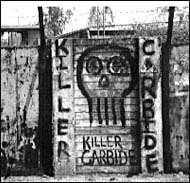
The very mention of Bhopal, or even reading its name on road signs as we approached its epicenter made me shudder. Even if, by some miracle, all the injustices from fifteen years ago had been addressed, the stigma still sticks.
I thought back to the time I had visited the site of the former Nazi concentration camp of Dachau, just north of Munich. This day trip from the Bavarian capital involved a change from train to bus a few miles from the site. As Dachau loomed, the bus driver spoke into his public address system.
‘Next stop for the concentration camp. Everybody off the bus for the concentration camp’ he rasped. I waited for him to add ‘Quick march!’ However, from his point of view there did not seem to be any stigma attached to a place called Dachau. The concentration camp was after all just one feature of the town, and now more than half a century later, life went on as normal. All that genocide was from generations ago.
Similarly, after I dismounted from the bus, with the concentration camp still a brisk walk away, I managed to get lost. A man was watering the plants in his garden, so I stopped and asked for directions.
‘Excuse me, can you tell me the way to Dachau?’
‘You are in Dachau. Where exactly are you looking for?’
Of course he knew what I was looking for. I don’t suppose they got too many foreigners in the town just looking for the local sausage shop. But from his point of view, why should an awful interlude of a few years, countable on his hands, forever blight the name of this peaceful settlement.
For me though, mention Dachau, and it could not conjure up any other image than the Holocaust, just as the taxi driver now shouting ‘Bhopal everybody, Bhopal centre, everybody out’ could not make me think of anything other than December 1984.
With all these depressing reflections, who would want to spend any longer in this city than was absolutely necessary? And so Bhopal was merely a one-night stand for me– a stopping off point on a hairy three-hundred mile long journey from Mandu to Agra; two pictures of tranquility, with a bleak shadow in between.
IV. BHOPAL TO AGRA
The Hindu God of Electricity
I checked into another state run hotel, although this was much more up market and state of the art than the one in Mandu.
I only had a handful of Rupees in my pocket and so decided to put the cost of the accommodation, together with an expensive splurge in its popular and plush restaurant on my Visa card.
The next morning, the long train journey to Agra did not bear thinking about – not the ride itself, but the process of getting the ticket. Even if I managed to get to the station one hour before the 10 am express departed – a tall order as I now rushed around packing at 8.30 am – the prospect of having to jostle for position in one of several long queues, and then finally getting to the front, where away from the more touristed cities, not a single rail clerk was likely to speak English, did not appeal. Missing this departure would also result in more grief. I did not think there were any other trains until later that evening.
I strode purposefully along the hotel corridor to reception. The light streamed through the windows.
‘Check-out’ I stated, placing my Visa card in front of the receptionist.
‘Sorry we cannot accept Visa.’
‘What? But I asked last night before I checked in and before I charged a large meal to my room number. No problem, your colleague said.’
‘Sorry we cannot accept it this morning.’
‘Last night OK, but this morning no, is this what you are saying?’
‘Sorry Sir.’
‘But you have the Visa sign displayed in the window of the main door, and upon your counter here. You better take Visa, because the few Rupees I have in my pocket won’t cover the bill.’
‘Sir, the reason we are unable to accept Visa this morning is because we have a power cut in the city’ He pointed to the lifeless light fittings. However the natural light levels still seemed bright enough not to require electricity. I was still puzzled.
‘Are you suggesting that it is not bright enough for you to be able to read the necessary counterfoils and my signature?’
‘No that is not what I am suggesting. The reason why a power cut prevents us from accepting Visa is that we need electricity to make our credit card processing machine work.’
‘Ah’ I said, finally catching on. ‘Well maybe I could rush out and look for a bank which will cash a travellers cheque for me. If I am lucky I might still make it for that train.’
‘Sir, today is Sunday. All the banks are closed.’
My irritability levels were starting to soar. ‘Well don’t think I am going to wait here for two hours, on the off chance the electricity will come back on. You better come up with an alternative solution. I’ve got to be out of this place in the next few minutes.’
The receptionist merely shrugged his shoulders and said ‘Well you could stay another night. Hopefully the power will be back on by tomorrow morning, and of course if it isn’t the banks will have opened by then.’
A couple of hours later the Hindu God of Electricity finally strutted her stuff. With a bit of a splutter, the Visa machine came to life.
‘Hurrah’ I said, whipping the credit card out of my pocket.
‘Hurrah’ the receptionist and two of his accomplices cried, delighted that a rather fuzzy television transmission of the latest India-Australia cricket match had come back to life.
The Hindu God of Transport
At the train station, the God of Transport was also on my side. I mounted the station steps with apprehension and strode into the main booking hall. Signs hung from its ceiling, pointing passengers to the right queue. Unfortunately all of them were in Hindi.
There were three long processions, with a booking window at the front of each, and another booth without a queue. I marched up to this window, where a clerk was filing. On my pad, I had scribbled in block capitals ‘BHOPAL – AGRA, NEXT TRAIN TIME? RUPEES?’ I tore this slip of paper off and pushed it under the screen to the clerk. I waited for him to point to the end of one of those long queues or to turn my sheet of paper upside down, tying to make sense of it, whilst muttering ‘Only Hindi! No English no!’
Instead he punched a few buttons in his mechanical ticket machine and barked in impeccable English ‘Bhopal-Agra Express train is arriving on platform five in three minutes. Here is your ticket. Please sir you must now pay me one hundred and twenty Rupees.’
If only they could have gone mechanical back at the hotel. To hell with all that electronic booking stuff.
Caravan to Agra
In the bigger conurbations, India’s railway stations are microcosms of its larger society. The platforms, booking halls and forecourts swarm with all manner of hawkers and travellers. By night the expanses are transformed into sleeping cities as hundreds of people lay out their bedding for the night. Some are just waiting for a train to arrive during the small hours, but for many this is a permanent communal bedroom. In these locations, the colour and contrast is just as emphatic as that found down many of the city’s bazaars.
Bringing this down another level, as the train started to pull out from Bhopal, life on the train seemed a microsm of that on the platforms and forecourts
Men with baskets of handkerchiefs to sell stood on the platform edge and pushed their merchandise through the train’s open windows in search of a sale. When they retreated back into the shade, they were replaced by children who pushed their hands through my window, clutching magazines. They receded to be replaced by other groups of children trying to sell fruit, nuts or samosas.
The carriage was a communal design, without cabins. It was packed with passengers and soldiers who had traveled overnight, many of who were going the whole hog from Bombay to Delhi. An array of baggage was strewn along the corridor. Many people still lay on the berths that lined the carriage.
I found a seat and wedged my backpack in between other mountains of luggage. The sound of a tap tapping got nearer. A blind beggar appeared at the end of my seat with his stick and started to sing. He sang for a minute, and then moved on a few more shuffles to the next alcove, where he continued with verse number two.
He was followed a couple of minutes later by a boy whose legs had both been amputated. His torso was propped on a wheeled trestle. With his fists, he pushed his way along the congested passageway selling matches.
The train started to move. A chai wallah appeared with his urn, ‘Chai chai, chai, hot tea, chai.’
A lady walked past with a cage of budgerigars, ‘Pretty birdy, very cheap.’ she said, presumably referring to her low prices.
An imitation of her followed, selling a different version of bird – the stuffed toy variety. The woman pulled their tails and this time they really did go cheap, cheap, cheap.
A young girl followed with a gold ring through her nose, and silver bangles up to her elbows. Her two boy accomplices carried a pair of drums. The trio paused at the end of my seat. She broke into song; the boys blazed away with their drum sticks; the sleepers seemingly slept on; the sweat seeped down the boys’ brows; the blazing continued; the girl carried on wailing; I proffered some coins and the cabaret moved onto another row of seats.
The Indian Railway’s meal wallah appeared, taking orders for lunch, which were then telexed down the line to a station two hours away.
I was hemmed in with a Sikh family, who were heading for Delhi. After a while I dozed off with a newspaper and book in my lap. Moments later I was woken by the feeling of the book being removed. I opened my eyes to find one of the sons opposite reading my publication. I dozed off again, to be woken by the feeling of my newspaper being removed. Looking up I saw the daughter with her head buried in my Times of India from last week. I dozed off, again to be woken minutes later by the feeling of both items being replaced in my lap. Yes my lap, as this particular alcove’s reference shelf.
Oh well I thought, when in India and all that stuff. So, just to test the water, I leant across and removed a magazine from the daughter’s lap – no need to ask. She showed not a flicker of emotion, but just stared straight ahead. Alas her women’s fashion magazine was of no great interest to me. I placed it back in her lap, eyeing a thick book on her brother’s knee, leant over and without a word picked it up. Again not a modicum of communication between us. Unfortunately his Oracle Visual Basic manual did not help me paint a rich mental picture of life on the rails.
‘Cold drink, fruity fruity, tomato soooup’, cried another drinks wallah.
A constant caravan along the line to Agra.
Cell window on a masterpiece
For any piece of magnificent architecture to capture the imagination, the element of surprise is a major factor. If I have previously seen a photo or some kind of clip of the building in question, then its impact is lessened slightly.
If I have been subjected to hundreds of previews over the years, then come the day, come the hour, the effect is negligible. I rarely stand back in amazement, but think instead, well so what. It’s no different from what I had expected.
Take Cairo’s pyramids for example; one of the seven wonders of the world, but such had been the cumulative effect of second hand sightings, that when I finally arrived in person at Gisa, foraging down the central bazaar was more preferable, at least being a more spontaneous experience.
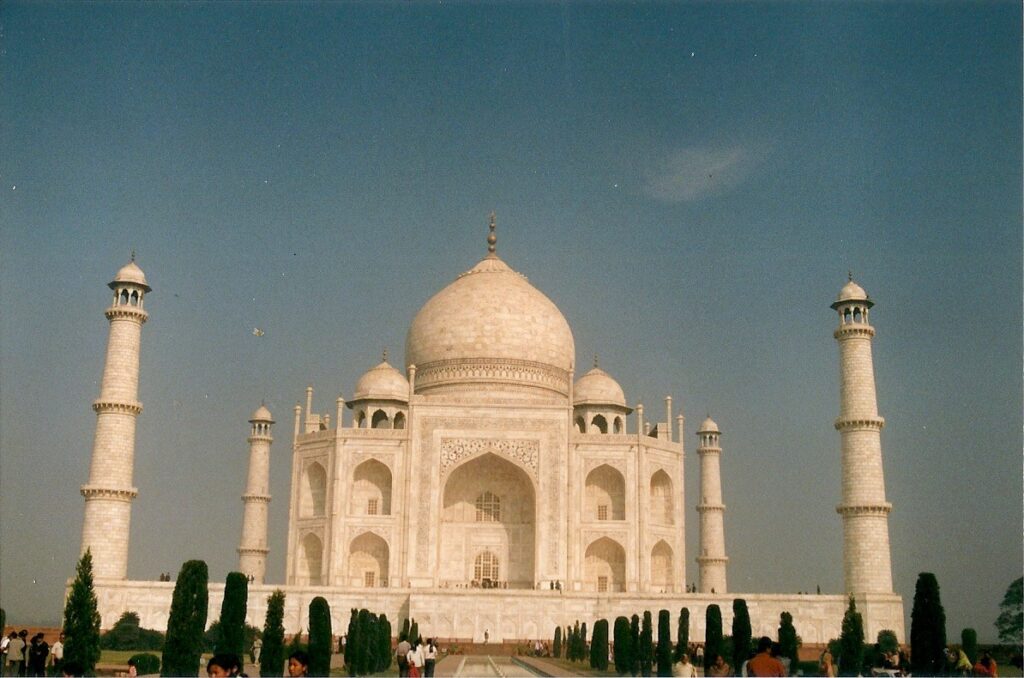
The Taj Mahal in Agra though did not comply with this rule of thumb. All the previous sightings I had had, before I arrived there in person were washed aside. I approached through one of its quieter entrances, paid a pittance of an entrance fee, to have a few seconds later this most magnificent of mausoleums revealed to me in all its tranquil glory.
It is difficult not to lapse into cliches when describing the perfect symmetry of this monument to eternal love. Built for and designed by Emperor Shahjehan as a mausoleum for his wife, who died giving birth to their fourteenth child, it was completed in 1653 and represents the zenith of Mughal architecture.
Set at one end of a large Persian garden, with watercourses, walkways and rows of cypress trees, it sits on top of a huge marble terrace, which rises up from a sandstone base. The Taj’s craftsmen inlaid the monument with silver, gold, jade, moonstone, coral, jasper and other precious stones from across Asia. It was, as the saying goes, designed by giants and finished by jewellers.
The crowds hover, but this does not ruin the experience in any big way. Its perfect balance leaves a lasting impression, at any time of the day. More fool those visitors who have come on a tour bus for a one-hour visit. To fully appreciate the ambience, several visits a day are in order, when from dawn to dusk, the glowing marble stone work gives off different shades of light. And at the pitiful entrance charges levied (Something that has always confused me), this is an affordable option.
My first visit to Agra was at the end of 1992 and now I was back again one Sunday evening seven years later. This time I planned to explore other parts of this city. The Taj was still an unmissable part of my itinerary, but not for the following day, Monday being the Taj’s day off.
That evening, I thought back to Egypt and my visit to the Sphinx a few years previous. Scaffolding was erected around it for essential renovation work. The nightly sound and light show though was still running – an interactive spotlight on the Sphinx, viewed through its newly acquired spiked metal overcoat.
God forbid the day, I thought, when the Agra branch of the Archeological Survey of India succumbs to that most philistine of concepts, the sound and light show. Come and see the Taj as it was never meant to be seen. Surely, when that fateful day arrives, it will be ‘hang your boots up’ time.
The following day I hired a rickshaw to the tomb of Itmad–Ud–Daulah, one of the city’s former ruling fathers, which backs onto the Yamyun River. A few kilometres along its banks was another Agra landmark, the Red Fort. Seven years ago on a Monday afternoon, I had stood in the Red Fort , gazing through a crenellated archway across the river at the distant outline of the Taj. It was a hazy view, but gave an appetising taster of what was in store for the following day.
Now, as I headed towards the exit of Daulah’s tomb, I found myself in conversation with two Austrian backpackers.
One asked hopefully ‘Can you tell us whether the Taj Mahal is open today?’
‘No’ I replied ‘It is always closed on a Monday, its weekly rest day.’
Their hearts sank.
‘You will have to go tomorrow instead’ I said.
‘But we are not here tomorrow. We pre-booked our rail itinerary across northern India, before leaving Austria. We arrived in Agra this morning and are only here for the day. We have come especially to see the Taj. Tonight, we have no choice. We have to leave.’
‘I’m sorry’ I said. ‘I’m very sorry’, and then wondered why the hell I was apologising. It was not me who had fouled up.
‘It is possible to see it at a distance from over the river at the back of the Agra Fort.’ I told them. ‘Of course it is not quite as good, but it’s the best you’ll get, if you have to leave today. Anyway, the Fort itself is well worth a visit.’
From their morose expressions, this was not much of a compensation. It was a bit like losing a fiver and finding a sixpence.
We talked briefly about where they had been, where they were going to and so on, but their sullen expressions seemed to be saying stuff India, stuff Agra – We are only killing time now, until we catch the evening train out. Sorry it’s the Taj or nothing.
A couple of hours later, I arrived at the Red Fort and walked to the crenellated archway, with the hazy outline of the Taj in the distance. At the top of the archway’s steps stood two women. It was the Austrians. I drew level. They were staring ahead, across the river, seemingly in bewildered silence.
It reminded me of a passage from the novelist and travel writer Paul Theroux’s Pillars of Hercules, in which he waxes lyrical about Venice.
‘At the western edge of Venice, towards the quays where the largest ship are moored, and next to the church of Santa Maria Maggiore, is a large medieval and mournful looking prison. Being in prison in Venice seemed to me like the classical definition of hell – that you are near heaven but denied it absolutely.’
Right there and then it felt like the two Austrians were so close to heaven, but were being denied it absolutely.
‘So you found it then’ I stated.
‘Yes, it’s beautiful, but it makes us so annoyed’
‘I’m sure it does. I’m sorry.’
‘Will you stop saying that!’
But their fate certainly was not as excruciating as that of Shahjehan. After the Taj was completed and his wife interred in its heart, Shahjehan’s son seized power and interned his father within the Red Fort. There, Shahjehan was able to live out the rest of his life, looking out of a cell window at his distant masterpiece across the river. Oh well, at least there would not have been any smog to restrict the view, not like now.
Mandu, Pithampur Tahsil, Dhar, Madhya Pradesh, 454010, India
Agra, Uttar Pradesh, India
Bhopal, Madhya Pradesh, India
Indore, Madhya Pradesh, India
Damian Rainford, 1999/2000
(Header image: Pixels Free Photos)
Back Home to theancienthighway.com
