PART 2. TO THE EAST
“She had reservations about Germans, that was true. She knew, she had been told, that West Germany was militarist and revanchist, and that East Germany was democratic and peace-loving. But she doubted whether all the good Germans were on one side and all the bad ones on the other.”
Liz Gold in John Le Carré’s The Spy Who Came in From the Cold, 1963.
Crossing the Threshold
The memory I have of passing through Checkpoint Charlie, from West Berlin, wasn’t the smoothness of transition. It was of being stood behind a small group of dapper dressed, jean clad American men. At the passport control booth, the group chatted light heartedly with border guards, wishing them a nice day, as though they were buddies. They might have even been on first name terms with the officers. I got the impression that the guys were US service men, on their day off, going on a lads’ jaunt to the other side, or, who knows, to enjoy a spot of information gathering. They were a lively bunch. Too lively, perhaps for the stern guards they were about to meet on the Eastern side of the checkpoint, across a short strip between the two huts.
I had visions of them suddenly making a break for it, running from one compound to the other– they weren’t the kind to stand still, even though a state of calmness was strictly advisable. I certainly didn’t want to get caught up in anything volatile before I had even got out of the traps
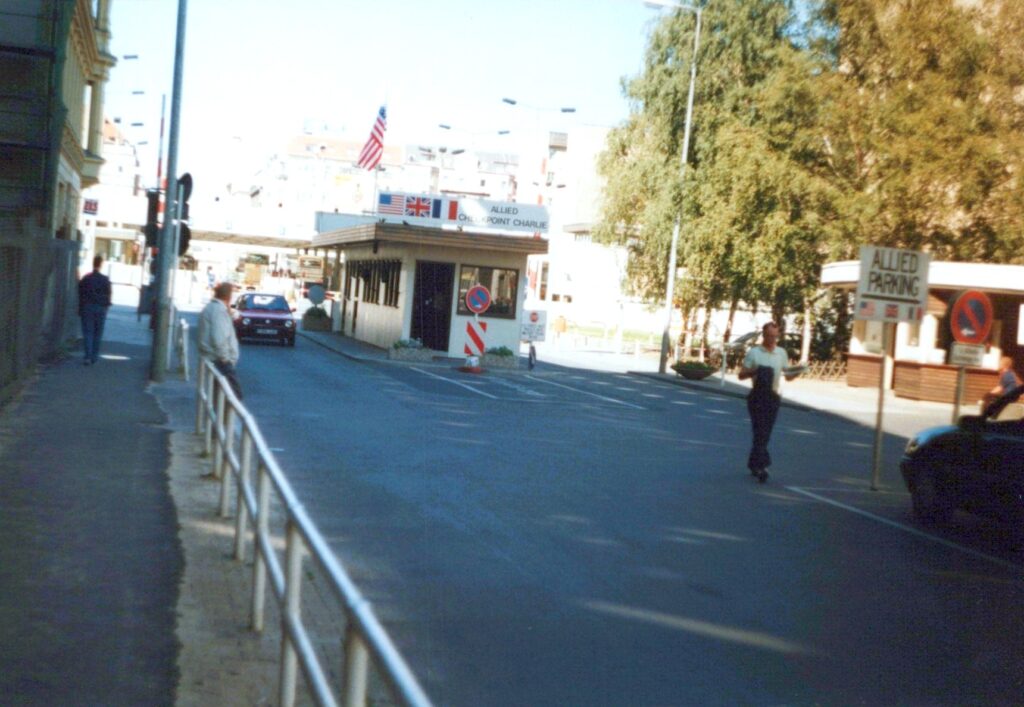
Completing the formalities in the West, I walked at a gentle pace to the East and offered up my passport, then changed a mandatory amount of cash into East German Marks, cash which I would be hard pushed to spend.
I emerged onto the strip between the eastern side of Checkpoint Charlie and the top of Friedrichstraße. It felt eerily deserted. The watchtowers and traffic barriers of the border zone were still visible behind me, receding as a reminder of the threshold I had just crossed.
There was a smattering of people who criss-crossed the streets ahead. But hell, where was that posse of Americans? Did they make a dash for it after all?
Walking along Friedrichstraße, the immediate sense was that, unlike the bustling neon lit downtown area of West Berlin, this was quite a drab affair. There was a predominance of apartment blocks and government buildings, generally built in a uniform cold grey cuboid style.
I suppose at this end, the flow of human beings would be largely confined to those who had arrived by foot or car from Checkpoint Charlie. The majority would be Westerners – Just like those US guys and myself– In contrast the average GDR citizen would not want to be drawn into this sinister world.
Workers of the World
I was anticipating large open displays of propaganda, as soon as my feet stepped into the GDR. Nationalistic statements, heavily weighted towards the virtues of socialism. Something that would make me feel I was still very much on a Cold War stage set. A vivid Erich Honecker portrait perhaps. Maybe even that famous one from 1979, of him in a passionate mouth on mouth embrace with Soviet leader Leonid Brezhnev.
These were not immediately apparent, but I wasn’t to be disappointed. A couple of minutes further on, I paused briefly to look up at a couple of giant-sized slogans that were draped down the side of multi-floored buildings. It felt as though I was just entering an Orwellian world. Through hard work, we build socialism, read one, For Peace and Socialism against Imperialism, read another.
It is quite telling that I haven’t (yet) found any photos of these banners from my visit. I can only assume that having just left the Wall and those watch towers behind, I still felt like I was living in a climate of fear and did not wish to get singled out for any official attention.
But would those posters recede as I got further into the city? Or were they deliberately positioned relatively close to the Wall to double up on that climate of fear? But there again, wasn’t that a key reason for me making this journey? I wasn’t really in a position to complain about a bit of fear.
Unter den Linden
My pace now had picked up a notch or two, as I arrived onto one of the world’s most iconic boulevards, the Unter den Linden.
Well, it certainly would have been iconic in the early part of the twentieth century. Cafe society and well to do shops would have permeated, alongside flowing columns of lime trees.
I did occasionally see a building that hadn’t suddenly been constructed or restored soon after 1945, and that looked to be of historical interest. But there was very little sign of anything that might constitute present day cafe culture. However, at least those lime trees added a degree of pleasantness to my walk.
Every thirty seconds a mass-produced Tribant car would drive past, but where were all those pedestrians? Perhaps, they were sat within their four walls, huddled around radio broad casts with staunch nationalist overtones, or maybe even too fearful to step out. Possibly this was a sweeping generalisation. I needed to carry on walking, to accumulate evidence, before I could talk such rubbish.
So that’s what I did, but I just got more downhearted. To think that over the centuries, Unter den Linden had stood as one of the most famous streets across the world’s capitals. But now, it just felt a notch up from all of that dowdiness of Friedrichstrße. Everything it seemed contrasted with the blue sky overhead.
I came to a department store. I am not sure if shopping there was just restricted to senior government employees and high-ranking Stasi members with tokens. But the general ambience across establishments, indicated that it was a Sunday, with everything closed, just like it would have been back home years ago. I then made out the dim silhouettes of people in the store, just about visible under low wattage bulbs and realised it was actually a Saturday So, it was open, after all. If only I’d had some tokens, even done a spot of spying or informing to earn some.
I carried on walking and spotted a delicatessen food store down a side street. There was a sizeable queue outside. But it wasn’t so much the waiting that put me off, as my unsureness about talking to strangers. How would it be viewed? Would people feel very uneasy about relating to this Westerner?
After all, they had their work quotas to meet, their families to support, their noses to keep clean, maybe even spying duties to carry out. All in all, they had their lives to get on with, and let’s not forget that for significant phases of the country’s existence, employment, housing, and health standards were actually quite comparable with the West. So why would they want to go risking it, striking up conversation with me, when I might already be under surveillance, after my meanderings and snapping away?
The Altes Museum – A Cultural Puzzle
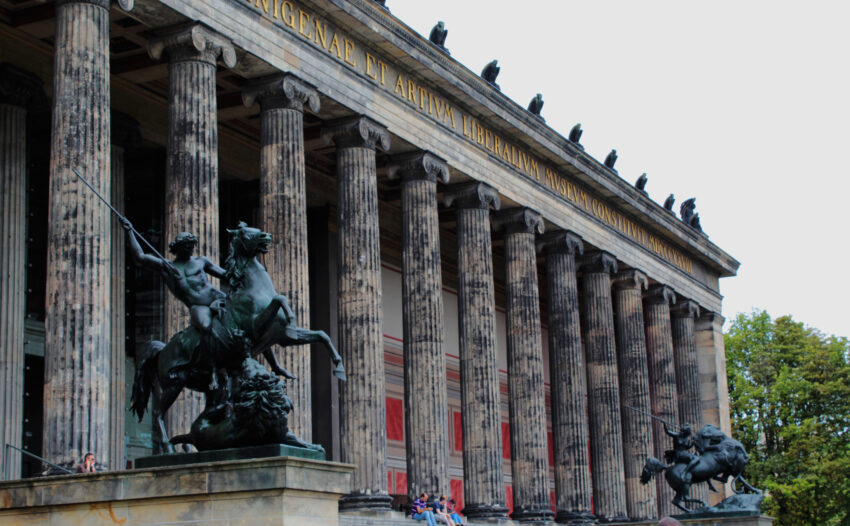
Further on down Unter den Linden, by Museum Island, I found myself in front of the Altes Museum (the Altes), with its lavish collection of antiquities. Its appearance, and that of other buildings close by, was far removed from the impression I had been given so far. Dull, grey, cuboid or austere weren’t adjectives that could be applied to the Altes. A clue to the extravagant extent of what lay inside could be gleaned from the wondrous design of the building. Built in 1830, It wasn’t just its neo-classical Greco-Roman design and pantheon like columns, but in the sculptures spread the width of this architectural wonder’s exterior.
Its interior was drenched with intricate displays of antiquities across civilisations. These included Greco-Roman and Etruscan exhibits.
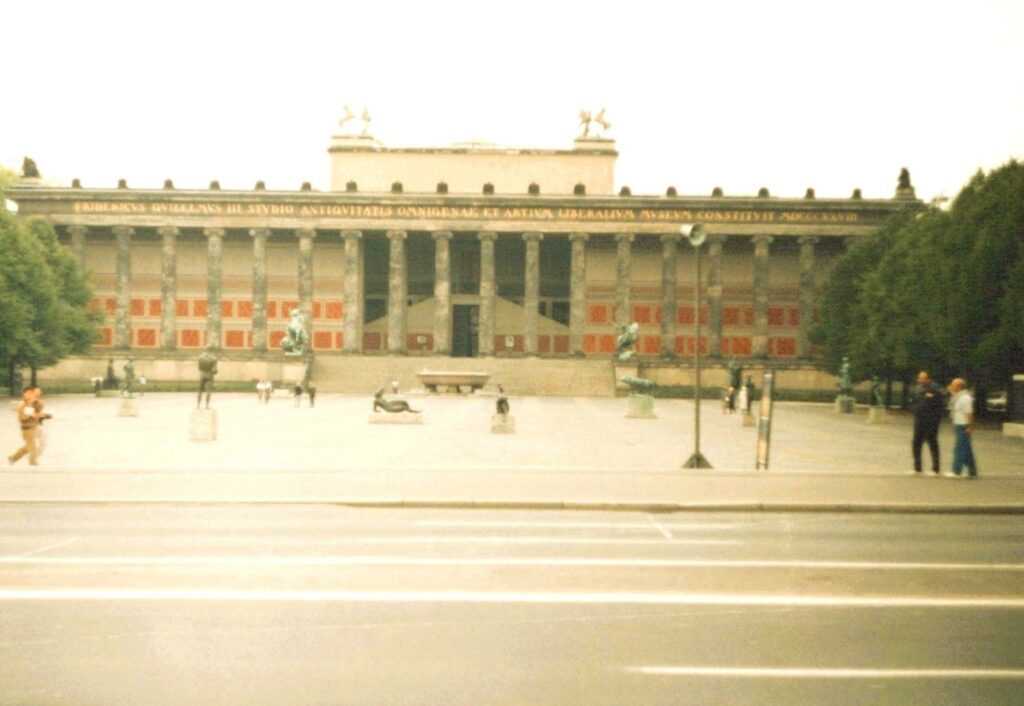
And yet even before I entered the museum, it felt like there was an ideological conundrum. Of course, the emphasis was on high art. So, whilst capitalist, fascist, materialistic West Berlin majored in commerce, the GDR didn’t hold back in showcasing its intellectual and cultural superiority — that’s how it seemed they wanted to project it.
How exactly did all this cultural materialism, hedonism even, sit with traditional socialist views on wealth and austerity. What, for example, would Marx have made of it? I don’t think there was too much about high culture and the proletariat in Das Kapital. But then, this was based on a world ideology, rather than two conflicting political frameworks from a divided city.
I was struggling to find an answer but just knew there was an issue somewhere. Something particularly ironic.
I parked my musings.
Instead, another concern preoccupied me. Just where the hell were all the visitors? The place was devoid of them, inside and out. Those intricate sculptures out on the front looked terribly lonely.
The place felt creepily quiet. Occasionally, my concentration would be interrupted by the echoing footsteps of a museum guide, as he made his way from one wing to the other. It would have given me a jolt. Like that department store on the Unter den Linden, the place felt closed, until you scrutinised it a bit more.
If this had been the Louvre or the Tate, the square in front of the museum would be crowded. You would need advance tickets or have to queue around the block. Here though, it didn’t feel like citizens were wandering around downtown or visiting its major attractions in throngs.
Just who was the museum really targeted at? It felt like the GDR, or at least its politicians, were in a state of ambivalence. The state seemed to be trying to project an image of the GDR as the real custodian of Germanic culture and intellectualism, but failed to do so in a manner that drew in its own citizens? Anything highbrow wasn’t on the agenda of most East Germans.
Ease of access from either side of the divide was another factor. It was probably easier to visit it from Hamburg, with an overnight stop in West Berlin, than for an East German family to come on a day trip from not-too-distant Wittenberg. Travel restrictions would not have been significant, but the surveillance it might bring was quite another matter.
But let’s be very clear, in case you think I have a downer on the Altes, I absolutely loved the place and would visit again, no question. I just wished I could have had some conversation with other visitors. Instead, I felt as lonely as those statues.
The Godfathers of Socialism
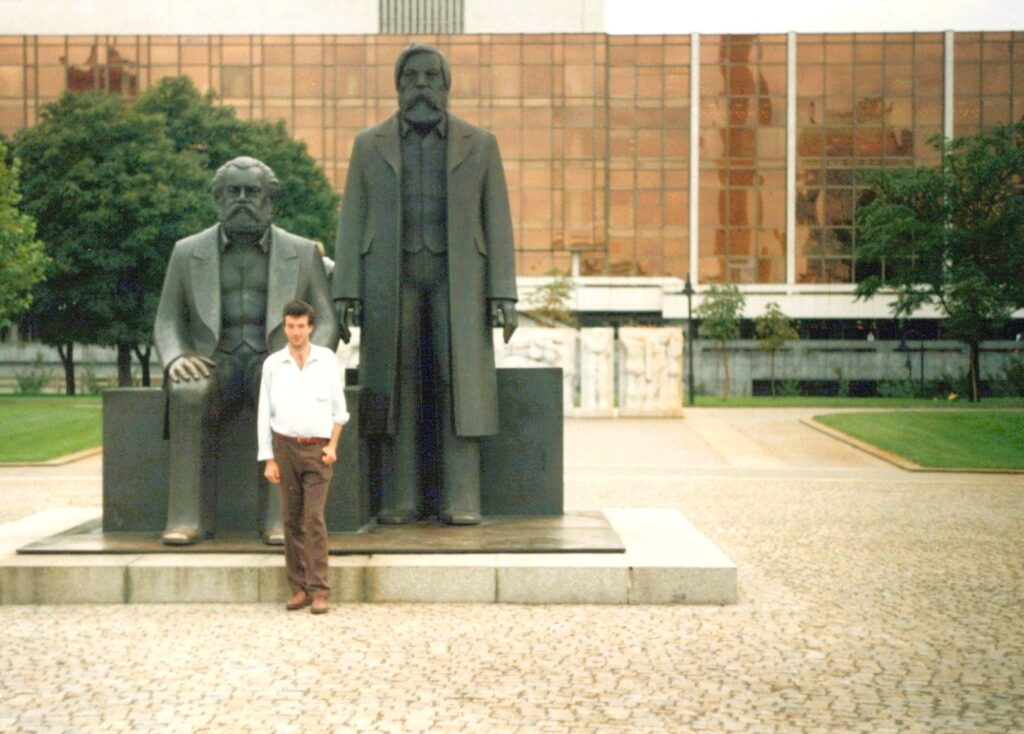
As I exited the museum, I saw a few strides away, gazing in my direction, two huge sculptures of the godfathers of socialism, Karl Marx and Friedrich Engels. Produced in1986, by Ludwig Engelhardt, they looked straight across at me, or should I say at the museum. What must they now be thinking (in as far as statues can have thoughts), as they gazed over at the Altes, with all its high cultured materialistic exhibits.
But here is the true irony. Immediately behind them was an ideological cornerstone of the GDR’s decision-making process, the East German Parliament, housed in the Palast der Republik. Marx and Engels were positioned with their backs to the legislature, whilst enabling them instead to admire the less politically sound Museum. Quite a contrast in choice.
I wondered what Stalin would have made of it, if this was the USSR, and he had turned up the day after the great statues had been set immovably into the ground, facing the wrong way. He was here to admire the very sculptures personally commissioned by himself. I had visions of Engelhardt and his helpers being given fifteen minutes to pack their bags, in readiness for a very long train ride east to Siberia.
In defence of the sculpture’s guardians though, it must be said, that I couldn’t spot a speck of pigeon dropping anywhere on our two friends. Someone had to be showing up bright and early each morning, with their ladders, to give them a good polish.
Cold War Warriors
I thought that there should also be a couple of corresponding sculptures in West Berlin. But who exactly? I started to have some fun, beginning with my short list of political theorists, learnt quite a few years previous. How about Victorian John Stuart Mill and his commitment to Western liberal democracy? Perhaps they could place him next to a statue of Austrian Karl Popper, an advocate of the open society, where all major decisions were based on hard evidence and efforts to disprove generalisations. I imagined people sat on the benches by the Kaiser Wilhelm Memorial Church, in the shadows of the statues, ruminating over their works, but I was getting carried away.
After all, the choice of sculptures was obvious. They would be right up close to and looking over the Wall, with the Brandenburg Gate on the other side. Yes, it would be of those two Cold War warriors, who at this point were both still in office, I give you Margaret Thatcher and Ronald Reagan, as in, she promised to follow him to the end of the earth. He promised to organise it.
Cold War speak as good as any.
The Berliner Dom
A few strides away from the Altes, was the Prussian Berliner Dom cathedral. This giant of twentieth century imperial architecture contrasted with the more modernist, socialist designed buildings that I was to come across that day.
The huge Dome on the skyline was an extravagant statement of high culture. In terms of aggrandisement, West Berlin wasn’t able to match it.
The cathedral suffered from extensive bomb damage in the war. Yet repairs only started in earnest thirty years later. But why did it take so long for them to commence. I suppose the priorities of the East German state lay elsewhere, particularly in a landscape still marked by destruction and rebuilding.
Surprisingly, they didn’t take their cue from the USSR, where the trend was one of religious oppression and persecution, and turning aesthetically pleasing places of worship, into, for example, planetariums, swimming pools or museums of atheism. If they had, the images projected would, I’m sure, have heaped praise on the Soviets and East Germans for their scientific ambitions and achievements.
But what was going off here now? Surely the regime wouldn’t still be sinking huge resources in bringing the building back to life. They had grand five-year socialist plans to implement instead. And yet, it’s hard to imagine the state not contributing in some way, for It would have taken a lot more than a weekly church collection.
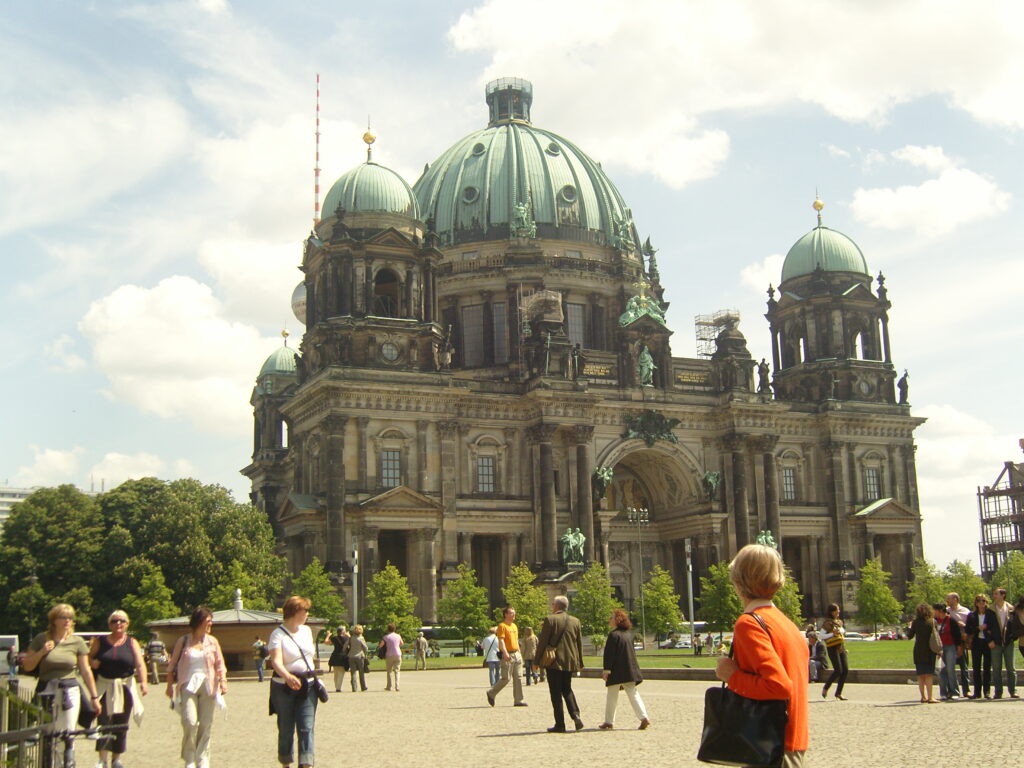
I made my way to the entrance, but damn, the cathedral was closed for further repairs again. Intermittent works were taking place. I couldn’t just walk in and start wandering around but, from the top step, I was able to take a peek inside, cricking my neck upwards to see the cracks that were still in the dome.
There were a small number of stained-glass windows on display. My mind started to work overtime, as I wondered if the state took over the place, would they have their own versions? Maybe one of Honecker serving time, for his communist activities, in a Nazi jail. He would be dreaming of one day being a leader of men, or of the working classes, at least. Alongside him, would be one of a proud Stalin, against a backdrop of factories that belched out smoke, soldiers and the hammer and sickle.
Over at the other end, there were a group of people who looked to be descending down a set of steps, to a crypt. Limited worship it seemed was allowed in the GDR and I guess the state would have settled for that.
Churches were still open, worshippers still attended, discussion forums existed. Whilst none of it was exactly encouraged, to some of the ruling party, it may have been viewed as an opium of the masses, that kept the populace happy. God was in the house. Until now of course — as Hertha had indicated on our train ride from Hamburg, cracks in the Wall were starting to appear.
The reality was that, in the unravelling climate, this small gathering, making their way down into the crypt, weren’t likely to be discussing such things as whether Jesus sat at God’s right hand or how the Gospel of Saint Luke, compared to that of Saint Mark. It was more probable that they were debating how power structures in the GDR were affecting their daily existence, for the worse, enforced in no small manner by a state security service that was second to none.
But this was all supposition. I had other plans I needed to get on with.
A Church and a Synagogue
I had two primary objectives that morning, as I set out from the West. One was to get across Checkpoint Charlie in one piece and the other was to delve deeper into the Night of Broken Glass (Kristallnacht) and how in an extreme evening of anti-Jewish prejudice in 1933, ordinary Germans and Nazi party members were encouraged by propaganda minister Joseph Goebbels to go smash up Jewish places of worship, residences and shops, and if murder occurred, then so be it. Berlin was not short on those rallying to the cause.
The Sophien Kirche – I walked from the Dom, looking for the Neue Synagogue – a Kristallnacht target – on Oranienburger Straße, sure that there would be some form of memorial there.
I found myself in the neighbourhood of Mitte but wasn’t having much luck with the search. My attention was diverted instead by the tall grey stone church that towered over the community’s buildings. Research has since suggested it was the Sophien Kirche.
As I drew close, I witnessed a steady stream of people making their way up its front steps, a bigger group than the one at the cathedral.
I sat at the back of the church. The congregation had gathered near its front altar. An animated discussion was taking place. Whatever was happening it didn’t remind me of any church service I had ever attended. I sensed that some of them were scrutinising me, or perhaps, I was just being too self-conscious.
A man in a black leather jacket and peek cap, holding a bible, then dropped back and sat beside me. He wished me good afternoon. We exchanged a couple of more sentences, before he left to join the rest of the gathering.
Well I guess it would have been quite remiss of the congregation not to check me out. I felt quite uncomfortable and left soon after.
I could have been misinterpreting the scene, but if they weren’t openly worshipping God, exactly what kind of community issues did they have under the microscope? And wouldn’t the sophisticated Stasi network have already infiltrated them anyway? So, no need to worry about me.
I played out in my mind, later that evening, a scenario. After I had been granted clearance, I would have been invited down to the front, in anticipation of finding out what aspects of civil rights were exorcising them. But then, wedged between the group, I would have been subjected instead to some serious prayer reading and would not have been happy.
Church meetings like this may seem a low-level incident. But in the following weeks, I realised how important they were, in contributing to that final tidal wave of protest against the Wall. At the time though, I was completely oblivious to it.
As Hertha had intimated, there was already a degree of protest in Leipzig that was significant enough for word about it to make its way over into West Berlin.
However, there were a couple of imminent prestigious events, which helped ratchet up the level of church meetings and protests, for there was nothing inconspicuous about them now.
The first was the fortieth anniversary celebrations to mark the creation of the GDR. I saw plenty of banners on display, with socialist slogans, reminding citizens of this. Second was the presence at these celebrations, of Soviet Premier Mikhail Gorbachev.
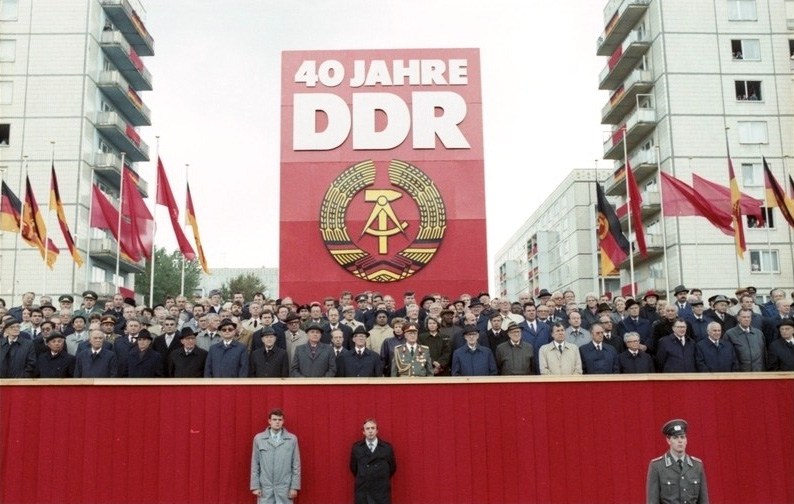
In the build-up to these events, as well as smaller gatherings taking place across East Germany, regular protest meetings were to be held each Monday in Leipzig.
I was stood on the steps outside the Sophien Kirche and in just forty-eight hours’ time the first Monday protest meeting in Leipzig would attract 1,200 people. These were to grow considerably by the time of Gorbachev’s visit and would reach 70,000 just after he left.
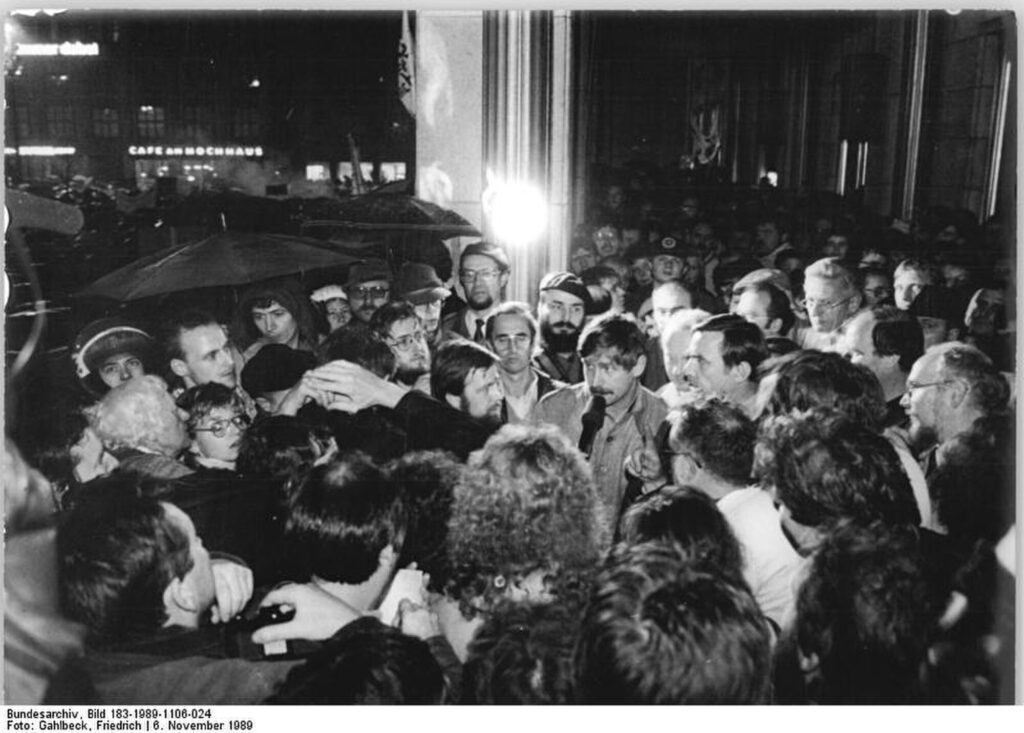
Of course, I am sure there were many non-party members who were content with societal structures and the state security apparatus. But an unstoppable force had been unleashed.
Gorbachev had also indicated his disapproval of Honecker’s level of autocracy and was unable to offer any Soviet support in managing the situation.
In hindsight, it was a historical Inevitability.
The Neue Synagogue – I left the church and carried on in search of the Neue Synagogue but started to lose faith in my sense of direction. Stopping any of the few people I saw on the street and asking for directions would have felt uncomfortable, but it had to happen. I asked a young lady, showing her my map and the name of the synagogue that I had wrote down. She was very upbeat — not the reluctance that I had anticipated — and skipped along in front of me. After a further ten minutes, she stopped and pointed ahead, then turned round, and vanished. I had been expecting to see a site restored in the manner of Coventry’s cathedral or the Kaiser Wilhelm Memorial Church. Somewhere that provided a place for reflection on the horrors of that 1933 night.
But it still looked like a building site. The Kristallnacht thugs had started on the synagogue. However, it was Bomber Command who had finished the job off in 1945. It felt as though nothing had been touched since the RAF had last visited the place and that we were stuck in a time warp, with it feeling like an unsafe place to wander around. And the impression was that there were no intentions to ever restore it to its former purpose. Possibly they were just waiting for the bulldozers to arrive, clear the place and construct new tenement blocks. There was an anti-Semitic feel about its neglect.
The neighbourhood had contained a vibrant Jewish community before the war, but in 1943 the Nazi’s declared the city Jew Free. I wondered whether some people who lived on the street had taken part in the trashing of the synagogue. Perhaps there were some who still lived here. Or perhaps it wasn’t just the synagogue that got levelled by Bomber Command, but the whole street, and there was no one around who still remembered Kristallnacht, and hadn’t been since they were killed in 1945.
The Palast Der Republik
I retraced my steps back to Museum Island and was drawn in again by the Palast Der Republik.
I loved the appearance of this building from outside. There was just something extremely eye-catching about its modernist bronze plated reflections, and in particular of the imperial buildings that were now reflected in its glass, not least the cathedral.
Whilst the Palast contained some recreational facilities for citizens, its prime feature was the parliament (the Volkskammer). As such it was a key feature of the GDR’s ideological law-making process. Its seat of power. A card-carrying people’s forum. At least this is the image the state would have wished to project. In reality, it was more likely a forum for rubber stamping decisions, already taken by the Politburo.
And didn’t the designers realise, when viewed close up externally, it’s startling reflections provided more of an artistic window on stunning imperial structures, rather than on ideological sound ones? Even the best view of the Marx and Engels sculptures was limited to their backsides.
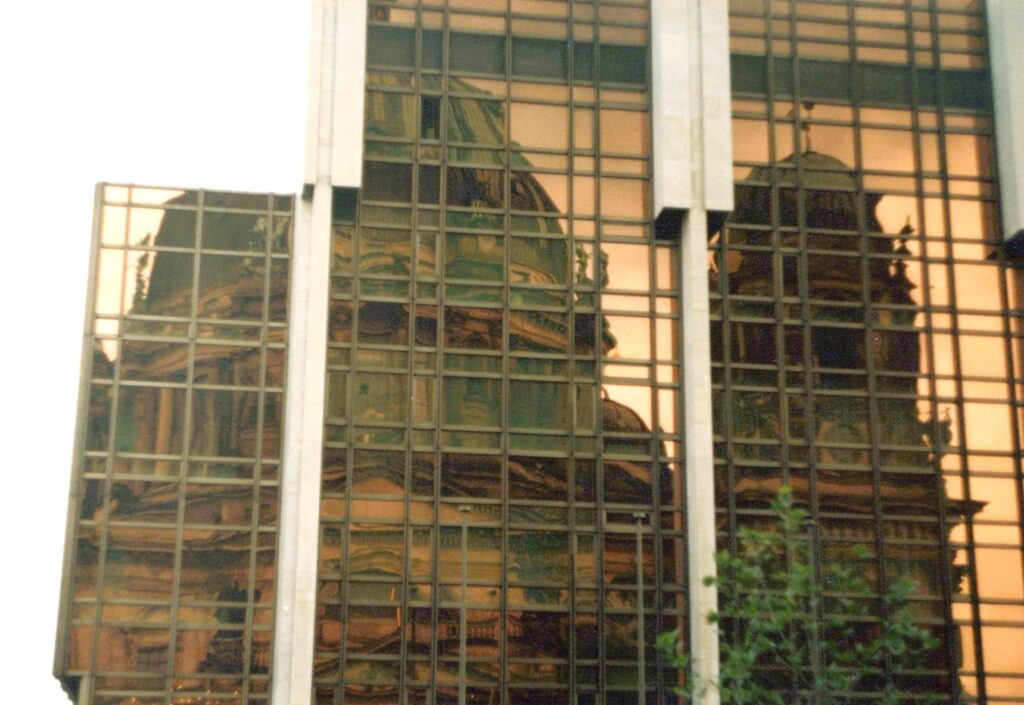
The perimeter of the Palast wasn’t exactly surrounded by armed guards, in a way that would suggest it was a ruthless seat of power in danger of being attacked by enemies of the regime – one where just frowning might have got you arrested.
Still, I made my way gingerly to the entrance, wondering if I might get wrestled to the ground at any moment. I crossed over its threshold, assuming that I would be promptly asked for some kind of high security ID card.
It felt like a lull before a storm, yet nothing had happened.
Instead, I ambled nonchalantly in the direction of a sophisticated gathering on one side of the great hall. There was a mixture of ages, from ten-plus up and they could have been assembled for an opera, with their dress contrasting sharply with my own down at heel attire. It didn’t feel like they were here to make some tweak to the latest five-year plan.
But something just wasn’t right, after all they were having too much fun, to a degree that I didn’t realise was permitted this side of the Wall.
It all seemed to be happening in slow motion. The crowd continued a floor up, where there was a balcony with people leaning over, to admire the scene below. As I got closer, there was a turning of heads, as people looked over and smiled. One lady beckoned me over, to a table containing a buffet, so I helped myself. A few strides away a man sat with his young son on a settee. They shuffled up to make a space for me.
It all felt very elitist. However, I wouldn’t have expected Erich Honecker to come marching down the stairs at any point soon with his inner circle. The symbolic, if unrealistic, image of open government conveyed in the Palast would have operated in different spheres from the Politburo’s own shadow world.
If I had to draw a social class continuum line between here and those giant statues of Marx and Engels, where would I place myself? Well, of course, I would more likely identify with those godfathers of socialism. So, what was I doing blending in so effortlessly with this bunch, when a soup kitchen might have been more appropriate?
By now. I had assumed that the crowd wasn’t directly part of the legislative process, but some kind of cultural celebration, for the upwardly mobile, relatively affluent and very well connected.
Were they still living their dream in a utopian bubble, oblivious to the distant rumblings of dissent starting to gather pace across the GDR?
Wasn’t this all just a privileged existence for them gone badly wrong? Did they have any inkling that pretty soon, they would no longer be able to dwell so happily within the status quo? Maybe, a lot of them just didn’t care anymore, including, I pondered, their Stasi minders and watchers.
I wasn’t to know, right then, that this was a regime very much in its death throes. Although, possibly at this gathering, people were actually aware of events that were going off. How could they, for example, have remained oblivious to the recent exodus of East Germans to the West, via Hungary’s newly opened border.
Partying here was, it seemed, a mere interlude on the road to far bigger events.
Ten years ago, when reflecting on this episode, what sprung to mind was a scene from the brilliant German film The Lives of Others, a movie about life under the Stasi. With reluctance, I had to accept that it had all been a fabrication of my mind. I must have been getting real life events mixed up with my favourite films. I wasn’t immune to human frailty.
However, in recent months I have retrieved a range of media from around the house, in relation to this particular journey. These were retrieved from under the bed, in the loft, at the bottom of drawers, tucked behind books. There, amongst this collection was a shot of the above gathering in the Palast Der Republik, as real as the day I had taken it.
It is still a mystery to me how I was allowed to freely enter, mingle, talk with people, eat food, and take photos in that setting. And, who knows, from a state security viewpoint, I lightly pondered, I might even have been infecting them with my Western values.
Quite likely, at the time, I found myself double checking that this was East and not West Berlin, in the year of Our Lord, 1989.
And were things really changing so quick? (Faster than you could ever have guessed, matie!)
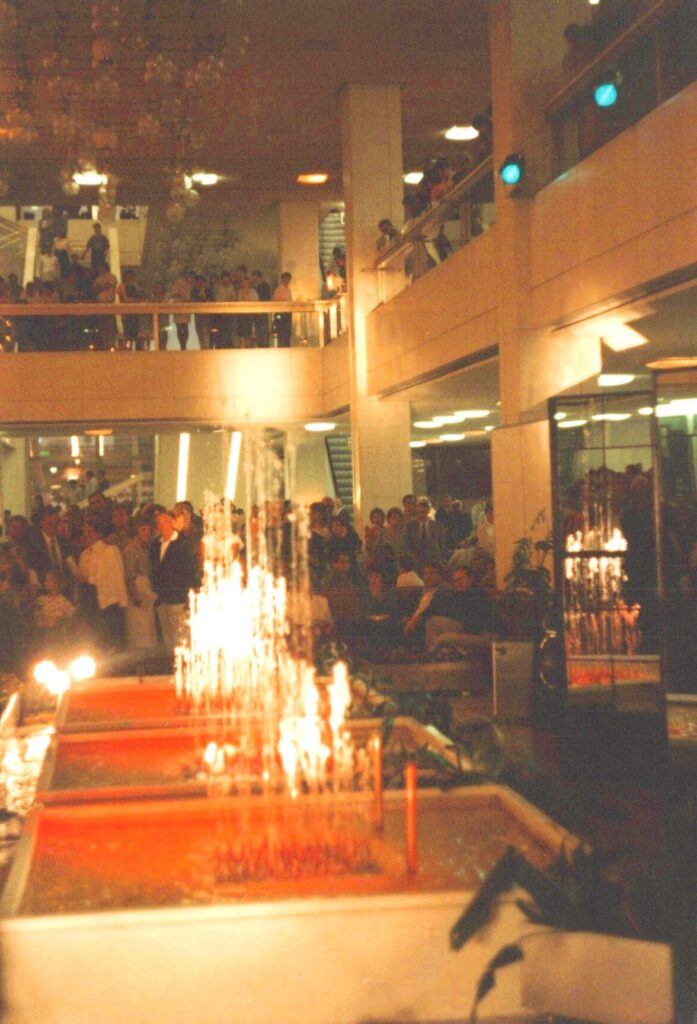
It had been a perplexing distraction. I would have loved to return. But even if I had been able to so freely gain admission, it felt unlikely I would bump into a similar gathering again. Such speculation is irrelevant though, as not long after the Wall fell, the place was discovered to be riddled with asbestos. It was demolished over a decade later.
But I was now suffering from sensory overload and needed to move on. As I exited the building, I would certainly have been chunnering a lot, in a not particularly articulate manner, along the lines of, what the fuck was all that about? My monologue could have been indiscreet enough to attract the attention of any surveillance outfit, if they weren’t already home packing their bags or contemplating what their terms of severance might contain.
Beliner Fernsehturm (TV Tower) – Perspective and Irony
In contrast, my next East Berlin destination felt ugly by comparison. Its view was inescapable whilst walking the streets, with its Star Wars type structure just looking down on you from everywhere. The building of the TV tower finished in 1969 and had a functional use, quite naturally as a tele-communications hub. However, its overriding purpose felt more like an ideological statement, its space age construction reaching high up into the heavens, demonstrating the technological and architectural skills that the socialist regime was able to draw upon, and never letting the West forget this.
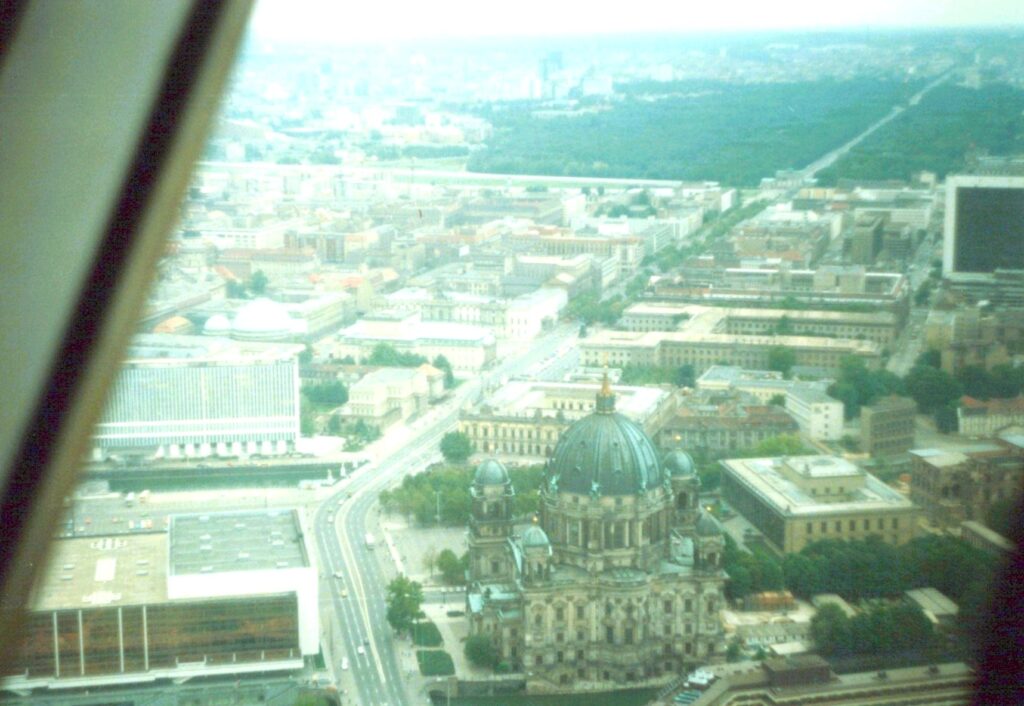
Brandenburg Gate in the distance, 1989, Author’s pic)
Aside from the glass ball and spire at the top, why did it have to be designed in such a featureless manner? Why couldn’t they have added a few imperial flourishes dotted around the column’s great length? I guess its appearance was all part of the ruling ideology, although it was lost on me, and it felt like somebody had missed a trick or two. Its saving feature was that at least while you were inside, you couldn’t see its exterior. This is what I thought, as I zoomed to the tower’s viewing level.
It provided a bird’s eye view of those magnificent imperial buildings that had been left standing after the war. These in turn seemed to dwarf any cold ideological constructions. I traced the path of the Unter Den Linden along its mile long stretch, culminating close to the Wall, which looked insignificantly small standing in the shadow of the Brandenburg Gate. Quite possibly, if this had ever dawned on the minds of the ruling party, they would have placed shutters on the particular windows which offered up this view, just like they had done on that train journey down from Hamburg.
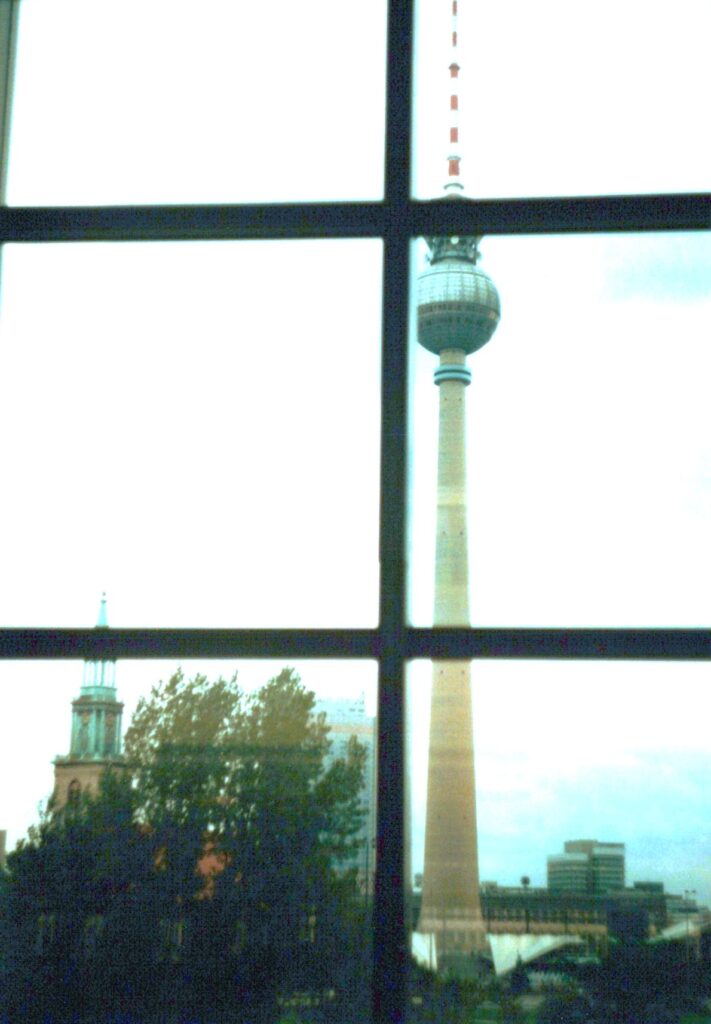
It was a bit like having to choose between two houses for sale on the opposite sides of the street. One was featureless and cold, the other an architectural wonder with considerable character. Which one would you choose? Well of course you might purchase the house of beauty, where you could sit forever staring at the monstrosity across the road. Or you could move into the featureless cold grey house, enjoying the pleasant view of the architectural wonder instead, warming the cockles of your heart. This analogy seemed to apply right now to the TV tower and the magnificent wonders it looked down on.
Alexanderplatz – The Gathering Storm
The roads I had walked along that day had a hushed edge about them. Whilst not deserted they fell someway below what I would have expected for Saturday, and I am talking in particular about key downtown thoroughfares. But then I arrived at Alexanderplatz and thank goodness, this place had a real buzz about it. It was a hive of activity, not just a local transport hub, but a meeting place for a diverse range of characters, or of people passing through.
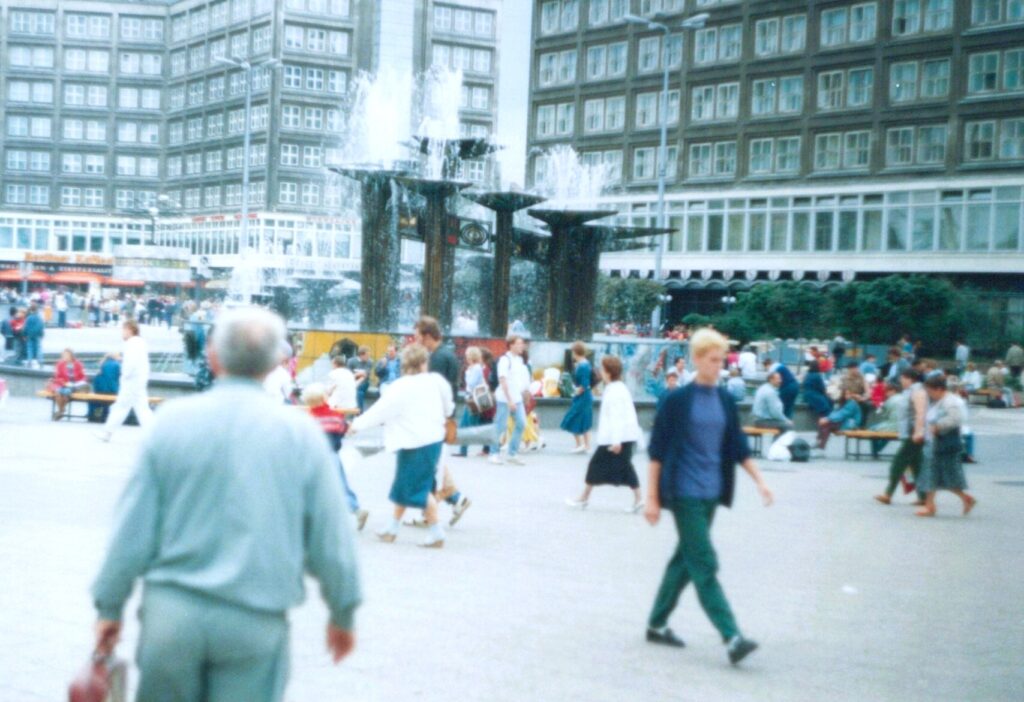
Of a policeman on a mission, of people with briefcases striding across the open space, of small groups of people in quiet conversation, which may or may not have been conspiratorial. And yet there was still a subdued feel about it. Frenetic it certainly wasn’t.
The memory I took away from the place was, once again, the old imperial world and the current socialist one sitting side by side. I sat alongside other people, in the shadow of the magnificently ideologically titled and modernist designed Fountain of Friendship Between Peoples. But, just like the reflective glass of the Palast Der Republik, when you sat by the fountain you faced away from it, looking instead at grand imperial constructions. The most striking of these, rising up ten metres, just a short walk away, was the 1891 sculpture of Neptune, the Roman god of the sea, with his chariot. It was as though the regime could never quite let go of the old world and would keep it in reserve, just in case.
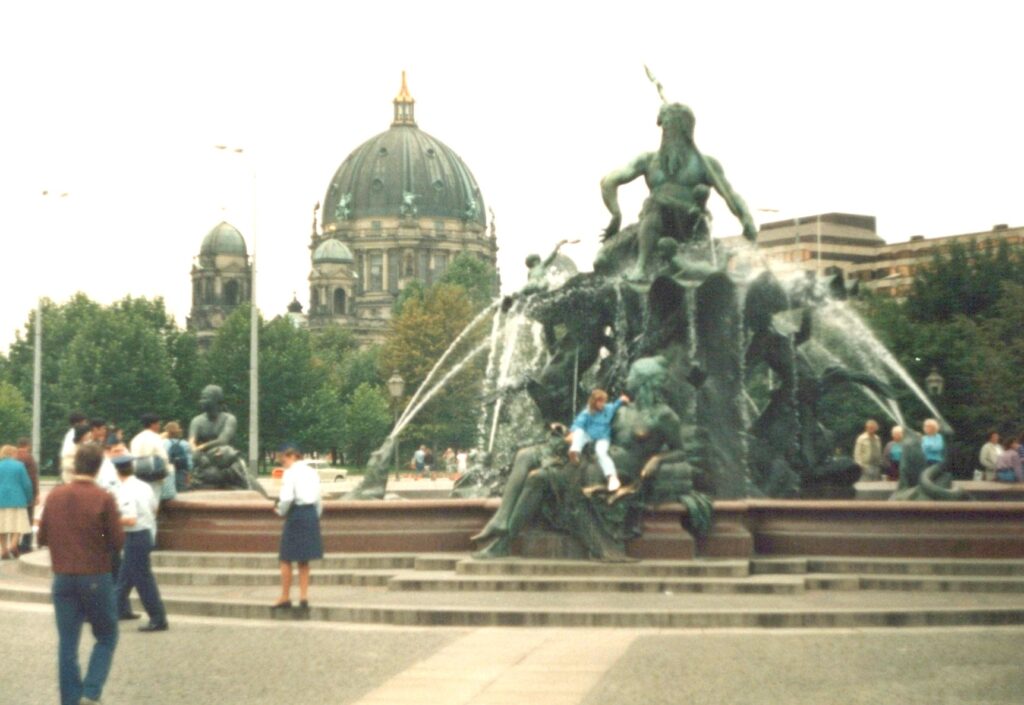
Just in case, as far as Alexanderplatz was concerned was pretty close. The Monday demonstration meetings in Leipzig had a big knock-on effect across the GDR. On 4th November, in excess of half a million peaceful protesters were to gather in and around my current location.
This would have been a sight worth viewing from the television tower. Even if the windows had shutters, I doubt if staff by now could be bothered to pull them down anymore.
Most significantly, it was a demonstration that had been sanctioned in advance by the state. Surely by then, the Government and its citizens knew the game was up.
Five days later, the Wall fell.
The Eternal Flame – Ceremony and Contradiction
A matter of minutes after moving on, I was back on the Unter den Linden, bit by bit making my way towards West Berlin.
It was late afternoon, and I stopped off at Neue Wache, to ponder the, particularly Soviet, millions, who were killed in battle against the fascist hordes.
At this nineteenth century Prussian guard house was The Memorial to the Victims of Fascism and Militarism. This contained the Eternal Flame, flickering, as its name suggested, for all time. Although even eternity, as the world was about to see, had its limits.
At the top of the steps, two GDR soldiers stood on guard. Pristine uniform, jutting chins under their helmet strap, stern faced, not a flicker of emotion.
My timing had been impeccable. I was about to witness the changing of the guard, with the goose stepping that is part of this ceremony.
The vigour, resoluteness and agility with which it was performed, as those boots rose at a considerable height from the stone flags to come crashing back down, all perfectly choreographed, meant that standing well back was advisable.
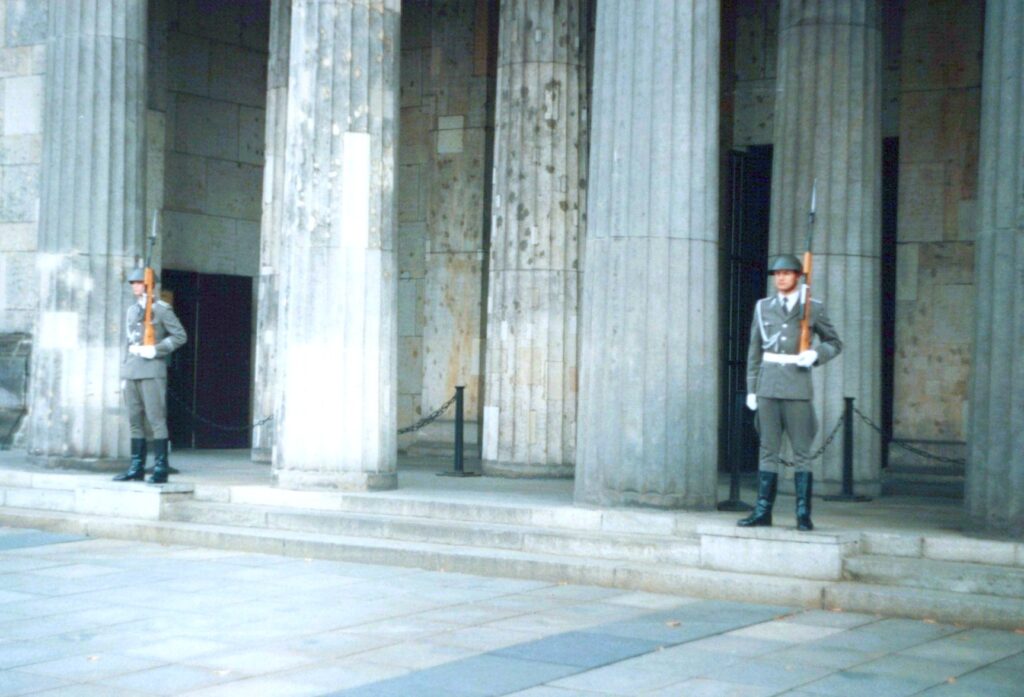
The event was enacted with nationalist zeal — an image of the victims of war viewed as an especially Soviet triumph over the fascist West, which didn’t just include Nazi Germany, of which the GDR had been a part, but probably every conflict that had ever had links to the western world.
I can still hear the slamming of those boots on the ground, but where the hell is the photo I took of the event, rather than the action less one I have recovered.
However, if the moment was meant to be about reflection, rather than idealistic ceremony, then how ironic, that it was a memorial against militarism, and yet the changing of the guard ceremony was anything but.
In 1993, under a unified Germany the memorial was dedicated instead to The Victims of War and Tyranny, with a worldwide focus. There was no longer an eternal flame, but a sculpture by Käthe Kollwitz of a Mother with her Dead Son.
The Long Way Back
I had covered a fair few miles in pushing ten hours but had had nothing to eat or drink. It was time to do something with those East German Marks in my pocket- spend them or lose them – preferably on food and alcohol.
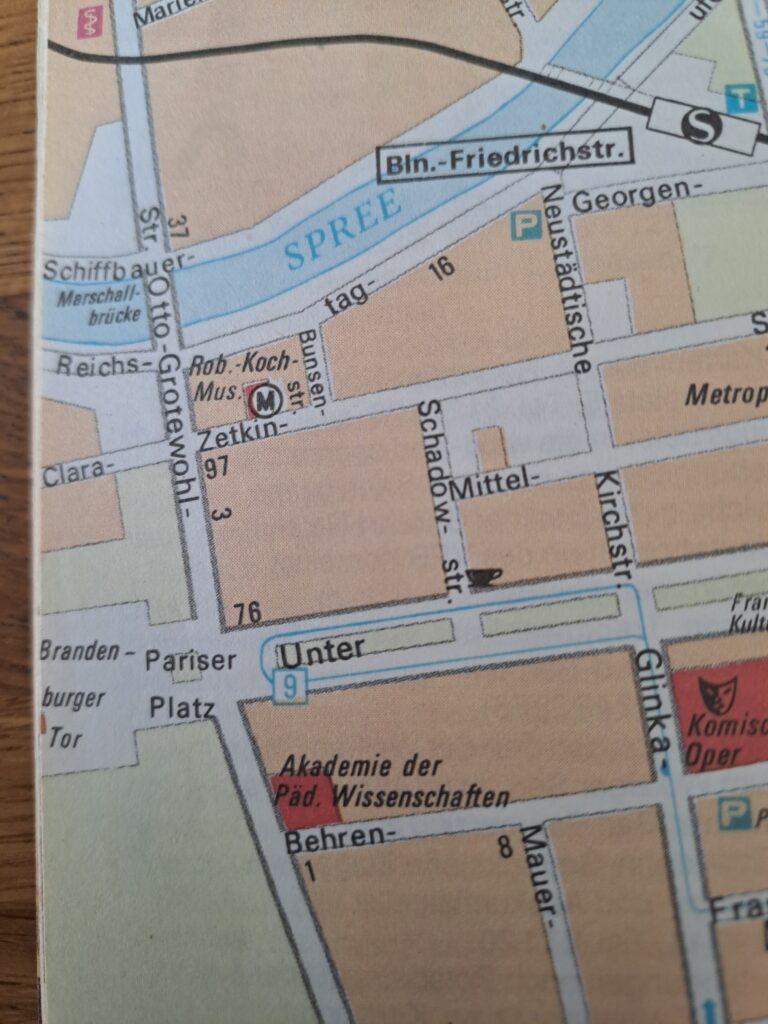
I had a booklet, picked up this side of the Wall, containing a detailed city map and a series of useful phone numbers and grid references.
I glanced briefly at the map, pointing myself in the general direction of the Unter den Linden and the Brandenburg Gate. The GDR’s deadline for me crossing the Wall again, back into the West Berlin, was still another five hours away. There would be side streets along this stretch that served good wholesome food —as in suckling pig and fries, with beer.
The first bar I found wasn’t serving food, but that was alright because beer was a higher priority, so I had one, possibly two. They slipped down effortlessly after all my meandering.
I moved on, took a couple of right and left turns, finding myself in another bar that did indeed serve suckling pig. So, I ordered this and a large beer.
I started studying that booklet with the map and useful numbers and grid references. It was produced by an East German publishing house, VEB Tourist Verlag, that majored in city maps and travel information. The guide was also translated into Russian and English.
The useful contacts were interesting. At some point they switched to alphabetical order, but before that, right at the start there was a section of Most Important Numbers. Well, that beer had certainly slipped down well, but it hadn’t impaired my judgement yet. Top of the pile was ‘Police’. You must be fucking joking, I told myself, possibly out loud. Well, I have an image anyway of a couple of drinkers turning around on their bar stools, to see what the commotion was about.
In case it wasn’t already patently obvious, calling in at the main East Berlin police station (or the local one), whether as a Westerner or East German, wouldn’t generally be a good idea. It might not be the brightest thing you had ever done. Let’s just say that the police and the Stasi didn’t exactly operate along separate lines. I shouldn’t need to say anymore. But don’t be surprised if once you got in there, the discussion doesn’t stay focused on the original matter.
I then started to look at other useful information provided. The transport section looked interesting, not least the river boat section, and in particular where precisely to jump on one, nighttime service information, exactly how far you could get out of Berlin and if this wasn’t far enough, details on where to change. All aided and abetted by that very detailed map.
The more I read it, the more it started to sound like part of an escape kit, rather than a practical guide for visitors. Was it on general display in bookshops, for citizens to pick up a copy?
I was still famished and in need of further refreshment. That pile of East German Marks to be got rid of before my return hadn’t gone down much and I didn’t feel like making a donation to the State, so decided I would spend the rest of my time and money in this bar. After all, I was having great fun here with my city map booklet. I ordered yet more food and beer.
I was intrigued by the pinpointing of petrol stations across the city and car breakdown services as well. You couldn’t go wrong. It seemed to get better and better.
Yes, just one more beer please.
I studied the map to see if there were any establishments pinpointed in the vicinity of the Wall. I was looking in particular for something along the lines of Hardware Shop (Ladders) – it wouldn’t have surprised me.
And then I noticed the contact number for a dentist, who quite possibly would have been a Stasi operative. I started to dream about that Dustin Hoffman scene in Marathon Man. Well, that made me sit up.
Joking apart, even if local bookshops were giving away illicit escape kits, there might not be such a clamouring for them these days, with all that was about to come.
I closed the booklet and watched some football highlights on TV. The day seemed to have had a fair number of serious and quirky moments, and I started to reflect on each of them.
But then, holy shit! Time had run away. I had allowed myself half an hour to get from the bar to Checkpoint Charlie, before that midnight deadline. But now it was down to twenty-five minutes. I downed the rest of my beer and made a sharp exit.
I tried reorienting myself through those back streets but seemed to be failing. Of course, several pints of beer weren’t helping.
I did the obvious thing and got that map out of my bag. Just look for the Brandenburg Gate and the Wall on the map, I told myself, and you can’t go wrong.
But wait a moment, what’s it called over on this side, it’s not the Wall, is it? No, of course it’s the Anti-Fascist Protection Rampart. Would there even be enough space on the map to print that? I had been on the look out for ideological slogans all day, when I didn’t need to go any further than the Wall.
Under the dim street lighting, I made out a circular band at the top of the map and a splodge that resembled the Brandenburg Gate. By now, I must have been back on Unter den Linden and soon to come on to Friedrichstraße. I was walking fast, but not necessarily in a straight line.
I thought it prudent to check the map again and stood in front of a brightly lit bar window, looking for that anti-fascist thing or whatever bollocks they called it, but in its place, all I could make out was Alexanderstraße.
“What the fuck,” I shouted.
How this had ever come to pass, I will never know, but in my complete disorientation, I had been heading north rather than south.
And this is the best (or should I say worst) bit, the map didn’t even have the Wall on it. Rather, it stopped metres short of this construction. Barrier? What barrier?
I started to stamp my feet in anger. Shouted a bit more. Was on the verge of doing some goose stepping. Probably slapped myself around the face a bit. All in all, I was pretty angry with myself and the GDR. I am not sure who I blamed more.
I snapped out of it, my anger discharged. I knew I could claw back the lost time and arrived on the Eastern Side of the Wall with ten minutes to spare and stumbled into to the West.
I have thought back a few times – even looked into it – over the last thirty-five years about what might have happened, if I had carried on for say, another twenty minutes in the wrong direction. Well, I would have found, in my frustration, a bar and carried on drinking. But then, at some point in the early hours, in this dream that has floated around my subconsciousness ever since, a Stasi officer enters the fray.
And through this haze, I can just about see myself having a rather detailed formal interview with said officer, who would have taken a very dim view on the matter. His organisation would want to know exactly who I was, what had caused me to treat my visa conditions with such contempt and what were my real reasons for being in East Berlin.
And then my bag would probably have been searched. This alone could have got me into deep shit, containing as it did a well-thumbed paperback edition of Len Deighton’s Spy Sinker – another escape tool of sorts. My decades old Russian Zenit camera would also have raised an eyebrow, adding to the conundrum.
It would have been relatively pleasant, if my questioning could have continued in the back room of the bar, over another pint. But at this point I was trying to extricate myself from my dream state, for God forbid that now I might get carted off to the Stasi headquarters in Lichtenberg. And this is the really awful bit, for I have since visited this building. I went with a friend for added security.
Well, if you can imagine your least favourite budget hotel chain, and work on the basis that a stay in the Stasi cells would have been a star less, in terms of the all-round visitor experience, and that should give you a good idea. And we will just leave it there.
PART 5 – MIDNIGHT REFLECTIONS AND A FINAL INSPECTION
Schnapps with Hans
Back across the Wall, a short walk from my accommodation was a blaze of neon lights. My mind was still buzzing from everything that had happened that day, so a few doors down from this midnight chaos, I found a small bar. There was just the barman and one customer sat on a stool.
“So how was it in the East?” the customer asked.
“How did you know I have just been?”
“Well, the timing is perfect. It’s just after midnight. You have come here to recover. But you only just made it back.”
Life outside felt frantic. The traffic. The crowds. The noise. The music. The flashing lights. But in here was perfect for me. It was an oasis, where I could hear myself think and talk.
“Should we move there?” the customer asked, referring to himself and the barman.
“I think it might just be a bit too quiet for you,” I replied, pointing to the street life outside.
I then told him about my experience of the wall-less map. He translated for the barman. And both started laughing.
“Ah, yes,” the customer said, “The old map trick. You fell for the old map trick.”
Both of them were still giggling.
I felt I was being mocked.
“You don’t get it, do you? You really don’t get it”, he said.
Well, I was certainly missing his point.
“They throw up that thing. Their anti-fascist protection monster. Because even for West Berliners, it’s still hassle to travel beyond the city. Then they are in a state of denial that, at least on the map, they could ever have done such a thing.
There was a pause, and I thought that his statement had finished, but Hans, for this was his name, was only just starting to get into his stride.
He set his schnapps and tobacco roll ups to one side and continued.
”By keeping it off the map, they think that it will help visitors keep it out of their consciousness, even though they have only just passed through the damn thing.”
“Thereby helping them return with a perfect image of their state,” I said.
I was starting to get his rant now.
The barman was also nodding, even though he didn’t speak English — as though he had heard it all before.
“But of course,” Hans continued, “people aren’t taken in by all of this. And it’s not going to be there forever.”
“Really?” I asked. Well, I knew that there were degrees of protest in East Germany. But both at home, and during my journeys, it was the first time I had heard someone come out and question the Wall’s long term future.
I waited for Hans to enlighten me further. Instead, he said, “Come on, let me buy you a drink and please get this guide thing out of your bag “
I passed on the beer but couldn’t wait to retrieve the map.
His diagnosis was instant, starting with the booklet’s cover, and most other pages. “Look,” he said, “they can’t even acknowledge the correct title of their city.”
There were no references to East (or West) Berlin, not even on the guide’s cover. It was referred to throughout as just Berlin. There was only one version of the city these days and it came with an overwhelmingly socialist slant. State controlled reality blending felt like it was in operation.
The very tone of the text, Hans pointed out, was one of East Berliners being indebted to the Soviets for liberating them from the Western fascists.
But wait a moment, he said, sorry, they do make reference to West Berlin, just once, and he quoted.
“In 1961, the state border to West Berlin was secured, thus making systematic and undisturbed reconstruction of the city possible.”
“So, without the Wall, they would have been too busy keeping fascist Germans out, to do any rebuilding. Is that what they are saying?”
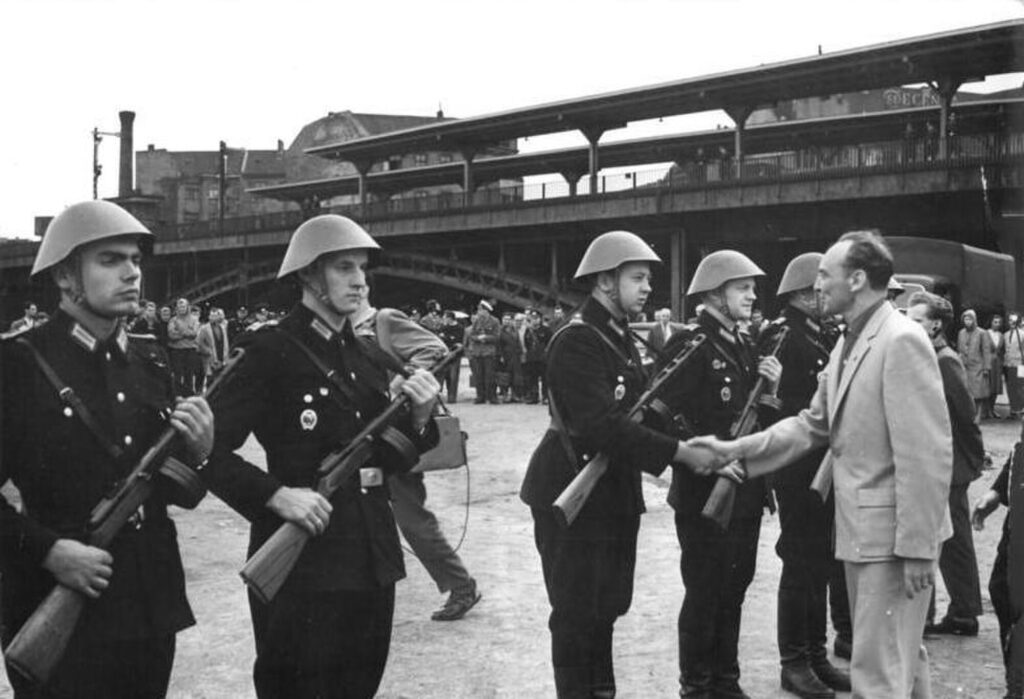
He paused and looked at me for a reply. But I had no answer. The only thing that I had done, was just visit the place.
“So,” he continued, “all the issues about freedom and dividing families, well those are just irrelevant. The Wall had to go up as it was all part of the rebuilding project?”
‘I really don’t know Hans,” I said. “Perhaps I need that beer after all.”
Although of course, we all knew.
It started to feel that this booklet wasn’t such a source of mirth after all.
I was curious to know if he had relatives over on the other side, separation from who fuelled his ire. I even contemplated coming back the following evening, before either of us had really got started on the drink, to see, what other insights he could provide.
But by then, I had gone west on a train heading to Hannover, back in the Federal Republic of Germany.
Griebnitzsee
En route to Hannover, the train had arrived close to the idyllic lake of Griebnitzsee in East Germany. The name sounded familiar and then I recalled Hertha’s parting shot advice (“Watch out for Griebnitzsee.”). Here, passengers were subjected to one last rigorous inspection by border guards, quite likely with Stasi officers in attendance. Rigorous was certainly the word, for being located close to Potsdam, a hub for Soviet and East German activities (and where the new post war map for Europe was drawn up), it still carried the weight of Cold War tension.
A number of escape attempts, across the lake had previously occurred. We could not view the lake or the station through our shutters, but the shore and railway station would have been heavily guarded, likely looked down on through watchtowers. This level of surveillance transferred itself onto the train.
The tense atmosphere seemed to be heightened by the near complete silence amongst passengers, which in itself felt intimidating. The lack of noise from the turned off engines contributed to this as did the continuous creaking of the train’s chassis. A guard and a man in plain clothes entered our compartment. They asked a fellow passenger a couple of pointed questions about his occupation, which seemed to unsettle him.
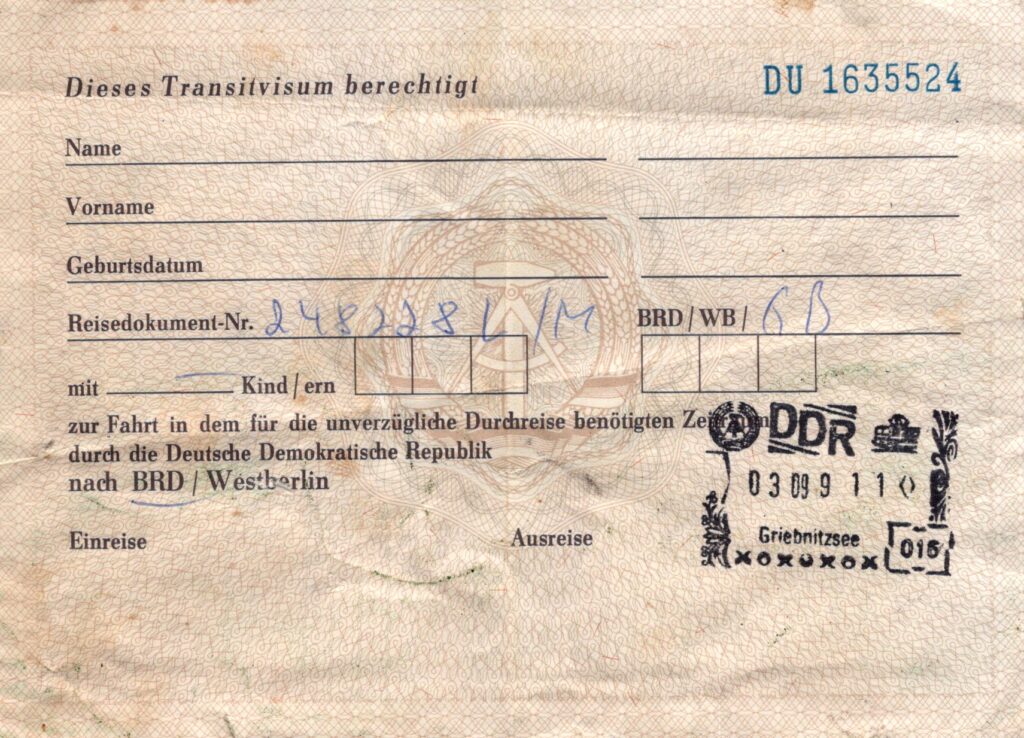
I kept my Len Deighton book well-hidden and received another transit visa to add to my collection.
Just one day later the first of those Monday demonstration meetings in Leipzig would occur, which in a matter of weeks would snowball into pushing half a million, over in Alexanderplatz.
As Marx had said, there was a historical Inevitability, although I am not sure he quite meant it in this way.
Next Chapter in Memoir – Back Home From The Wall
Previous Chapter in Memoir – Towards Berlin: The War and the Wall (1989)
(GDR 40th anniversary photo: Bundesarchiv, bild 183-1989-1007-402/Franke, Klaus/CC-By-SA)
(Leipzig rally photo: Bundesarchiv, Bild 183-1989-1106-024/CC by SA 3.0;)
(Securing state border photo: Bundesarchiv, Bild-18385607-0001 / Krisch, Werner/ CC by SA 3.0)
