A desk is a dangerous place from which to view the world.
John le Carré, The Honourable School Boy, 1977.
PART 6 – BACK HOME FROM THE WALL
A Very Local War
So, that’s my story, but of course it doesn’t quite end there.
The moment I crossed back into Britain, another border—far pettier, far more claustrophobic—was waiting for me.
I had come back in from the cold a few weeks ago now. True, I had slipped back into the old routine – the washing, vacuuming, bin out for collection. Work-buy-consume-die. Killing time before I headed off for last orders at the Hare and Hounds.
That was only part of it though, for the truth was I had come back home to a different cold war, which felt like a micro reflection of the one I had just left behind — the paranoia, the surveillance, the factions. Clearing off to Berlin was a way of cleansing my head of this.
I played a key role in establishing intelligence gathering frameworks about social work referrals within a large local authority in the English Midlands. There was a lot of friction between the managers of community social work teams and their hospital social work equivalents (Managed by Pete). It had its own cold war feel to it and I often found myself caught in the middle.
But at a Deputy Director level, holding this tension all together was Michelle Wallis (not her real name). Loathed by operational managers and staff for her ruthlessness, Michelle had a lot in common with Erich Honecker for the rod of iron with which she ruled. She was Director, in all but name and always wore tinted dark glasses, never removing them, maybe feeling that it added more mysterious power to her image.
Her office was twenty paces away from my own, and we would sometimes observe people who had been called in to see her about some misdemeanour. This included social work files of client stolen over night from a car, I recall on one occasion. They looked a bit troubled, these people, as they headed towards Michelle’s door, not sure if they would still be in employment when they left. A lot of employees prayed for her downfall, even if they had been guilty of said crimes in the first place.
It came my turn to visit Michelle, a few months before going behind the Wall, in the early spring of 1989.
I stared hard into those eyes, behind the heavily tinted lenses, wondering what really went off there. Just who was Michelle Wallis really? And would she let me out early without an almighty rollocking?
We rapidly established a common understanding of key solutions to the Department’s intelligence gathering cold war, not that I dared to reveal any dissent in the matter.
I walked back into the office. A couple of colleagues turned around.
“Well, we didn’t expect to see you again,” one said.
“Is she losing her touch?” asked the other.
“All very strange, “I admitted. “In fact, she was bordering on the placid. Deeply contemplative. Almost reasonable.”
But when I say, I had reached a common understanding with Michelle, it was more like us being clear where the organisational tensions lay, and the convening of a social work manager’s workshop to resolve the matter. Here she would tell them how things were meant to work, and how they jolly well would fucking work. World without end. Amen.
Not surprisingly following this, the environment then settled down against the background of an uneasy truce, with overtones of hatred still lingering in the air. It felt like an unsettling occurrence might be just around the corner, which could turn this semblance of detente on its head.
No one, though, could have foretold the form that this event would take.
News spreads like wildfire. It was mid-summer now and in what was to be a glorious day for quite a few social work managers, Michelle Wallis was arrested for attempting to steal expensive items of clothing from an upmarket high street store. Admission to hospital followed. There was much debate about the precise value of this bounty — maybe a Departmental lottery ran on the matter.
You may think that the vanquishment of Michelle had reinstated our cold war and certainly there were a few trainee despots running around trying to resurrect old tensions.
Against this volatile back drop, I cleared off to Berlin, for some therapy. Perhaps one cold war would nullify the other.
I certainly hadn’t expected to see Michelle again, and I nearly said this to her, the day I returned to work and we bumped into each other in the corridor.
But then again, I hadn’t reckoned with the tenacity of Pete, the manager in charge of hospital social work and in particular hospital based mental health services.
He wasted no time in ensuring that a matter of months after her thievery, Michelle was back in post, recovered from her breakdown and kleptomania and maintaining an iron grip once again. He had ingratiated himself most deeply with her. It was like Donald Trump finding his way back into office for a second term – unlikely but do-able.
And of course, for Pete, who was always made to feel inferior to and by his community-based counterparts, he really could no longer do any wrong in Michelle’s eyes. He was the social work manager who had come in from the cold and who now had parity at the high alter. It was like a scene from Machiavelli’s The Prince.
I got called in to the Senior Management Team not long after, about an unrelated matter. And there Pete was, sat next to Michelle. He was grinning across the table at his subdued counter parts. “Has the cat got your tongue?” he probably wanted to ask them.
A few months ago, there was little evidence to suggest the landscapes in Berlin and on my own work front would shift in such a dramatic manner, and that then, after a few months or decades of turbulence, a state of normality would return.
And that is a salient lesson for all of us who may be dealing with our own unwritten but very unsettling cold wars, often in circumstances where experienced despots just refuse to lie down.
The Great Fall
So, forward a couple of days. It’s Thursday 9th November, I am back from the pub after a couple of pints of Marston’s Pedigree. Maybe I even chatted down there about Berlin, and Michelle (her shopping adventure weren’t exactly a state secret, having been headline news in the local rag).
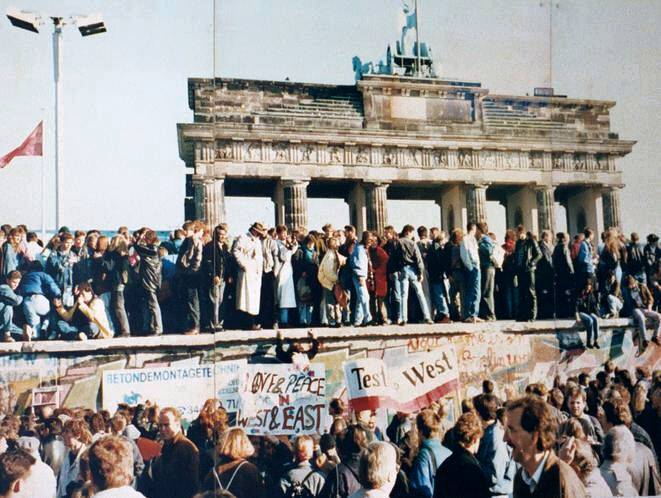
I am in bed, waiting to hear the news headlines at midnight on BBC Radio Four. And you know full well what was top of the bill. The week had been full of cold wars for me. But the fall of the Berlin Wall was a truly jaw dropping moment.
“Oh my God. Unbelievable!” I said.
“Couldn’t you have waited,” I probably admonished myself out loud, “Just for a matter of weeks. Why did you have to go over there so early you idiot?”
If the Hare and Hounds had still been open, I would have got dressed and headed down there again.
Well, I don’t think I got much sleep that night. I would have just been dozing, trying to communicate transcendentally with Hertha.
Are you there right at this moment Hertha? Of course, you bloody are! Are you sitting right on top of that fucking wall? I know you are! Don’t give me that shit about not liking crowds. You better write you know, you better god damn bloody write. Why didn’t you tell me this was going to happen? You did? Alexanderplatz? Four days ago? Half a million? Oh, fucking hell. Are you going over there tomorrow? But haven’t you got work? What do you mean, no-one is going in? Why don’t you visit the Altes Museum tomorrow? What, you are waiting in? Who the fuck for? Your sister? Where does she live? East Berlin? You haven’t seen her for how many years? Oh, my Lord, why didn’t you say? Didn’t have chance? You had five friggin’ hours on the train for God’s sake. Have you spoke to her? She doesn’t have a phone? So how do you know she’s coming? She might be waiting in for you instead. I want a card, right? Post it tomorrow. Just God damn bloody post it. Oh, my life!
So, was my transcendental rant in vain? Did I ever hear from Hertha again? A few weeks after the fall, I got the card. I am still looking for it. I hope it turns up soon, alongside a string of other Berlin memorabilia – I am unlikely to have thrown it away. It was of the Wall, and just said something along the lines of, “Hi Damian, Remember me? Very interesting times here in West and East Berlin Best wishes, Hertha x.”
I sensed that the card would arrive one day, with or without the fall of the Wall. In fact, I was relying on it, to keep my memories alive, and to allow me to put the whole thing to bed and look for other challenges. It was like I had finally finished unpacking. Unpacking my gear and unpacking my memories. Memories in particular of a stranger on a train.
In the meantime, how could we have naively assumed that the Cold War finished with the collapse of the Wall in 1989 and the Soviet Union in 1991. The threats are just as real, maybe not driven so much by ideology, but the East-West divide is still very much at the heart of it all.
But there isn’t so much evidence of the old order left in Berlin these days. They didn’t waste any time in removing the Checkpoint Charlie constructions I passed through, most of the Wall has gone and why couldn’t they have left just a couple of those Orwellian banners at the start of the East.
True, you couldn’t miss the TV Tower, and the Stasi HQ is a must, but most of the evidence is now held in people’s minds, their photos and what they have committed to paper. I certainly hope I have helped in that respect – even if it’s taken over thirty-five years, for crying out loud!
Epilogue
I left Berlin before the Wall came down. I had walked besides it, watched its guards, touched it and sensed its fragility. But the collapse itself—its televised drama, its euphoric chaos—I witnessed from afar, from the comfort of my own four walls.
The border I had studied so closely dissolved without me.
In the weeks that followed, I stockpiled newspapers, clipped headlines, and tried to make sense of what I’d seen and missed. But history was accelerating. Velvet revolutions gave way to bloodier reckonings. And just as Berlin’s bricks were being carted away, Romania lit up my screen with fire and fury.
Next Chapter in Memoir – A Revolution From The Sofa (Romania)
Damian Rainford, 2025
(References: Niccolo Machiavelli, The Prince)
(Feature image: Lear 21, English Wikipedia)
