
Delhi Travel Writing; Journey January 2000 –
Chaos at the Crossroads
Emerging from the Central Post Office in Old Delhi, I stepped out into the afternoon smog. In contrast to the wide boulevards and flowing traffic of New Delhi, this was a convoluted gridlock of taxis, auto rickshaws, cycle rickshaws, lorries, buses and bicycles.
Soot belched out of exhaust pipes and hung in the air with an acrid blanket-like effect. The other side of the road seemed like a distant mirage. This was the third time I had stood at this particular crossroads of the Indian capital in eight years.
The air quality had not improved. My eyes smarted and the wearing of anti-pollution masks amongst rickshaw drivers was now common place.
A few strides away from the post office at a crossroads, the Grand Trunk Road headed east, parallel with the railway line to Calcutta. A quarter of a mile south was one of Delhi’s principal landmarks, the Red Fort, where Mogul emperors once held court. The banks of the Yamun River were a couple of minute’s walk away on the Grand Trunk Road. Along these banks, during the twentieth century, the cremation of three heads of state, all murdered over a forty-year period, had taken place– Mahatma, Indira and Rajiv Gandhi.
From the Moguls to twentieth century India, such was Delhi’s turbulent history, it seemed that you never had to walk far to find evidence of tragedy across its ruling epochs. Beyond its more publicised sites though, this often required scratching around a little bit.
Lothian Road Cemetery – the dead
I crossed over to the opposite corner of this busy junction, where a tall perimeter wall hid a small settlement of sorts from the traffic and the outside world. Passing slowly through an entrance in the wall, I found myself in Lothian Road Cemetery– a nineteenth century Christian city of British dead. The wall provided the cemetery’s occupants and myself with a barrier against the cacophony on the other side.
Uniformity of design and layout had not been considerations in the design of this compact complex, which spanned some seventy-five square metres. The convoluted array of final resting-places did not have any natural order. Rather, they seemed to be strewn in random fashion at right angles or parallel with each, on low or high ground, or sometimes just tucked away behind a tree in the corner of the cemetery.
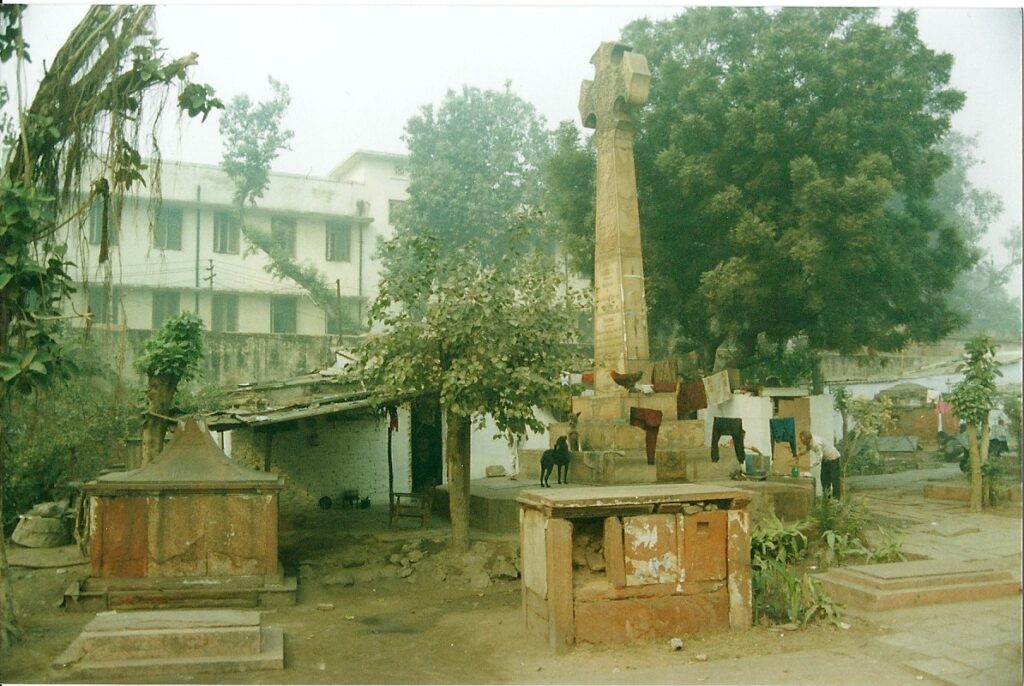
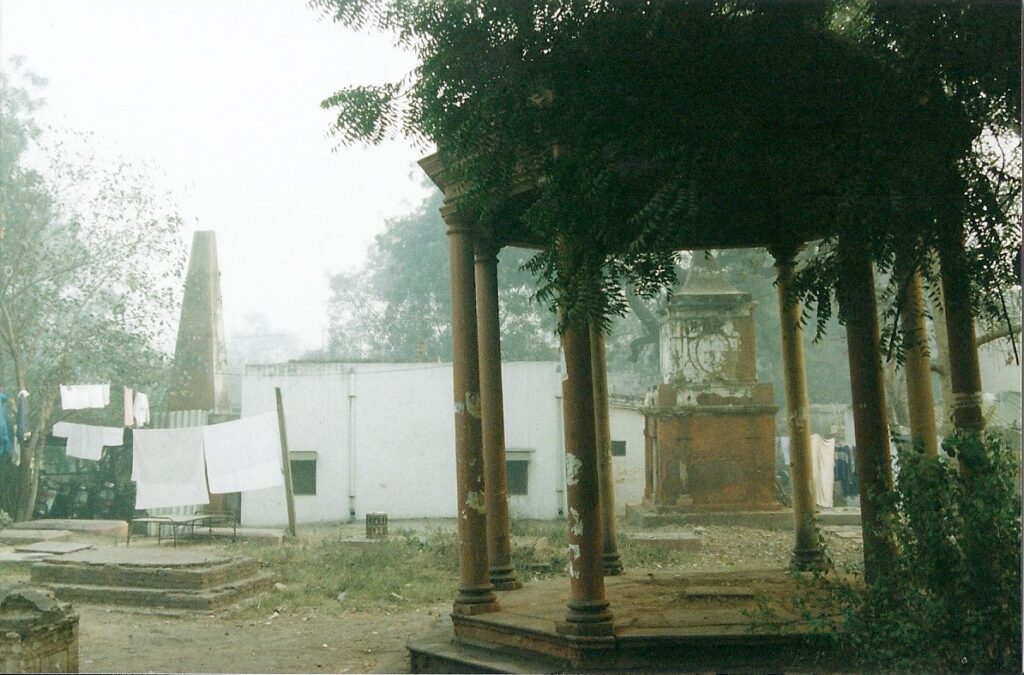
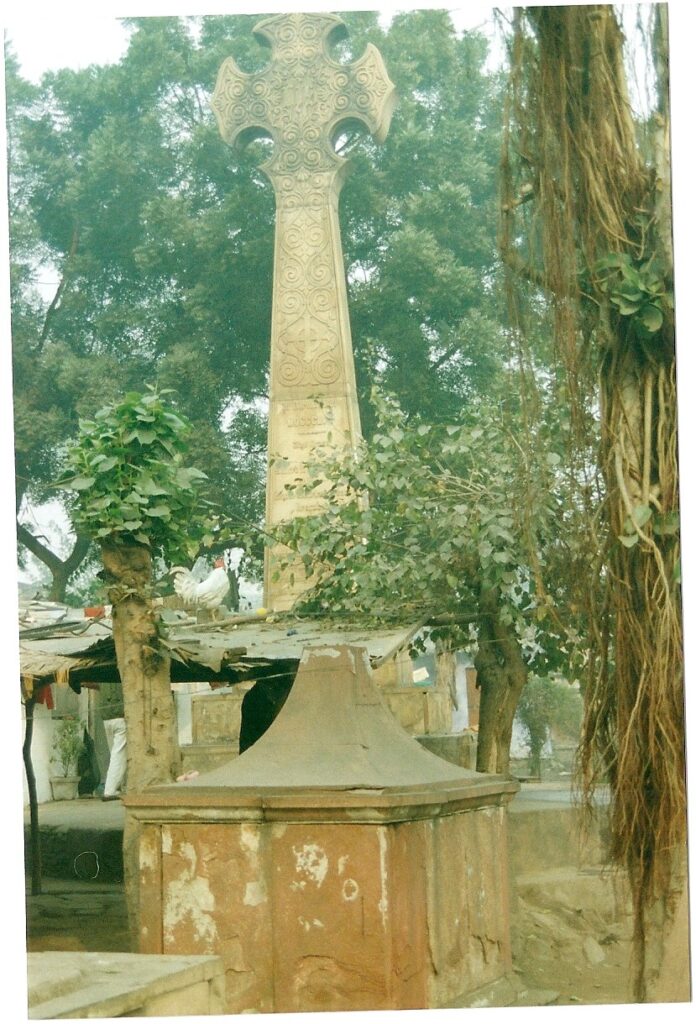
Equally as incoherent was the design of the marble or sandstone graves. One burial plot was in the form of a bandstand with eight stone colonnades; others resembled mausoleums; another grave had a lavishly carved twenty foot gothic cross erected on it; those that were long and flat may not have been quite so voluptuous, but certainly provided an abundance of space in which to wriggle around. The only consistent feature about this place was that all the graves aired on the side of the grandiose.
From the years I had lived in Bradford, West Yorkshire, I was familiar with the lavish Undercliffe Cemetery, burial ground of some of that city’s leading pioneers in the Victorian industrial revolution. It felt as though part of this had been transported to a much smaller plot of land, five-thousand miles away. Lothian Road’s dead had been pioneers of another sort though. They were all part of the machinery that held up the right to rule of Britannia’s East India Company.
These constructions had definitely seen better days. Most of the tombs were now cracked or flaking and on the drab side. Decades of pollution from the other side of the wall could not have helped.
A hardened layer of dirt obscured most of the cemetery’s epitaphs. At one grave I brushed away a layer of the dust with a firm application of my palm to reveal some basic details about its occupants, ‘In memory of Thomas Bates, Garrison Sergeant Major of Delhi died 25.6.1824 Aged 19 and Thomas Bates his son, died 25.11.29 aged 7 years.’
English cemeteries in the subcontinent from this period contained many a sad and gallant epitaph relating to untimely deaths, frequently through fatal disease. Maybe Mister Bates and son, and many of their dead neighbours had come to a bit of an sticky end, but at least they could be thankful that they were not in the land of the living some twenty-eight years later in this part of the capital. If they had, they would quite likely have been subject to the terror and impromptu massacres that were a fall out from the Indian Mutiny.
Terror around the Cemetery and the Indian Mutiny
At the point of the Mutiny, over 90 percent of the soldiers who upheld British Rule, under the umbrella of the East India Company, were native Indians, better known as Sepoys.
In 1857, the bullet for the new Enfield rifle required the end to be bitten off before being rammed down the muzzle of the gun. To aid this process the cartridge was heavily greased with animal fat. A rumour started and quickly spread amongst Hindu and Muslim Sepoys, that the grease was a mixture of cow and pig fat. Biting such a cartridge would amount to defiling their religions. In an effort to defuse the situation, the British tried to have the Sepoys make up their own grease from bee’s wax or vegetable oils, but a revolt had been simmering for a number of years and the seeds were now sewn.
The uprising of Sepoys against their English masters started in Barrackpore and, amongst other places, snowballed its way to Delhi. Officers loyal to the British forestalled the seizure of the Magazine, close to Lothian Road Cemetery, by blowing it up.
In the carnage which ensued, neither side flinched from the use of terror, all in the name of what each perceived to be a divine cause. Three thousand Delhi wallahs were tried and executed, often on the basis of suspect evidence. Frequently they were strapped to the mouths of cannons and then the touch paper lit.
In revenge, most of the Europeans in Delhi were murdered along with Indian Christians. Just down the road from the cemetery, bitter street fighting took place in the narrow streets and alleyways surrounding the Red Fort.
Back on Britannia’s home front, in the press every dead British child was portrayed as a slaughtered angel, every murdered woman a violated innocent whose death must be avenged, every Sepoy a blood thirsty savage. Those public figures that preached restraint, like Governor Lord Canning, or Clemency Canning as he was labeled, were pilloried.
As I wandered around this burial chamber, the honking from the other side of the perimeter wall sounded distant and muted. Not a bad spot to be laid to rest I thought. Even the smog that drifted over the wall was hardly a cause for concern for these old souls who had long since given up the need to breathe. It was hard to imagine that less than a century and a half ago, it would have been desperation stakes around this plot of land.
Lothian Road Cemetery and the living
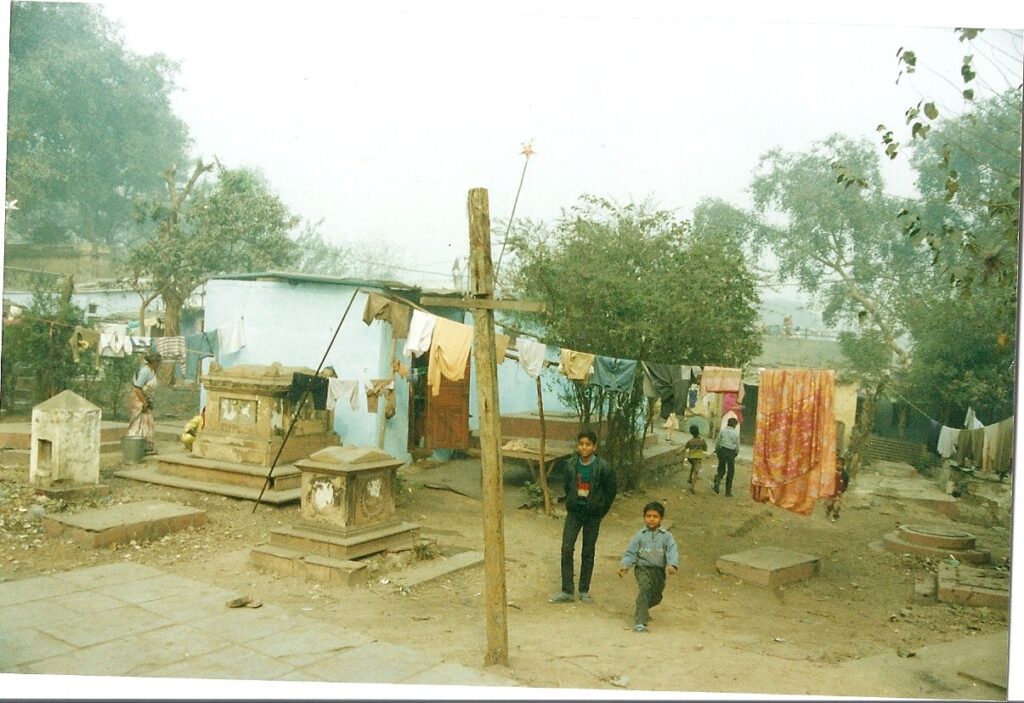
I was not the only living person walking around the cemetery. Juxtaposed with the tombs from all manner of angles was a meandering spread of single level houses, most of which were pegged back to just inside the perimeter wall. Some of these stretches of houses ran parallel with each other, forming enclosed streets with blue painted accommodation on both sides. Along the middle of several of these streets were large tombs, against which some of the living residents of the cemetery now leant.
In the small courtyard of one of these houses sat Mrs. Christy, chopping chillies. She placed down her knife and stood up. ‘Welcome to India in 2000’ she said, reading out the wording of the decoration which hung across her door.
I returned the greeting and asked, ‘How many people live in the cemetery?’
‘There are twenty-eight families and we are all related. Also we are all Christians’.
I sat down on a chair outside the entrance to her house and she disappeared to make a cup of tea.
Curious children appeared in drifts and leant against the tomb just in front of my chair. One pointed up to the sets of Christmas lights that were strewn between some of the houses. ‘Happy Christmas in India’ he said.
Mrs. Christy emerged from the house carrying a china cup of strong looking Indian tea, cutting through this cordon of twenty onlookers, she handed the brew to me.
‘Are these all your children?’ I asked her.
She blushed. ’No, only these five’ she said, leaning over and touching each of her offspring on the head.
Mrs. Christy’s mother in law had now appeared from the house. ‘So you are British’ she stated.
‘Can you tell from my complexion?’
‘No, the few foreigners who visit our village are usually descendents of people buried here – they come to pay respect to their relatives. Some come each year.’
‘Did you have a big celebration here at Christmas?’ I asked.
‘Yes, we ate lots of cake.’
‘Christmas Cake?’
‘Yes, I went to many different shops for all the ingredients from my favourite recipe. Then I went to a bakery and waited for several hours while they baked a cake for our village in their large oven.’
‘One cake for twenty-eight families?’
‘Yes, but like I said, they had a large oven.’
‘And one week later it has all gone?’
‘No, it has not all gone. I will go and bring you some.’
She disappeared and re-emerged with a hefty slice of sweet tasting bright emerald green cake – not the dark colour I had been expecting.
After a couple of mouthfuls, I put the plate down by my chair, picking it up for the occasional nibble.
A Christmas carol and blackmail
Mrs. Christy’s daughter stepped forward from the gathering of children. ‘ Please Uncle, can I have your autograph?’
I signed her exercise book.
One of the other youngsters asked ‘Please Uncle, sign me your sisters’ names’
I signed.
‘Uncle?’ asked one of Mrs. Christy’s sons, ’Please sign me your address and phone number.’
I signed.
“Uncle?’ asked another child ‘Please sign ……’
‘No!’ I shouted, eyeing this growing crowd of children, ‘No more signing ok? I just want to sit by myself for a few minutes.’
‘Ok Mister, said another girl, just your age then, just sign me your age. This is only two letters I think?’
‘No sign my age’ I said, making a stand.
A new face forced his way through to the front of this attentive circle, a diminutive but stocky youngster. He held a large cricket bat, which was nearly equal to his height.
‘Sir, no signing, no. But maybe just one game of cricket? We have a special cricket pitch in the middle of the cemetery.’
‘One game of cricket, one game of cricket’ The children started to chant.
‘No!’ I said ‘No signing, No cricket.’
The crowd went temporarily quiet and backed off. I opened a book of short stories about Delhi, which I had read from cover to cover before leaving England for India. Somewhere in these pages there were a couple of paragraphs which referred to the cemetery, but after fifteen minutes I gave up looking for them.
The crowd of youngsters had been whispering amongst themselves. They were, it seemed, in conspiratorial mood. Mrs. Christy’s daughter now stepped forward from the fray, leant over and murmured in my ear ‘Uncle, just sing us one Christmas carol, just one carol please?’
‘Hah, I don’t think so!’
She eyed the large slab of cake that still lay on my plate, into which I had only managed to make small in-roads. ‘You know, my grand mother would be quite offended if I were to tell her that you did not like her cake.’
‘So where did you hide yours’ I asked, but got no answer, just a smirk.
‘And so’ she continued ’if you sing us a carol, all of my friends will forget to tell grandmother that you do not like her cake.’
Delhi, India
An innings on the tomb
Iwent for a compromise – Anything but sing a Christmas carol and eating more of the lead like cake was not an option. ‘Ok, no carol, but maybe one game of cricket.’
‘Now?’
‘No, only if you leave me alone for twenty minutes.’
The deal was struck and the crowd sloped off to mark out the cricket pitch. I continued in vein to search my book for its fleeting reference to the cemetery. At the appointed time the children returned to escort me to the heart of the matter.
Walking towards the pitch I passed the twenty foot high gothic cross. Washing lines had now been attached to the left and right hand projectories of the cross and radiated off at a number of angles, attaching themselves to the roof tops of surrounding houses. I stooped under the dripping washing and arrived at my place of execution, the cricket pitch.
As I had just seen, the graves could be multi-functional and if the gothic cross could hold a multitude of washing lines, then there was no reason why the top of the long low-lying tomb in front of me could not be the site of the cemetery’s cricket pitch.
The stocky boy with the unwieldy cricket bat was waiting for me, and handed this heavy piece of wood over. I grasped the handle and stepped up a foot onto the tomb’s surface. He walked down to the other end of the tomb, from which he was to bowl, and eyed me up.
The broad two metre high cross at the head of the tomb was, I now realised, to be my wicket. During my twenty-minute rest period the crowd had chalked three stumps on the cross.
The final bit of preparation involved a strutting cockerel, which had strayed onto the pitch, quite literally being given the boot.
The stocky bowler looked down the length of the tomb at me and nodded, as though to say ‘Right, your number is up now mate’.
He started his run-up and twenty children broke into chants of ‘India, India.’ Some of the village elders were now looking on, bemused by this cameo.
Well I’m sorry, Colonel whatever your name is, I thought to myself, hope you don’t think I’m being too disrespectful walking all over your patch like this.
The least I could do under the circumstances was to make sure the ball did not strike his cross. At the end of it all, I am pleased to say that I was five overs – not out.
I gathered my belongings, shook hands with the vengeful bowler, said good bye to the Christys, waved to the other actors in this play and stepped back through the whole in the wall to the frenetic cross-roads.
As I got into a rickshaw, I felt another short story coming on.
(Header & feature image: Pixel Free Photos; All other photos are author’s)
Damian Rainford
December, 1999
Further information about the British in India: https://williamdalrymple.com/
Back to Home theancienthighway.com
©2021 The Ancient Highway
