
Journeys 1999 – 2023
Empired Out
At the end of 1999, just days before the start of the New Millennium, I was to return to India for a further stint of wanderings.
In the months before flying out, I consumed far too much literature on the history of British India. I made inroads into Lawrence James’s dense tome on the Making and Unmaking of the British Raj. I then switched over to Jan Morris’s jaunty Pax Britannica trilogy about the wider Empire, managing 1.5 books here, before picking up John Keay’s erudite piece The Honourable Company. But I think, by then, I was just Empired out.
Clive in a Box
My reading confirmed quite a bit of what I had previously absorbed in relation to Britain’s colonisation of foreign territories, particularly India and especially about Robert Clive. I was under no illusions just who Clive of India was and of his leading role in the subjugating and plundering of the subcontinent, under the auspices of the East India Company.
He just seemed so different to the man who had a whole glossy children’s book of mine, devoted to him. This was part of a box set about courageous people, and Brits in particular, who had made the world a much better place. Clive wasn’t the only suspect person included in this box set. However, the collection also included the likes of Florence Nightingale, Emmeline Pankhurst and Marie Curie. The beautiful and the damned, leant side by side within the box, all to be deeply revered.
Recalling the general tone of these children’s publications, before setting off for my latest foray into India, made me come over all colonial. I really couldn’t understand what those Guardian readers were complaining about. Yes, we stole the country’s freedom and plundered its resources, but we gave the natives their governmental and judicial institutions, and a rail network, not to mention doing our best with a Christian god. Boy had we civilised them!
But of course, it is no joking matter. All this ‘modernisation’ was implemented in a manner that enabled the new rulers to exploit and ship the wealth out of the country even faster; to use it as a bargaining counter in the dark side of triangular trade; and, to exacerbate a famine that killed millions of people. And that is just for starters. There really didn’t seem to be much to recommend it from any kind of moral perspective whatsoever.
Focusing on the Raj
And so, after all this reading, I arrived in the subcontinent, feeling a bit like a pariah-representative of a small nation state, five thousand miles away.
But my history lessons over the coming weeks, whilst in India, tended to focus on the 90-year era of direct rule by the UK Government – the British Raj, which superseded the East India Company, an epoch which was to last until independence. I was to revisit Robert Clive instead a matter of months later, when he reappeared in my life, in a way that I could not have envisaged.
The Delhi Durbars
During the course of the Raj, the British held three monumental pageantries – Durbars – on Delhi’s city edge, at the vast Coronation Park. These commemorated the crowning of three monarchs in London, with King George V attending his own Durbar in 1911 (Youtube video), accompanied by Queen Mary.
The 1911 Durbar was also used as an opportunity to make an emphatic statement that Delhi was now the new British capital of India. An obelisk was erected in the centre of the park which marked the event, and emphasised, through its inscription, the people’s subservience to the British state.
As if this wasn’t enough, once-upon-a-time, across the period that the Durbars were held, a series of sculptures and busts of monarchs, governors and officials of the British Raj were positioned across the capital, lest the population forgot who their rulers were.
The largest of these was a fifty-foot statue produced by Lutyens, of King George V. Such were the size and grand designs of these sculptures; they would not have looked out of place in ancient Rome.
However, whilst this was part of the city’s history, it wasn’t enough to make me want to go off in search of the Coronation Park. I had, though, packed William Dalrymple’s City of Djinns before leaving England. Its perusal now revealed a brief anecdote about the site of those Durbars that got my attention.
Off with the Shackles
Dalrymple highlighted how, a few years after independence, the city’s politicians finally realised that they didn’t have to keep staring at these large monuments as they went about their everyday business. Why, after all, would they want to carry on commemorating such an era, now that they had broken free from its shackles? And so, plans were set in place to have them all transported to the wasteland that had once been the Coronation Park. Here, they could remain out of site and forgotten about, except for those who might chose to head out of the city in search of this past, including people, like me, who possibly bordered on the obsessive.
Well, I had to see this. Just what kind of backdrop would I find there? Would there be small crowds of people who still had some affinity for the Raj? Or would the glorious statues just be covered in pigeon droppings, maybe with some of their heads bludgeoned off?
The Land That Time Forgot
I am looking back on this day now, nearly a quarter of a century later. Two things in particular have stuck in my mind. Firstly, it was the first afternoon of the New Millennium. Secondly, it took an inordinate two hours to travel by rickshaw from the chaos of Old Delhi’s Chandni Chowk district. My original glance at those pages in City of Djinns seemed to refer to the place being in the north of Old Delhi. But, as I now look again at the text, I can see that it was actually in “the far north of the northern most suburbs of Old Delhi”, and I guess that you couldn’t go much further north than that, without ending up in, well, a Himalayan foothill, probably.
The smudge marks across the couple of sides of text in Djinns, that relate to the park, and across Antonia Frazer’s sketch of King George’s statue, also serve as a reminder of the other rickshaw drivers we stopped to ask for directions, as we got to within a couple of miles of the place. They would leave stains on the pages, as they ran their fingers across the drawing and say words to the effect of, ‘Ah yes, very nice statue, but we don’t know where it is.’
It was starting to feel like the land that time forgot.
Eventually, we pulled up alongside a large overgrown expanse. The driver indicated that I should get out. I could see in the distance, through some shoulder length overgrowth and hanging branches, the outline of the statue of King George rising formidably up into the afternoon sky.
Present and Missing – An Art Audit
I cut my way through to the centre of the park. Arranged around Lutyen’s giant sculpture of the King, resting on an array of plinths, were busts of viceroys and other prominent contributors to the days of the Raj. Other plinths stood empty. Perhaps, at the turn of independence there had still been people of influence who wished to see particular statues kept in their neighbourhoods. Or perhaps, some of the busts made their way from atop of the plinths to fine-art auction houses in Europe. Certainly, if Lutyen’s hand was behind any of them, they would have been worth a fortune.
I had visions of this artwork being uncovered in a thousand year’s time, beneath metres of highway and historians not having a clue what the sculptures were really about. Just who were they meant to represent? Where had this distant civilisation come from?
I spent half an hour wandering around this isolated dumping ground for relics of the Raj, which might not have been a bad place for snakes to hang out. Here, it seemed the pieces had remained, all but completely forgotten about. They might just have well been smashed up. Indeed, I am sure if this was part of the former USSR at its breakup, this is exactly what would have happened. But, whilst the Raj in India had experience of brutally putting down rebellions, it wasn’t viewed as a totalitarian dictatorship; not in the sense of ruthlessly generating a leadership personality cult. Rather the viceroys, by and large, just got on with their exploitation and asset stripping.
A Fair Swap?
At one end of the great ceremonial boulevard that is Janpath, where the statue of King George V originally stood, a replacement was erected in 2022. Instead, there now stands a black granite sculpture of Subhash Chandra Bose, in paramilitary uniform. Bose, the Indian nationalist, who unlike Gandhi, could hardly have been described as a pacifist, and whose anti-British sentiments, led him to form war time allegiances with the Nazis and Japanese – one man’s terrorist, another man’s freedom fighter.
New Day, New Millennium
But was this the most exciting thing I could do on the first day of the New Millennium. The park’s tenor contrasted sharply with the marching, swaggering street bands of Delhi that I had recorded that morning. And wouldn’t a New Years Day splurge, with conversation, down the United Coffee House on Connaught Place have been more appealing? Instead, here I was stuck in some large shitty expanse, of my own volition, it must be said. But at least I was continuing to learn about the ironies of empire on this monumental day, and you can’t beat a bit of irony.
A Garden of Eden?
The atmosphere, compared to the chaos of Chandni Chowk, was tranquil. Any noise generated by the internal combustion engine seemed to be very distant. All I could hear was the squawking of crows and the gentle sound of water being sprayed by a hose pipe, that a woman was using to water the park’s lawns.
I had seen black and white pictures of the 1911 Durbar, and imagined the dense crowds at the Coronation Park would have made a fair bit of noise. Yet, this would have all felt quite natural compared to the traffic jams to which I was about to return, in the thick of Old Dehli, where the place was awash with exhaust pipes that blasted out acrid fumes.
A Times of India newspaper I had bought the day before, called for a return to a by-gone era, when Delhi was, pollution and traffic wise, like a Garden of Eden. … If only, I thought. Some serious time travel would have been needed for this to take place, transporting me to a period that at the very least predated those Durbars.
But then, as we entered the midst of this chaos, an apparition; a lone voice in this rat-race choir. We pulled level with another rickshaw; not the standard yellow model, but a new green one with shiny smart casing and not an exhaust pipe in sight, for this was an environmentally friendly, smokeless, battery powered model. On the vehicle’s side, a proud exclamation of its experimental status as a pilot vehicle in the City Authority’s conservation drive; an initiative to purify the stratosphere, although it felt more like a misplaced angel in hell.
Oh to return to a time of former glory, before the coming of the internal combustion engine, when this truly was an exotic land and the air through which the forts of the seven cities of Delhi could be viewed, would have been so much more transparent. Right there and then, given the right of the thousands of auto-rickshaw wallahs to maximise their exhaust emission, it seemed like a futile initiative. Moments later, with a tooting of the horn, we overtook and cut in front of this lone campaigner, immersing ourselves in a jam of soot belching rickshaws, which felt much more like the natural order of things.
Staying Safe
I clung on in my rickshaw as we navigated our way across Chandni Chowk, eventually arriving onto a flowing, but still precarious, boulevard that approached New Delhi. At regular intervals, there were advertising hoardings that hailed the coming week as Delhi’s Police Safety Week. ‘We want you safe’, the posters proclaimed. Although, like that columnist, who dreamed of a return to Eden, surely this was just a pipe dream. Also, why from my own point of view, couldn’t that very week be Safety Week, goddammit? Why should I have to wait until I was no longer in the country?
History in a Georgian House
I returned to old blighty in the early days of 2000. Completely unexpectedly, in the space of five months, I moved house across the English Midlands, putting roots down in the market town of Shrewsbury. I bought an 18th Century Georgian house in the town centre, in the shadow of the looming spire of Saint Aulkmund’s church, which dominated the skyline. The house was a Grade II listed building; A desirable bachelor’s pad, on four levels and physically attached to a pub.
A series of deeds to the house, including expansive indentures on thick parchment paper from 1739, were handed over, reminding me that history, from the Civil War onwards, was all around me, not just within this sturdy set of indentures, but a brief jaunt away from my front door. It was not all laudable history by any means, but nether-the-less, history that I wanted to follow up on.
In search of Clive
A short drive from my new abode, examples of Robert Clive’s lavish booty were on display at one of his former properties, Powys Castle, now managed by the National Trust – but that could wait.
More immediately, after three days of unpacking, I opened my front door, and without touching the pavement, swung my legs around, and entered the Loggerheads pub. Such proximity was to certainly get in the way of my writing over the coming years, but equally, I am sure there were occasions when the beer give it added focus.
I sat in the oak panelled snug with its uneven red quarry tiled floor. Until it became illegal at the start of 1976, this was a gentlemen’s only room. I started to dream of one day having my own serving hatch built into our shared wall.
I left the pub, with more 18th Century history in my sights, walked down the very narrow steep winding stretch, that is Grope Lane. This decanted me onto the start of the Old Market Square. Looking down on me, standing on a rather high plinth, was a well-polished statue, devoid of all pigeon mess, whose size made me feel rather insignificant. This important looking gentleman, you would think had earned his right to have occupied his place at the entrance to the square. He had after all bought his way into the highest civic positions in the town, being both its former Mayor and Member of Parliament. Well, hello Clive, I said and what brings a gangster like you to our Welsh Border town. In fact, how come you get treated with such reverence here – reverence being defined as merely being allowed to occupy this prime position; although in truth, for many people who walk past him, Clive is just the ‘Man on the Square’.
The Wealth of Clive
In the weeks before taking up residence in Shrewsbury, I was intrigued to find out that Robert Clive had rented pied-à-terre in the town, which could be added to his Castle in Powys, and to anything he owned down in the capital. Interestingly, it was open as a museum and constituted part of a stable of Shrewsbury visitor attractions managed by the local authority. But first, I had to find out where in the town it was.
I cut across the square, past Clive’s statue, and made my way to the tourist information office. I was after a leaflet about Clive’s House. But exactly what kind of slant would it take? At least the town wasn’t erasing the memory of Clive, pretending that he never existed. But, would the leaflet view him as a historic local celebrity, who had carried out his civic duties for the town admirably, and use the museum to showcase a remarkable life, or would his house act as a memorial to the excesses of colonialism that he had done so much to foster?
Clive had acquired a fortune with his ill-gotten gains – in the region of £120 M at today’s prices. He arrived in Shrewsbury and bought positions of high office. When he later stood before Parliament, answering questions about corruption, far from expressing any regret, he stated, ‘My Lords, I am astonished at my own moderation.’
A Moral Decision?
Unfortunately, at the visitor centre help desk, a lady informed me that the museum was currently closed.
“Oh,” I said, “Will it be open this afternoon?”
“Sorry,” she replied, “I don’t think you understand. I mean it is closed for good.”
When I asked about the reasons behind this, she couldn’t offer any further explanation. Perhaps, she wasn’t the best person to quiz about the matter, with it being more appropriate to address such queries to the town’s fathers. But I did start to suspect that the decision might have been a moral one, rather than anything to do with visitor numbers. Perhaps someone with a key influence behind the town’s governance, did have a basic grasp of colonial history after all.
Out of Sight and Out of Mind
Still determined to view Clive’s House, I arrived on the edge of the small enclave that is College Hill. I drank a pint of beer in the Benbow pub, to which I would return many times in the coming years. I enquired where exactly the museum was, but people feigned ignorance.
I left, climbing my way, but a few strides, towards the convent of Saint Winifred’s, but just before I drew level with it, I came upon a short, cobbled cul-de-sac, consisting of four houses. I walked past the first two, arriving at the start of the third. Alas, an ornate gate straddled the width of the street preventing any further progress. A plaque on the wall the other side of the gate though, informed me that this was indeed Clive’s house. Now the place did not allow visitors. But why? Intuition told me the reason, but I would still have liked confirmation. I started to orientate myself, for the short jaunt back to my house. And then it dawned on me, I didn’t just share the same town as the ghost of Clive, why, we were freekin’ neighbours of sorts. Ninety-seconds later, I was back home.
I walked past this gated street several times a week, either heading for the train station, or on my rambles around the town. However, a few months into my residence, I had become immune to Clive’s presence in Shrewsbury. With his house hidden behind that metal gate, he had become like those sculptures in Delhi’s Coronation Park, out of sight and out of mind.
Leaving Clive
Time rolled by and fifteen-years after moving into that meandering property near Clive’s House, the place was no longer suitable for my needs. Clearing off to India at short notice also became a thing of the past, now that my status had changed to loving husband with children to boot – although those noisy kids nearly drove me to it.
Moving a mile out of the historic town centre, to the other side of the River Severn, we sadly no longer had a pub attached, but still had views of the Shrewsbury skyline – including its spires, castle, Flaxmill Maltings and former prison. I drifted away from any focus on empire and similarly my travel writing drifted way under the bed.
Visiting Bristol – Further Lessons in Empire
But then at the end of 2019, just like the end of the last Millennium, I reached a landmark birthday. The family went on holiday to Bristol to celebrate – it was an unexplored place for all of us.
Our rental home was perched on high, looking down a steep bank onto the city’s Great Western Dockyard. It afforded a view of Isambard Kingdom Brunel’s SS Great Britain, with its hulk now functioning as a museum. The creation of this iron ship in the 1830s was a highly innovative piece of engineering and opened up the potential for more efficient transportation of raw materials across either side of the Atlantic. It had a clear connection with the days of Empire, although not in the same exploitative vein as the practices employed in British India.
On our first morning, I left the cottage with my wife. We ventured out, exploring the neighbourhoods of Clifton Hills and Clifton Village. We were heading for Brunel’s Clifton Suspension Bridge, a major sight in itself. But found ourselves pausing on the way to absorb the many grandiose merchant’s houses that the place seemed awash with.
There was a feeling of palatialness about the area, with these properties just oozing wealth. It was a beautiful one-hour ramble. Yet, we didn’t need PhDs in local history to connect this with the slave trade. We didn’t need to tap it into Google. We just knew; Immense beauty, at a price.

A short drive would have taken us to more deprived multi-ethnic parts of the city, where people lived whose distant forbearers had been oppressed by those very human beings, whose wealth funded the creation of the lavish houses of which we now stood in awe. Oh irony.
Edward Colston
The following day, bright and early on a crisp, clear Sunday morning, I left the family in bed and headed out to the Cabot Tower in Bristol’s Brandon Park. The top of the tower afforded a panoramic view of Bristol, for as far as I could see, its maritime landmarks, its affluent districts and those that were less so. It was an exhilarating experience and not every day that you turn sixty. I carried aimlessly on, eventually finding myself on the edge of Anchor Road. I stopped to take in an impressive statue of a man who was deemed to have contributed significantly to the 18th century development of Bristol, Edward Colston.
Its plaque left me with a warm feeling. It stated:
“Erected by citizens of Bristol as a memorial of one of the most virtuous and wise sons of their city AD 1895.”
Well quite right that this astute looking gentleman should have been honoured in this way. He must have done so much to raise living standards in the city.
I felt that I owed it to him to look into his life a bit more, and so tapped his name into my iPhone. It was a disconcerting moment. The plaque gave a jaundiced view of reality to say the least. If it had stopped to seriously consider for one moment Colston’s senior position in the East African Company, its responsibility for the transportation of half a million slaves and the deaths of many thousands of these, then the City authorities might have viewed his huge charitable donations to the city in a different light. After all, murder is murder.
And yet here he was, as bold as brass, a leader of men, who on the abolition of the slave trade, was still campaigning for its retention. Independent art exhibitions had helped raise awareness. However, the brief time I spent on Google, indicated that a local conflict was brewing on the matter. There were even long-standing governance groups on the issue, trying to identify a middle way. And yet, as I say, here he still was. It was as though by acquiescing, city politicians hoped that the status-quo would prevail.
We had a restaurant table booked for lunch and so shortly after, sauntered along the water’s edge, cutting through the mile long Christmas Market. On the way, we walked past the bottom end of Anchor Road. Everything about the ambiance that ran along the harbour side felt so good natured, steeped in tidings of comfort and joy. The junction with Anchor Road felt no different. We were just so happy on our special day. However, in this particular spot five-months later the atmosphere was to be extremely different. Some would describe it as menacing, others as triumphant.
Empire Revisited
We returned to our Shropshire home on Christmas Eve, looking forward to the rest of the festive season, and the start of a new decade. We couldn’t have anticipated the local challenges and world events that were just around the corner.
Barely into the New Year, but 500 yards away from our abode, the River Severn burst its banks. Daily life became a challenge – helicopters circled overhead identifying hotspots in need of help, schools were inaccessible, shopping malls and stores were flooded out, we clung on from our elevated position.
A matter of weeks later, a virus that originated in China, made its ugly way around the world and, as with many households, its outcomes posed huge challenges for our family.
Then, on May 26th, a black man, George Floyd, was murdered during the course of arrest in Minneapolis, by a police officer, Derek Chauvin. This led to worldwide revulsion, protests and the birth of the Black Lives Matter movement.
On the TV news, we watched, as an angry crowd swirled around Edward Colston’s statue and toppled it from its plinth. He was then rolled down the hill, down Anchor Road, and pushed into the river. The atmosphere contrasted sharply with the Yuletide one we had experienced in that very spot just five-months earlier.
A Defining Moment
It had taken two-hundred years, from the abolition of slavery, to get to this point. To many of those angry protesters, it must have felt that if it was left to the City Hall’s working parties, they could be waiting for another two-hundred. And then maybe the best they could hope for was a discrete information board that contextualised matters a bit, acknowledging that Colston’s methods might require a bit more research.
As that statue rolled down that hill, it seemed to be a defining moment, not just for Colston’s edifice, but for similar tributes that were to be found well beyond Bristol’s boundaries.
In Liverpool, for example, whilst so much has been done, via its Maritime Museum, to acknowledge the huge role the city played in the shipment of slaves, there are streets that are still named after leading lights of this enterprise, and we are talking more than a couple here.
And then of course, there was Robert Clive’s statue in the heart of Shrewsbury. With the wave of national revulsion, surely, this now had a limited life span. Although perhaps I shouldn’t have been surprised that his presence on the Old Market Square was to continue relatively unchallenged. Yes, there was a petition, but the town after all didn’t have thousands of residents whose predecessors had been exploited and abused by Clive’s actions. Awareness raising of the impact of Empire just doesn’t feature writ large in most people’s existence.
Back to Clive’s House
Then 2023 arrived. I had walked past Clive’s house hundreds of times in recent years without given it a second thought. But as I approached it one sunny Sunday May afternoon, I turned into his cobbled side road and paused at the iron gates. As I looked through them, I could see that the plaque was still in place against the brick work. I took a couple of pictures.
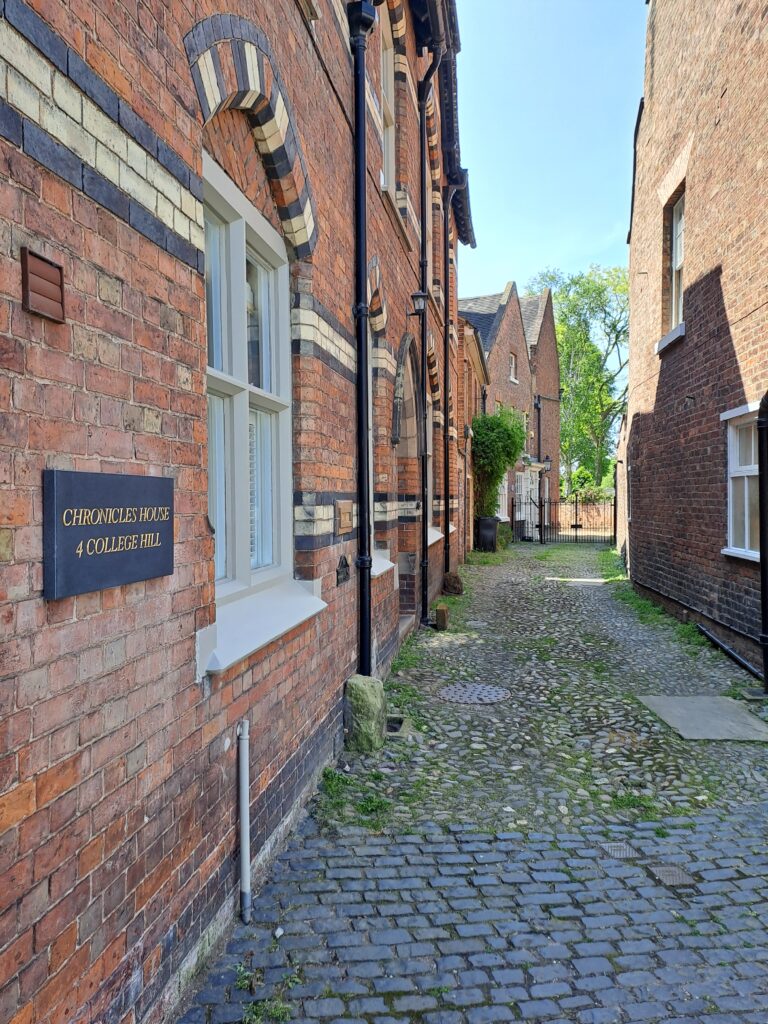
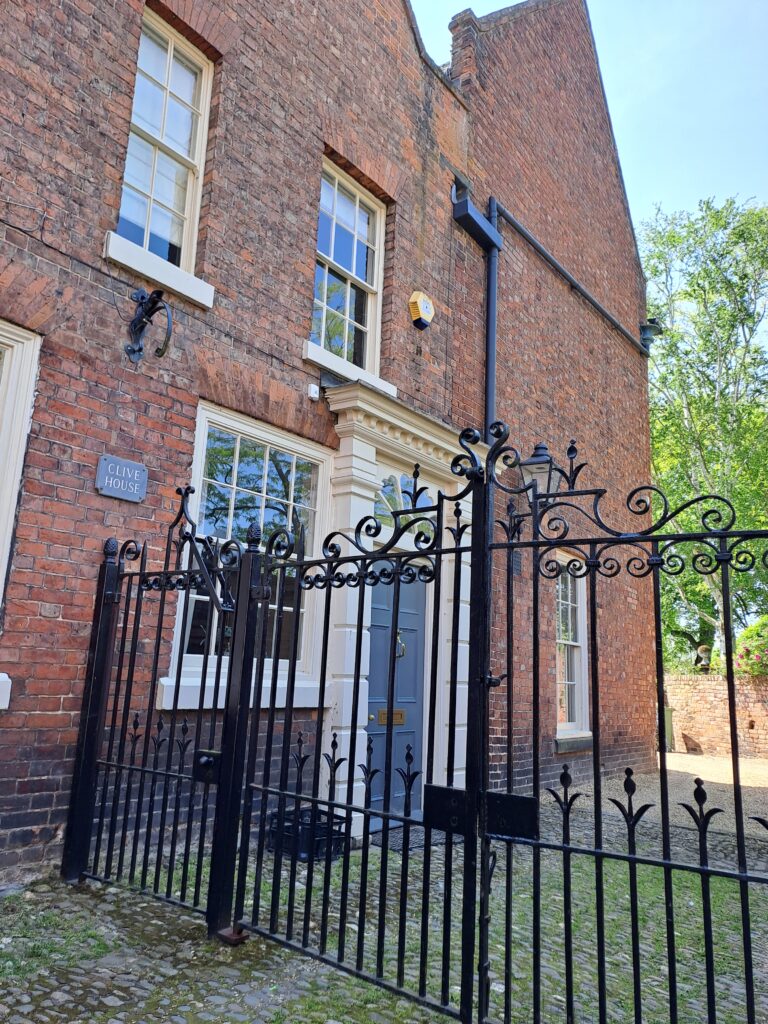
I continued on down the road to the Market Square and arrived at his pristine graffiti-less statue. His sculpture was only erected a hundred years after his possible death by suicide in 1774. However, this delay was less to do with not wishing to be seen to be associated with Clive’s excesses, and much more to do with the stigma of suicide.
Around the other side of Clive’s statue was a newly erected information board, which finally gave some context about the man on the plinth, stating, less anyone was in doubt, that he was a controversial figure.

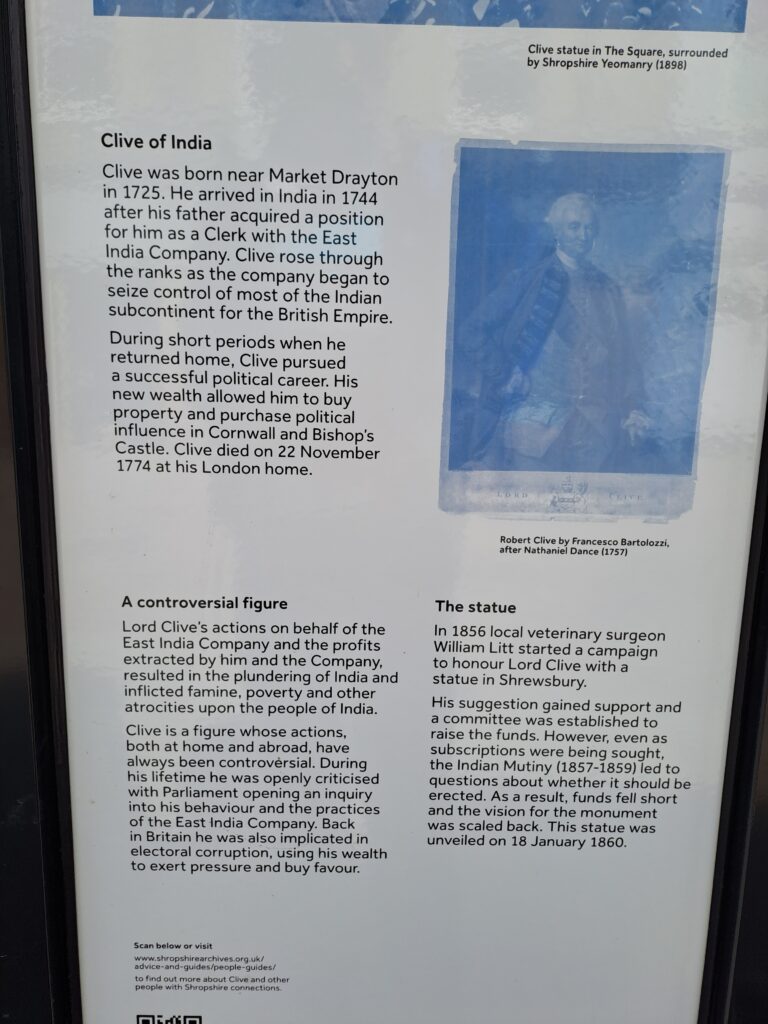
But for the toppling of Edward Colston, the board may never have appeared. Perhaps it was deemed to be prudent to come up with something, lest Clive’s statue was suddenly removed by an angry mob, rolled down the Wyle Cop, and pushed into the River Severn – Although, there was a three-year gap between the two events.
For those towns or cities that have clear connections with the horrible and wealthy side of Empire, they name streets, in others they erect statues. Hundreds of years on, undoing this then becomes an ethical dilemma; after all, don’t they serve as essential reminders to our past, good or bad?
Yet, in post-war Germany, they didn’t seem to keep many statues of Adolf Hitler, to help raise awareness amongst the population of his murderous deeds. Similarly, there were no prolonged debates about whether streets should be renamed, and monuments removed when evidence of the late entertainment icon Jimmy Savile’s prolific sex abuse emerged- it just happened, more or less overnight. Where there is a will …….
But to finish our story, we leave that statue, on Shrewsbury Market Square, travelling for half an hour down country lanes, until we reach the small Shropshire hamlet of Moreton Say, just by Market Drayton. It is here that Robert Clive was born. In the 12th century church of Saint Margaret of Antioch, he was also baptised. Finally, in 1775, here he was laid to rest, in an unmarked location, reputedly within the church walls. Unlike his statue, though, he wasn’t left with a high-profile tribute, which was certainly more to do with alleged suicide, than misdemeanours committed.
Instead, our low-key outing ends, as by the church entrance, displayed inconspicuously is a small plaque that reads:
‘“Robert Lord Clive, 1725-1774, founder of the British Empire in India, baptised and buried in this church.”
Fittingly it was a past remembered in a minimalist manner, not glorified, for in death we are all equal.
Damian Rainford, 2023
Further reading and Listening
William Dalrymple, The Anarchy (2021)
Black British Lives Matter (Lenny Henry and Marcus Ryder podcast)
Featured image: CottonBro Studio (Pexels.com)
