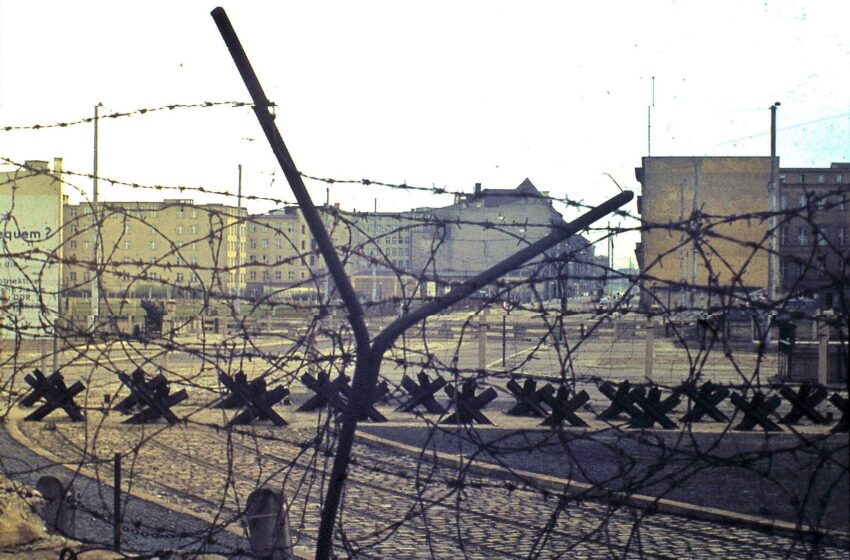
Prologue
It was by now the late summer of 1989, I stepped into a city that was still divided, but already beginning to unravel. Berlin was a paradox—half stage set, half surveillance state. The Wall loomed, not just as concrete, but as a metaphor for ideology. I didn’t come to witness history—I came to escape my own cold war, the one playing out in office corridors and quiet frustrations back home. But what I found was something stranger, a city on the cusp of collapse, where even the most mundane encounters felt charged with meaning. Weeks later, the Wall would fall. But in those final days, it still held—just barely—and I was to stand in its presence.
PART 1 – TOWARDS BERLIN: THE WAR AND THE WALL
Raising the Wall
The people in Washington were too bloody frightened, Werner. The stupid bastards at the top thought the Russkies were going to move this way and take over the Western Sector of the city. They were relieved to see a wall going up.
Not my words, but those of Bernard Samson, Len Deighton’s protagonist spy in his masterpiece Berlin Game (1983).
The three sentences stopped me in my tracks, when I first read them in the late eighties. It seemed to provide a startling, jarring, alternative perspective on the history of the Berlin Wall, not least how it was ever allowed to go up. It seemed to be saying, “Well we don’t care if those stupid Ivans build a monstrous wall, as long as it helps keep them incarcerated behind it, and away from West Berlin.” If such a scenario had more than a grain of truth to it, then just who really carried the responsibility for raising the stakes in Berlin in this manner? Surely, we all did. All sides pursuing an agenda, where a wall would help look after a range of vested interests.
It suddenly felt Machiavellian — the ease with which the Wall went up and stayed up. Possibly, the notion was pure fantasy. But the quote was a contributing catalyst to me walking out from my Leicestershire village late one summer’s morning in 1989 on a journey that would ultimately take me across Berlin’s divisive construction, and into the German Democratic Republic (GDR).
I had always been drawn to the fault lines of twentieth-century Europe. My father, by the 1970s, was well versed in international travel, including Eastern Europe; my mother had an encyclopaedic interest in Cold War politics, fuelled by espionage dramas and spy scandals. Those influences coalesced early. By my late teens, I had devoured classic spy novels, not always understanding how the pieces fitted together, but sensing there was something essential there — something about power, secrecy, and ordinary lives caught in between.
And yet, the Cold War did not simply switch on in 1945. It had deeper roots — in the Russian Revolution, in fear, in intelligence services learning to see enemies everywhere. The Second World War was not an ending but an interlude, shaping what followed. That continuity would become increasingly apparent as I moved through places still bearing the scars of both conflicts.
I had written about this journey before, or tried to. Drafts existed, then disappeared to the bottom of bags and drawers, overtaken by the mechanics of life. It is only decades later — searching through photographs and memorabilia — that the material finally found its way back to the surface. Some journeys, I have learned, only make sense when time has done its work.
So, it was the end of August 1989. I had my passport, a one-way flight ticket and just enough foreign currency to get started. I didn’t have access to any smart phones or electronic planning devices, having to rely instead on my own intuition and paper maps to get me through an uncertain couple of weeks.
I closed the front door behind me, locked it, put on my Second World War and Cold War lenses, and headed in the general direction of West Germany. This wasn’t an academic exercise, but an attempt to experience history as something still unfinished.
The Victims and the Vanquished
Amsterdam was my gateway.
People have long memories of history, especially when they are the victims. Many years later it is not surprising that it is still part of a national psyche.
I paid for a coach tour of the city. Our tour guide was a dapper dressed man, in a long flowing black coat and top hat. He talked through the coach’s public address system in a most sophisticated manner, about the major exhibits that we were about to see at the Rijksmuseum. But it wasn’t his animated description of Rembrandt’s the Night Watch or Van Gogh’s Self Portrait, before we had even arrived there, that stuck in my mind. It was a single throw away comment.
“Of course,” he said, “Amsterdam is very busy now. But summer has nearly finished. It won’t start to get so frantic again until April. You see this is when all our German visitors arrive. Lots of them. We call this the second invasion.”
Some laughter followed. But I cringed and wanted to slide down my seat. After all, there was a chance we had Germans on board, although I am sure it would have made the guide de even happier. Perhaps, I was even sat next to one.
In ten seconds, he had side stepped from intellectual pursuit to prejudice. It got me thinking about my planned journey tomorrow, across the border to West Germany. Just how would the war be remembered there? Was it really just as simple as moving from victims to vanquished? Didn’t the vanquished have victims as well?
Operation Gomorrah
After an afternoon in Bremen, I arrived at the frenetic hub that is Hamburg’s Hauptbahnhof station. I admired its array of platforms, and magnificent internal and external modernist architecture, much of it faithfully restored since the war. Its transportation links to Scandinavia contributed to it having one of the highest passenger flows in the country.
Hamburg was a member of the Hanseatic league and had a centuries long trading and commerce connections with the UK, helped in no small part by its rich multicultural history.
Its history of diversity could not hold all that was to come though. The city’s ruthless pursuit of the Nazi agenda, and the war of attrition that was subsequently played out here contrasted sharply with the long trading relationships between Britain and Hamburg.
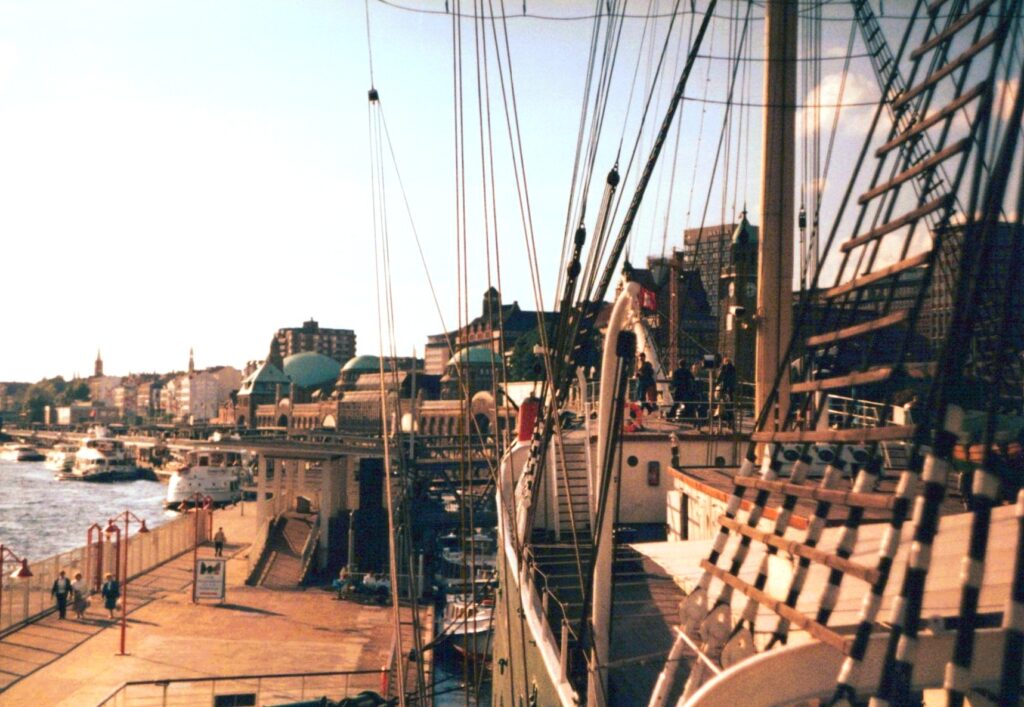
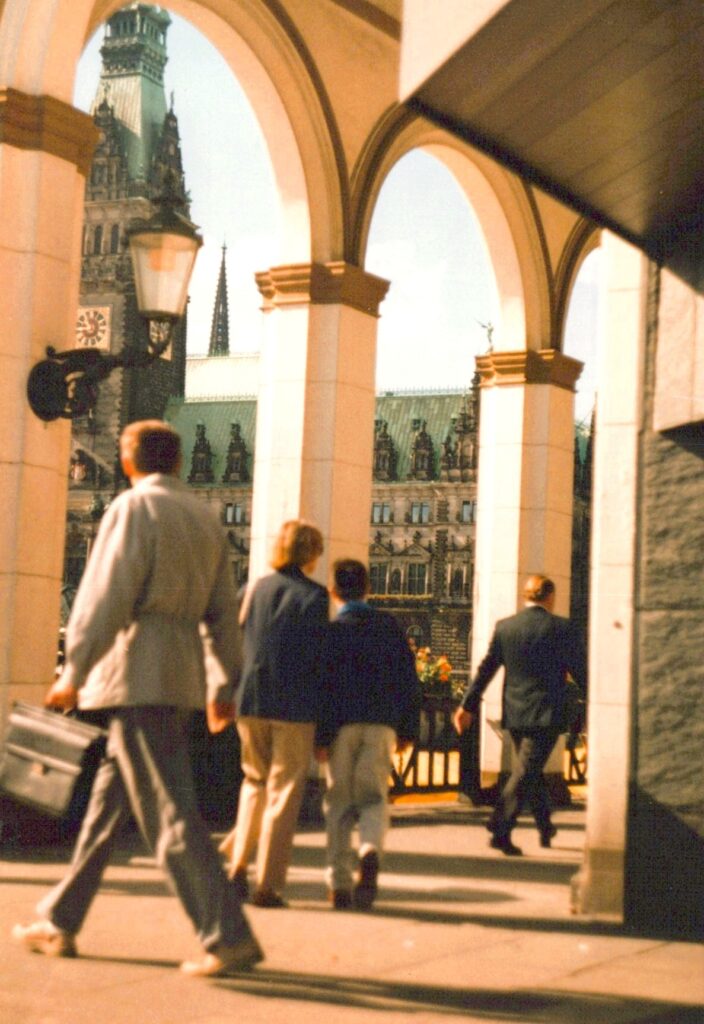
(Author’s pics, 1989)
From wandering around the city, I didn’t get the feeling it was a magnet for English visitors anymore. Apart from the Beatles and footballer Kevin Keegan hitting it off here in their early days, and us doing a spot of damage to the place in the 1940s, there didn’t seem to be that much that connected us.
But then I remembered my father’s tales of his travels to these places, whilst he was on business. I particularly recalled his reference to Bremen and Hamburg having really got it in the war, or words to that effect. Although, at the time, this didn’t really seem to single it out from most other German cities.
However, it was only weeks later, back in the UK, that I realised that, got it was quite an understatement. I watched a documentary, with colourised footage, about Operation Gomorrah’s Anglo-American carpet bombing of Hamburg, in July 1943. The attacks continued through to the remaining weeks of the war in Europe. The dry windy weather, the city’s wooden buildings, and the intensity of the bombing over several nights turned the city into a giant fireball.
The fatalities from this obliteration were huge. Viewed as an enormous success by Bomber Command, it is only in more recent decades that the morality of such operations has been seriously questioned, especially with the targeting of the city continuing, even as the war against the Nazis had entered its death throes stage.
I was staying at the Youth Hostel. I recall vividly, the very cold greeting I received from the receptionist, after his scrutiny of my passport and booking form, and my temerity to ask a couple of new arrival type questions. He was so brusque and unhelpful, and somewhere quite to the right of any stereotype of Germanic formalness. What the fuck, I thought, did I just say to upset him?
This was a small incident that stayed with me. However, it is only in more recent years, that I have speculated if it had anything to do with the levelling of this metropolis half a century previous.
The devastation wrought seemed like it was only a step below nuclear fallout. And if it was connected to this, I would hardly have blamed the receptionist for venting his spleen. If he had roots in Hamburg, there were chances that he had relatives from a couple of generations previous, whose bodies were pulled out of collapsed cellars or who were among the many who were fished out of the Eilbek canal after they had jumped in to cool down the phosphorous wounds that consumed their bodies.
I could be wrong, but ….
Lübeck – A False Utopia?
From Hamburg, I headed out for fifty miles in a north easterly direction to the city of Lübeck, a UNESCO World Heritage site that overflowed with medieval charm. The river Trave and the canals that flowed through its centre brought a sense of calmness around the wealth of cafes that majored in marzipan pastries.
Lübeck marked a turning point for Bomber Command in 1942, one of the first raids carried out under the new directive permitting the targeting of built-up civilian areas. It was chosen as much for its cultural vulnerability—its medieval timbered core—as for its modest shipbuilding industry.
The fatalities were a tiny fraction of those later endured by Hamburg, but the damage was immense: the old city burned, churches collapsed, and centuries of history were lost in a single night. It was a warning of what was to come for Germany’s cities. And yet, standing here now, it is hard to grasp how a place so grievously scarred could ever have risen again.
As I moved from cafe to cafe, I certainly wasn’t thinking about the nasty Nazis or Cold War history. My mind was adrift as I mingled with throngs of students, families and retirees, joining them in their contentment, whilst they basked in what felt like a utopian existence.
I sat on a boat, as it navigated its ways around Lübeck’s waterways. With a crisp breeze blowing on my face, I asked my neighbours opposite where they were from. “Why, Lübeck of course,” the lady replied,” We are always cruising on our waters. It just reminds us of how lucky we are.”
Adjacent to me were a group of students from the city’s university. I asked them, if they were also always travelling on the boat. “We wish.” they said. “How great that would be.”
I meant to enquire what they were studying. I assumed afterwards that this involved BAs in ‘Happiness’, or something that suited the town perfectly.
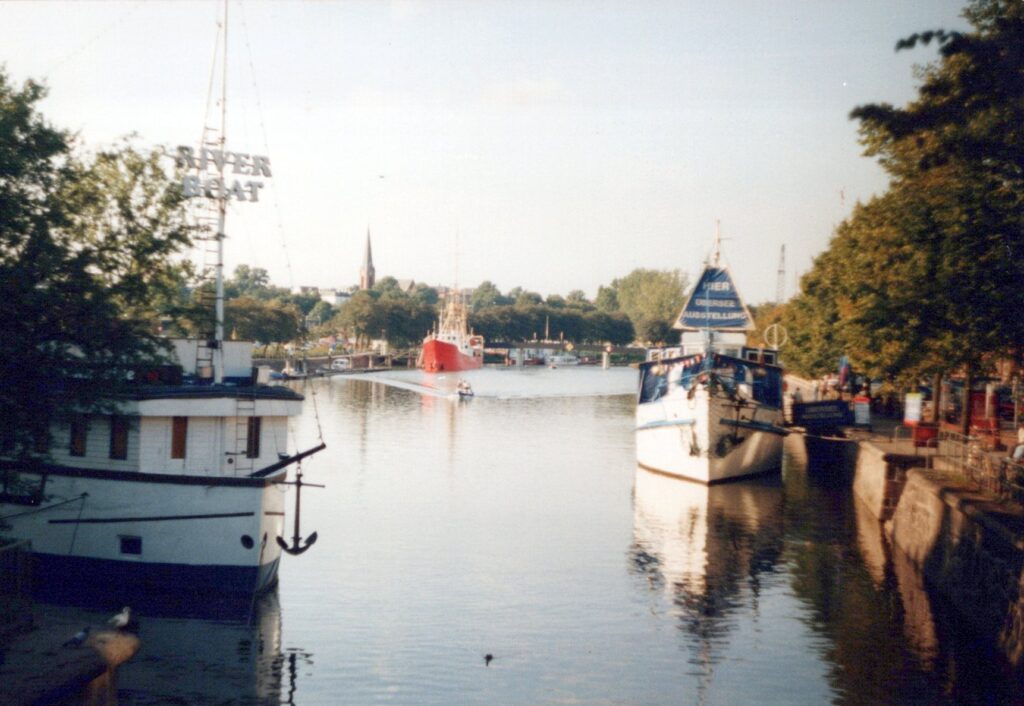
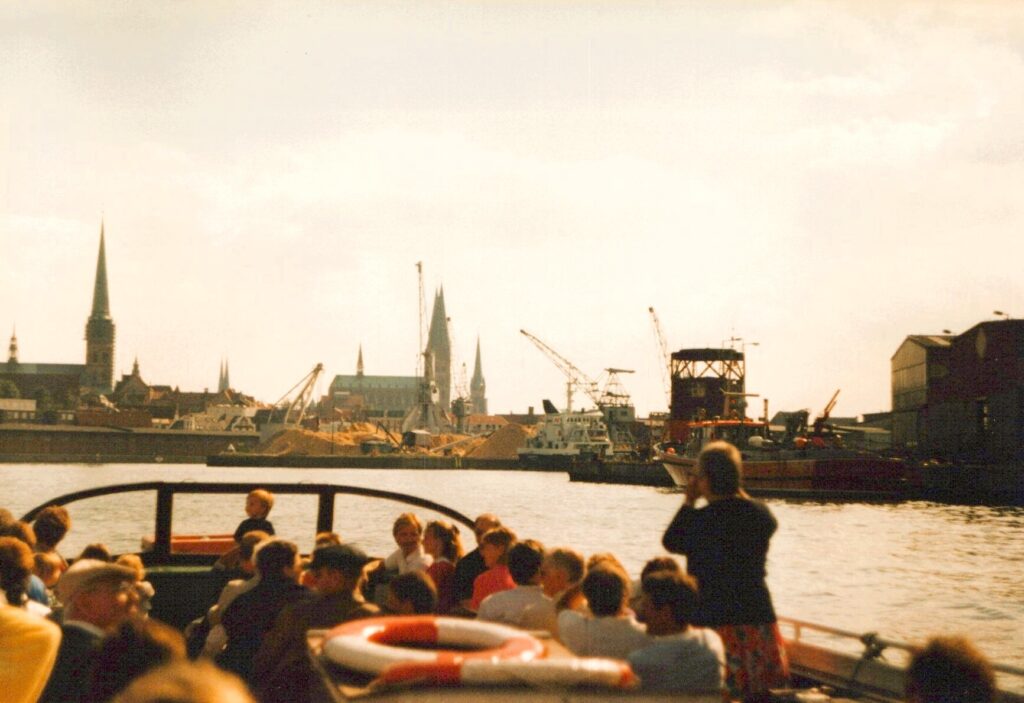
(Lubeck, 1989, Author’s pics)
Indeed, there are places I have visited that should be twinned with each other, so they can provide mutual self-support over their shared tragic pasts or others for their perfect existence. Lübeck felt like it had both. Certainly, its residents would never want to diverge away from the status quo. God had rebuilt the place in his own image, just like it had ever been, and that was how it was going to stay.
Yet, surely underneath all this calmness, to the politically aware, there must have been a continuous sense of unease. It was after all, just six miles to the heavily guarded GDR border point of Schlutup, which sat in a wooded area and was not short on escape attempts, into West Germany or Denmark, or on the infiltration of Stasi Spies. Espionage hubs weren’t just the preserve of Berlin.
And, as I sat there, watching life go by, with my latte and marzipan pastry, just who were the two men with sunglasses on the neighbouring table looking out for?
Still, I kept dreaming. After all, my time was running out in this surreal existence, I would soon be forced to confront all the officialdom of a neighbouring dictatorship.
The Reeperbahn – In search of Smiley
I returned to Hamburg. But, if you had mentioned the place to me in the weeks before I’d set off, it wouldn’t have been bombings or the Beatles that sprang to mind, but the principled, unassuming, bespectacled George Smiley, on location and on an illicit rendezvous in a Hamburg brothel. Here he blended in perfectly, in an amber glow, in a twilight world, where he was trying to make sense of incriminating Soviet honey trap photos of his would-be Jo, the hapless Otto Leipzig.
Also vivid were my recollections of reading this chapter of John le Carré’s Smiley’s People, as the sole occupant of a dimly lit railway cabin as it crossed the Pennines on a winter’s night in 1984. He had entered my head in another era, long before I set off on my current journey.
So, I went looking for him, amongst the frenetic night life of the Reeperbahn on a Friday night. A blaze of neon lighting, sex shops, bars and, of course, brothels. Crowds of people ducked in and out of this range of establishments. There was no shortage of individuals seemingly just looking, just window shopping.
In the middle of this labyrinth of nocturnal outlets was an open fronted brothel, a modernised affair. Its doors and sides were completely transparent and provided a clear view into the giant hanger behind them.
I peered in at a throng of very scantily clad ladies. They mixed with visitors to the establishment, who were clasping drinks. Included in this gathering, I have to say, were those two would-be spies from Lübeck, possibly on a night out from the GDR.
There seemed to be much stroking of arms and attempted enticement. It was like one big adult party, all very much spot lit and on public display.
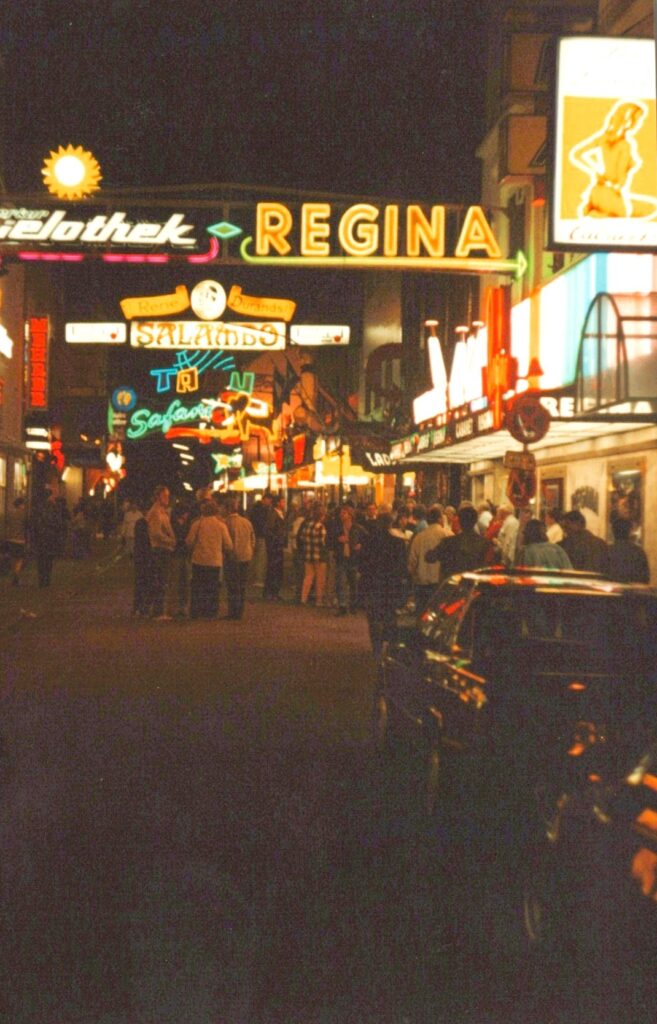
What would George have made of it? Maybe this was the place he visited, although I doubted it. Far too outrageous for him. There was nothing discreet about it. Not the quite the same as trying to navigate one’s way through a myriad of darkened rooms, with a password to hand. If he had tried it on here instead, the girls would have descended on him in public view, removed his glasses, stroked his cheek, or worse, and brought him out in a cold sweat. These were my thoughts. Then I realised I was mixing George up with myself. A couple of girls then started to open the door for me. One grabbed my wrists. I didn’t want to have to say, “Oh, just looking.” Especially for them to then accuse me of being shy. I could, l suppose, have asked them if they knew George, but I moved on to a musty smelling bar a few doors down.
There now, I should be safe here, I thought. The bar tender directed me over to an empty table. I was quite looking forward to ordering a beer just for myself, but he brought an older lady over, old enough certainly to be my mother. She sat down.
“Zwei bier?” he asked.
It wasn’t so much having to play out the role of toy boy that troubled me, more the expectation of forking out for two drinks.
I got up and left. After all I had a train to catch in a matter of hours, a journey into the unknown.
Although, if I were to go back now to the same bar, in my mid-sixties, and the place had remained frozen in time since I had upped and left, how would it have felt? I am sure my prospective companion would have taken on a spring chicken appearance. I might even have looked at her through starry eyes, before still refusing to buy her a drink.
PART 2 – TOWARDS BERLIN: STRANGERS ON A TRAIN
Berlin Bound
At Hamburg station, I took up my seat as sole occupant of a railway cabin, bound for Berlin. The collapse of its infamous Wall was just weeks away. It started to feel like it would be an eerie, secluded, uncomfortable ride. I was still uncertain what would lay ahead once we entered the Warsaw Pact Zone, at which point the train would pull to a sudden halt. No one to give me any kind of insight, no one to hold my hand, if the ride and the accompanying officialdom just got too intimidating.
Thirty-minutes into the five hour journey the train arrived in Lüneburg, a medieval, university town that had escaped any bombing in the war. This was to be the last railway stop before the train crossed over into Iron Curtain territory.
My travels were littered with fleeting, chance acquaintances that had only lasted for an hour or so but yielded a host of anecdotes. Sometimes, contact with these acquaintances would be maintained well into the future. Occasionally, as was to prove the case right now, I would find myself in the company of a passenger for much longer.
Hertha opened the cabin door and asked was it alright if she joined me. She was in her mid-forties. She told me that she was originally from Hamburg and had been visiting family members there, as well as friends in Luneburg. She was now travelling back home to West Berlin, where she worked as a social worker.
“Who are the family members you have been visiting?” I asked. “Does this include your parents?”
“Just my father,” she said. “My mother died when I was a baby.”
It seemed quite a frank thing to say.
Then I started to do some mental arithmetic. Well, quite possibly she could have been a toddler during the raising of Hamburg in World War Two and her mother had died in that hellfire. This was pure speculation, but at the same time there was a significant possibility. I didn’t really want to get into the war though. Quite ironic, seeing as this was one of the interests that had brought me here.
“Oh, I am sorry,” I said. We both sighed and continued to stare out of the window in contemplative mood. My thinking about the pending unpleasantness of crossing into East Germany. Maybe her, about the sad loss of her mother, that had occurred all those decades ago, and that might remain as an oppressed memory.
I didn’t exactly have a barrage of further queries for her but was sure there were some enlightening insights she could provide about my journey so far and all that was to come.
Yet, there were occasions, when I would ask her a question and she would just gaze at me. I didn’t know if she was pondering the matter or had sunk deep into another world and was oblivious to my utterances.
Her demeanour was becoming more standoffish. Was I picking up anti-men vibes? Some of her responses gave off a quietly left-leaning, feminist aura. Well, I saw that as a plus — infinitely preferable to sharing space with anyone too one-dimensional. Or was I just layering her with my own assumptions? Perhaps she was simply introverted, someone who didn’t engage easily with strangers.
Still, I found myself sneaking glances. Her eyes looked hollow, and I couldn’t help but feel that she was quite haunted. But if she was a social worker, wouldn’t engaging people have been her specialism? Or was it something to do with empathy? The haunted engaging with the haunted, in a like-minded fashion.
I really wanted to find my way behind her surface.
And so, I paused for reflection, waiting for one of us to initiate the next round of dialogue. These might have been spaced out, but when they arrived, her contributions, either through her facial expressions or the spoken word, really struck home.
An Inspection
The train had now started to slow down. Brakes were being applied. We seemed to turn away from the window and look into each other’s eyes. Hertha rolled hers and said, “You look like you are far too relaxed to me, considering what is just around the corner. We will soon be arriving at Schwanheide station, just across the wire in East Germany. Here, you will get to meet the reception committee close up. I must endure this several times a year, and it doesn’t shock me as much these days, but for you?”
We stopped for a short time, while they swapped West with East German locomotives and then carried on.
As we approached Schwanheide, I was hoping, even praying, that I could peruse any strategic installations, and the intense level of security that was probably on display – barbed wire, watch towers, and God forbid, the quality of life of the citizens themselves, if they were allowed anywhere near the station.
But, if this wasn’t possible, surely, I could just stick my neck out of the window or at least put my nose up against the glass. Here, I could observe the approaching platform, lined with, I was sure, border guards, dogs and a range of surveillance equipment. This would include gizmos for looking underneath seats and other paraphernalia. I had seen much of these five years before in Budapest. But Hungary and Poland had now given up that one, so why was it still rampant here?
“Can I just lean out the window and look?” I asked her, but she glared at me. Her look seemed to be grounded in fear and probably translated as, “Are you out of your tiny fucking mind, you ass?”
She then shook her head in disbelief.
“I’ll take that as a no”, I replied, responding to my own question and I bowed to her worldly experience in these matters.
The relative tranquillity was then interrupted as a large posse of grey and dark green uniforms – the Grenztruppen border guards – mounted the train, whilst some of their colleagues looked underneath it. They reached the cabin next door to us and there followed a lot of raised voices, but it all seemed to be one way. More men and women whose surveillance equipment included mirrors at the end of long poles walked past and entered the adjoining cabin. I wanted to ask Hertha what she made of the situation; however, she was just staring ahead at the wall.
But then she looked into my face. She rolled her eyes again as our gaze connected, and I sensed that she was worried, no terrified, lest I should ask some dim-witted question, for any of those guards to hear.
Our cabin door was flung open and two Grenztruppen entered.
One of the guards leant over to the window and pulled the shutter down. “Don’t touch!” he barked. And then I was to recall my father’s tales from Eastern Europe, where he had witnessed the same practise whilst on location as an employee of Thomas Cooks travel agents. It was another anecdote that had long since remained dormant in my mind.
With a minimum of fuss, they checked my passport three times, leafing through its visa stamps and comparing the photo with myself, as though my appearance might have changed from fifteen seconds previous.
They issued our transit visas, enabling us to travel beyond Schwanheide and across East Germany.
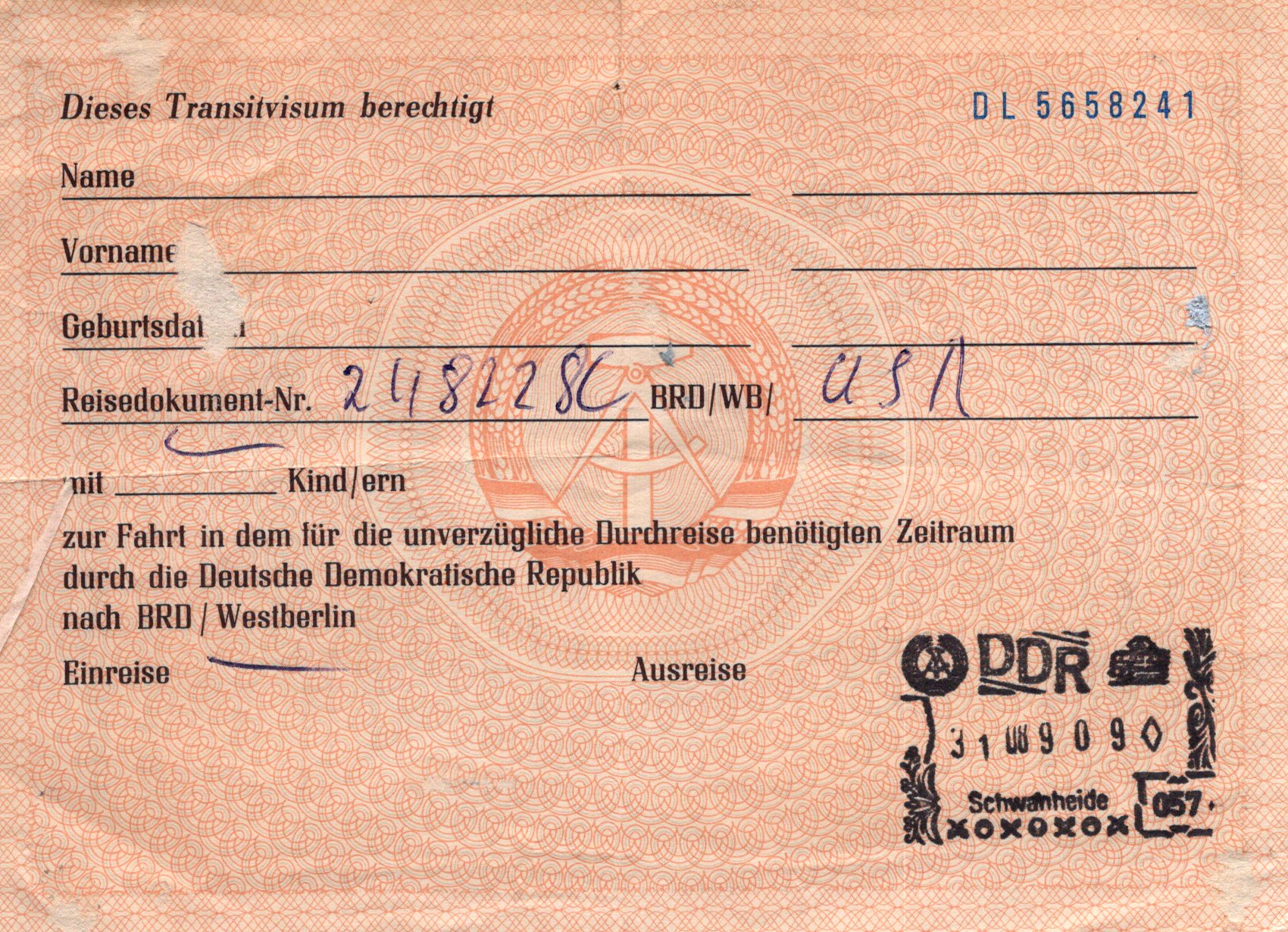
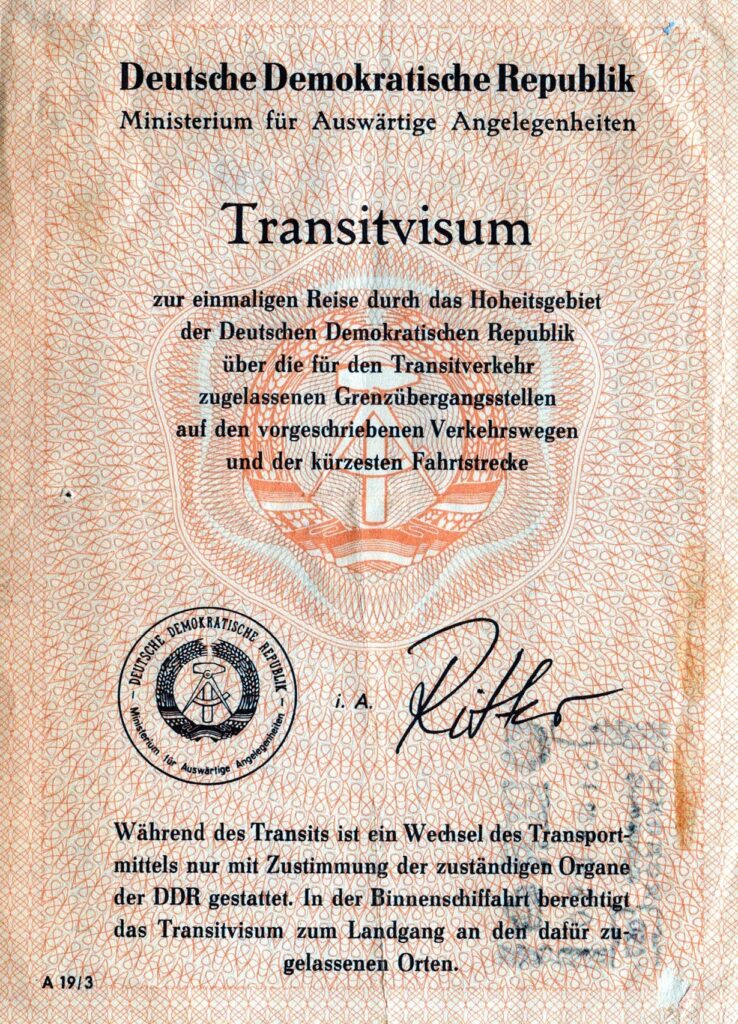
“There, that wasn’t so bad then, was it? “asked Hertha.
However, I could see from my visa form that they had failed to complete certain key details, not least what I was called.
Maybe the guards were just going through the motions, oblivious to the role they played in maintaining national security. Were standards starting to slip? I hadn’t come all this way, just for them to do half a job.
“But wait a moment,” I asked Hertha, perhaps a bit too loudly, “Am I meant to fill these details in myself?”
“Oh, your name?” she replied.
“My name? I wasn’t thinking of my name. More along the lines of Ronald Reagan or Donald Duck. Would they even notice?”
Not a murmur.
Perhaps my Cold War quip was lost on her or maybe with those guards stood just by our door, she felt unable to lighten up.
Boy, was I in need of a joke here; a wise crack; a coping mechanism.
I recalled crossing the Iron Curtain in 1985, visiting Budapest with a couple of old chums. Before this train ride, we had somehow acquired enough “alternative material” to probably open up a shop that was strictly for adults. Maybe, in retrospect, this laddish venture wasn’t the smartest thing we had ever done, but we managed to cross the wire with said contraband, both ways. The inspection crew then seemed almost personable, in comparison to this bunch now.
I was about to relate this to Hertha, with the guards stood a few paces away. It might make her laugh (slightly) but I thought better of it. Instead, we continued to maintain our staid personas.
Introspection
And now, with those shutters pulled down all the way to Berlin, our compartment took on a different ambience with its sepia glow.
We had another four hours ahead of us before our credentials would be scrutinised again in the environs of East Berlin. But what on earth did we find to talk about for such a long stretch?
There was certainly stimulating material that could have kept us going, but in the end the dialogue was kept to a minimum. Both of us, for the most part, just chose to sit there, in silence enjoying each other’s company. Occasionally a brief sentence would pass between us, to then be followed by a contented sigh. Perhaps, we were both wondering what secrets the other might hold deep inside their heart.
The few items of conversation we had though were so illuminating, that in the hours that followed, I wished I had made some kind of effort, some kind of suggestion that we meet up again in Berlin, East or West, that she could speak more frankly about the rolling of her eyes, assuring her that my attentions were strictly honourable, that I wasn’t a Stasi secret police officer (although she might have been), and that she might be well placed to act as my guide. However, what could I offer her in return? And after all, just because we had been the sole two occupants of a cabin didn’t obligate her to me as a companion.
But above all, you must remember that our five hours together were spent crossing two countries that were deeply divided in ideology and in their take on autocracy, and that Hertha had experienced life at both ends of a historical spectrum that spanned forty- something years. Hard to believe that she didn’t carry some scars. Hard to believe that she didn’t harbour bitterness. She was born into one dictatorship under the Nazis and was now living a short stride away from the East German version.
My mind started to wander further. An undercurrent of adrenaline was starting to surge through me. I was probably by now giving Hertha one of her stares back, oblivious to her presence. The notion of leaving my village, back in England, making my way across Holland and East and West Germany, to stand in front of and then cross over completely independently, as I would days from now, an oppressive Wall that had for nearly thirty years separated families, taken lives, been a fulcrum that had balanced paranoia induced ideological concerns of the East and West, and most of all had been a catalyst for further stepping up the nuclear arms race, well, all that was a bit too unnerving. Yet here I was trying to look into the inner soul of someone who had silently endured it all.
Then, Hertha brought me out of my trance.
She said, “Wherever you end up in Berlin, East or West, it will be an interesting experience for you. There isn’t quite the same tension there now as in Leipzig.” And then she said something about President Gorbachev is visiting the East in a few days from the USSR. I think they really love him.
I wanted to know more. “Leipzig?”, I asked. But by then, a border guard was stood outside our cabin door. She just gave me a cold look, as though to say, “Please don’t ask anymore, you cretin.”
There were two huge events though that were only just around the corner, that made my expedition rather profound. One, of course, was the sudden tearing down of the Wall, a matter of weeks later. If this apparition had come to me, as we made our way towards greater Berlin, I am not sure how I would have processed it. Perhaps it would have been Hertha who unveiled it to me, as I drifted into another trance. Certainly, I would have remained speechless until, well probably until I was back home on terra firma, stoking the fire and drinking beer.
And if, at times my commentary drifts into the surreal, I don’t intend it that way, for much of what I write about is very serious. However, to most observers, and probably every Cold War spy – both literary or real – that ever existed, this pending seismic event could only have taken on a dreamlike quality.
Hertha though would probably have just shrugged her shoulders and said, “Well they certainly had it coming. The signs were there anyway. Look at Leipzig. Look at Poland.”
In Berlin though and for people like Hertha, it was anything but surreal. They were very much on the front line of geopolitical tensions. It was chillingly real.
The other huge event? Well, I will let Hertha take over for that one.
Fifty Years On – A World War Remembered
“And of course,” she said, “tomorrow will be fifty years.”
“Will it?” I asked, “Fifty years? I see.” A brief fifteen second pause, then, “Fifty years since what?”
She gave me a penetrating glance, paused for contemplation and disbelief and then said, “Since World War Two started. Didn’t you know (you ass)?”
“Gordon Bennett,” I said, sitting back
I paused for a moment and then added, “You mean, fifty years since Hitler invaded Poland?”
I immediately realised it probably sounded like a personal accusation. I tried to back track, but it was too late. Her head had dropped a bit, and I was struggling to make out her facial expressions in the dim shadows of the compartment.
Then in a literary flurry, she countered, “We weren’t all so complicit, not to the extent that you might assume. In fact, my family were quite ordinary.”
And how do you know what I assume? I wanted to jump in, but of course she was right. And as for the concept of ordinary, she really didn’t want to get me started on that one. I’m sure you all were, I nearly said, all starry eyed and ordinary, but held my tongue.
However, I kind of felt an imbecile, not just regarding my display of ignorance about the fiftieth anniversary, but how insensitive it must have seemed towards this war baby from Hamburg.
It went quiet for ten minutes, but she then opened up again with some helpful suggestions.
“There are bound to be demonstrations across the city.”
Demonstrations? I nearly asked but just stopped myself in time. “Oh, the fiftieth anniversary, you mean.”
“Yes,” she said,” Demonstrating against racism and nationalism. Never again, and all that stuff.”
‘Too right”, I said.
“You could maybe join one,” she suggested.
“Where would be the best place?”
“I would be surprised if there isn’t one near the Russian War memorial on the edge of the Tiergarten.”
“And how about you,” I asked, hopefully, “Will you be joining one of the demos?”
“No,” she replied, “I don’t really handle crowds very well.”
“Oh,” I sighed.
Nazi Dissent – The Ultimate Price
Then she came out with another suggestion.
“If you want to travel a bit further out, away from the centre, you could try Plötzensee.”
“Is it a nice place to visit?”
She gave me one of her looks.
“Nice?” she said. “Nice? It’s a dreadful place. It’s a former Nazi prison, where dissenters were taken and executed. Impaled on giant meat hooks. Lots of them, actually.”
I was eating a sandwich and just looked down. Well, there was no need for that.
Then she asked, “Do you know of the bomb plot to kill Hitler? Valkyerie? A lot of these people were killed here.”
It was another light bulb moment. I knew some basic details about the events and particularly the aftermath that surrounded the plot, I just didn’t know its location or name.
And then, she added, “Yes, it was famous for this.”
Famous? I wanted to carp. Famous? I don’t think that’s the right word, But I just kept quiet.
She knew her country’s history, and so she should. Perhaps the conspirators were heroes to her. They had after all risked their lives, when many other strata of society were happy to comply with the regime, whether through fear, general willingness or outright admiration.
“Thank you for this suggestion. I shall certainly visit this place, “ I said.
There were different levels of bearing witness, I realised, at a micro and macro level, at a deeply individual level, or on a wider basis, at demos. Hertha had just unearthed them both.
End of the line
We had travelled all the way down from Hamburg, through five hours of largely silence. Part of it tense, enforced by inspections and the loitering East German Guards; part of it through contentment. Finally, the train entered the fringes of West Berlin.
At Bahnhof Zoologischer Garten, a final act of separation. Hertha said something about good luck at Griebnitzsee, that I didn’t really understand at the time. I jotted my address down and handed it to her. “I collect postcards,” I said, “If you get chance, please send me one.”
Suddenly, we arrived and were thrust into a swirling, chaotic neon scene. But as we stepped down onto the platform, my mind hadn’t caught up. It was still somewhere back along those tracks, on mute, and detached from the frenetic backdrop that now lay before us, still trying to make sense of all that had just happened.
Then, Hertha was off, manoeuvring like some kind of greyhound through the crowds. I watched her head bobbing up and down, receding further away in the distance. And just like that, she was gone.
So, no support machine for me after all, as, psychologically and physically, I sought to make my way around the fractured world of Berlin. Now, I was alone. Alone in a city that, as I was to see, still bore its dividing scars.
PART 3 – WEST BERLIN: FIFTY YEARS ON
The Wall – Close Up and Personal
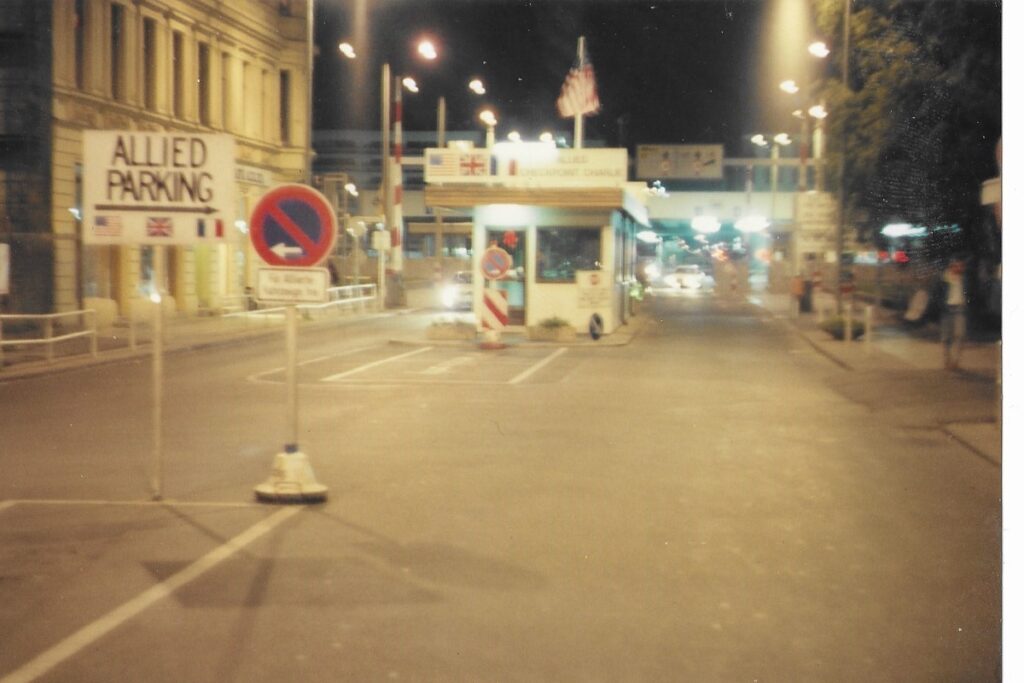
The next day, I made my way towards Checkpoint Charlie, with no immediate intention of crossing the divide. Just a few strides away stood the Wall itself. Stroking the twelve-foot-high damn thing seemed as good a way as any of kick-starting the day. Beyond it lay a strip of raked sand, floodlit and exposed, with watchtowers rising not far behind. It was no mere barrier, but a militarised killing zone for anyone who tried to cross.
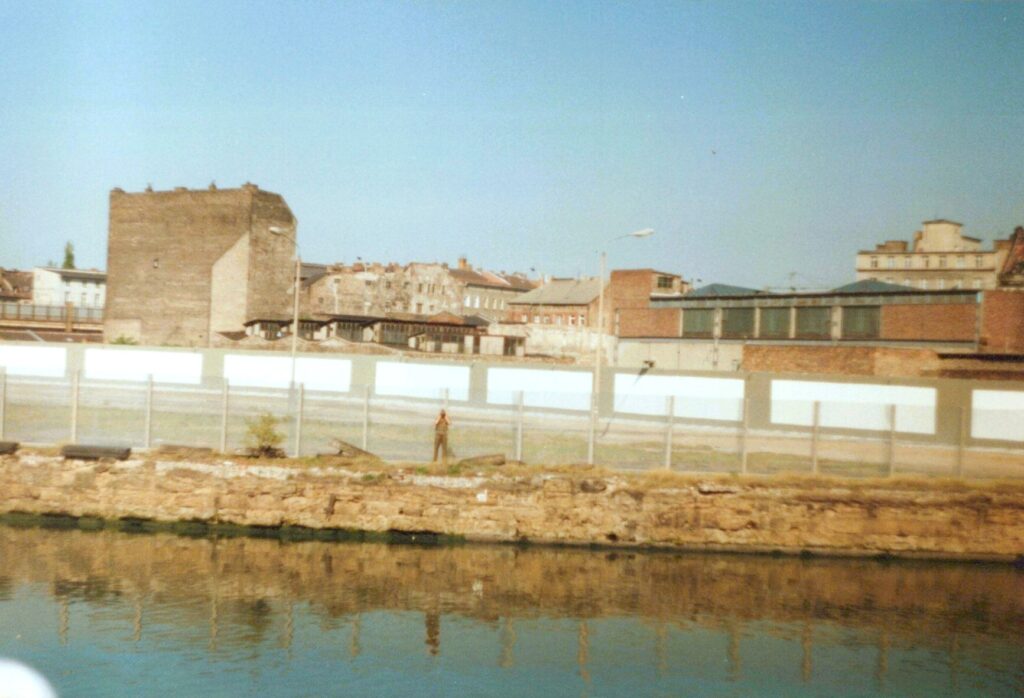
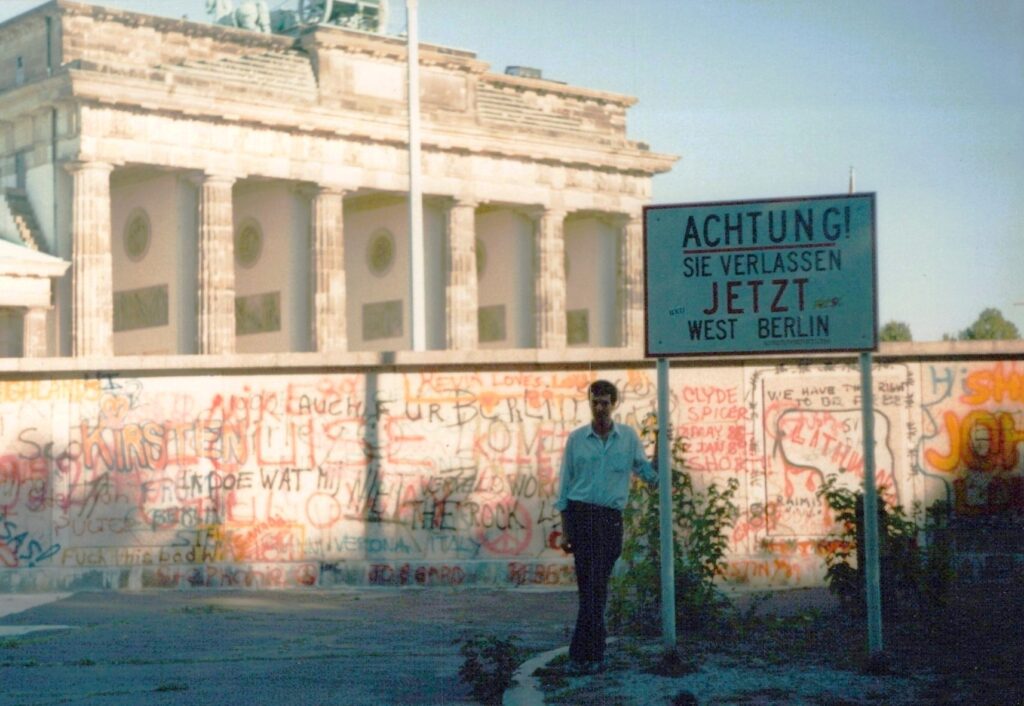
How I wish I had taken more close-up photos. Why did I not do this? What a missed opportunity. But how was I to know time was running out? The pictures of me in front of the Wall were, I remember, taken by a Polish man and his wife. The feeling I got from their determination to connect with me was that they were very excited to be on West German soil. Looking back, perhaps their trip had been made possible through Poland being the first Warsaw Pact country to come in from the cold. I had always taken it for granted that I had some God-given right to travel there, one day. But them? Maybe it had only become possible a couple of months ago.
I placed my palms against the Wall, trying to find any bare patches that weren’t covered in graffiti. I bet it wasn’t like this on the other side. The Polish couple looked on, as though expecting me to levitate. It was a cold and clammy feel, but that was as mystical as it got.
Checkpoint Charlie Museum
I walked to the Checkpoint Charlie Museum. Its displays were crammed with descriptions and artefacts relating to the history of the Wall and escape attempts. They really packed a punch. The aspect of the museum I always remembered was its proximity to the checkpoint itself. It was merely a few strides away. From inside it was just about possible to observe the East German border guards observing you. They must have felt a bit beguiled to be able to see, from their Eastern side of the divide, the museum and all the slanderous allegations it must be making against the GDR, not to mention all its visitors, each one a possible enemy of their state.
It even held the original means of transportation escapees had used, including a hot air balloon and car modified with secret human hiding compartments. The attempt that most intrigued me was Tunnel 57, which involved the successful escape of 57 individuals (always a clue) from a derelict house in East Berlin. I imagined the repercussions there must have been when their actions came to light.
For a number of years I had the ticket stub, yellow in colour and with an image of someone attempting to climb over the Wall, on my mantelpiece. It was like a talisman to me, but now it has long since vanished.
Tiergarten Reflections – The Calm Before the Storm
I left the museum. It was a bright sunny day, and I sauntered along a series of arteries inside the large expanse of Tiergarten. The closer I got to its centre, the more idyllic it seemed to become, cafe culture dominated, and the environment was getting increasingly green. It was a city park that traversed wide boulevards and must have provided a lot of escapism for its residents not just from the daily grind, but from the Cold War tensions and the nearby intimidating monuments that supported this. Here we were, a short stride away from them, and everything was just so heavenly. It was surreal, like there was nothing to be concerned about, that those Cold War flash points might just have well been 500 miles away, rather than a stone’s throw. A calm before a storm.
Well Hertha, I was sure, knew about those flash points that were going on right now, but I guess a lot of people were living out their lives blissfully unaware, on the grass verges, on the nudist beaches, in the coffee houses and bierkellers of West Berlin.
However, for the politically aware, maybe the imminent gathering pace of Leipzig’s Monday demonstration meetings, just over 100 miles away, would have been a source of hope, even despair. Hope that, encouraged by Gorbachev’s disapproval of the East German regime’s staunch authoritarianism, that it might lead soon to better freedom of expression.
Others might have despaired that, GDR man Honecker – not one to compromise- would take his cue from Peking’s Tiananmen Square massacre, just two months earlier.
Not many could have accurately guessed how matters in Berlin were really about to shape up.
Soviet War Memorial
I walked on. After half an hour, I reached the edge of the Tiergarten and found myself on Straße des 17. Juni – a thoroughfare that commemorates the 1953 uprising in the GDR. Set off this boulevard, I could see the outline of the monolithic, multi-column Soviet War Memorial, topped by a giant sculpture of a Soviet soldier. In front of it, a small crowd of people gathered on its steps. As I got closer, I could see two Soviet tanks, a few strides away from the memorial steps. They comprised part of the monument’s site.
I would like to have been able to state here that the tanks had been on active service, in the Battle for Berlin in 1945, but alas not. These were later versions.
I had expected to find a substantial crowd on this monumental day – fifty years precisely since war broke out – not just the thirty or so people who paused for quiet reflection.
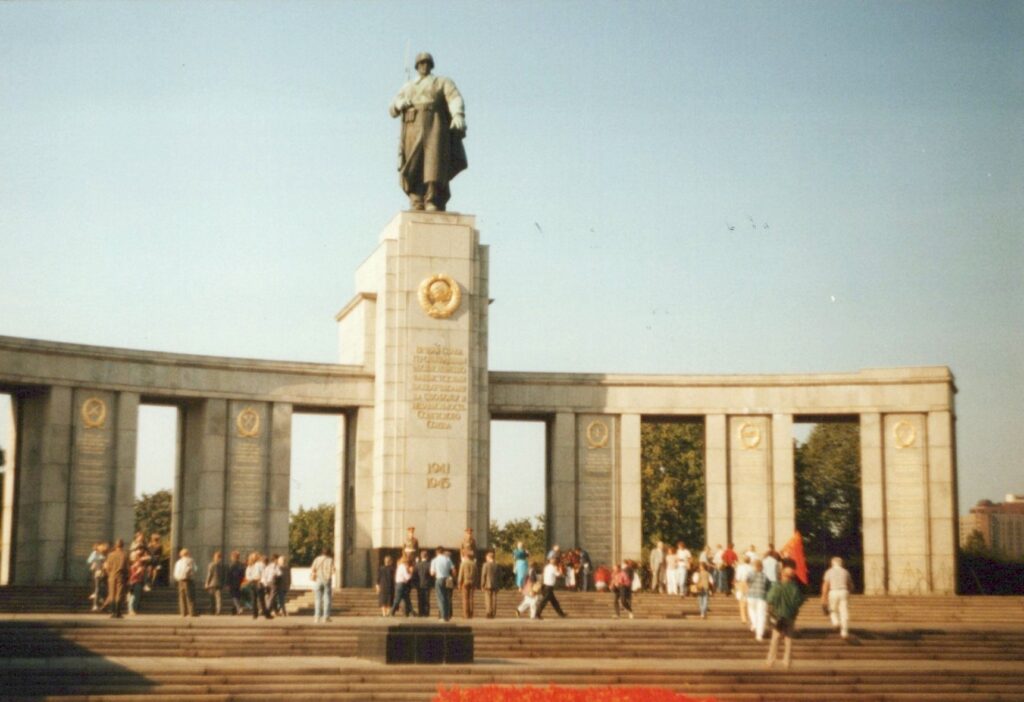
On the top step, two Soviet soldiers stood rigorously to attention. It was easy, for a moment to think that I was already in East Berlin. A highly unusual sight, to see them standing the wrong side of the East-West line.
Behind them stood a plaque with a giant inscription In Russian. One of the small crowd knew its meaning and jotted it down for me. I kept her note as a memento for a number of years but managed to lose it. In tones of nationalist zeal, it read, “Eternal glory to the heroes who fell in battle against the German fascist invaders for the freedom and independence of the Soviet Union.”
Well, 80,000 Soviet Soldiers had died in the Battle for Berlin, and so they were certainly entitled to their piece of nationalist zeal. But it seemed peculiar to see it all being enacted over here. It felt like time warp stuff, as though the Wall hadn’t yet gone up (let alone down).
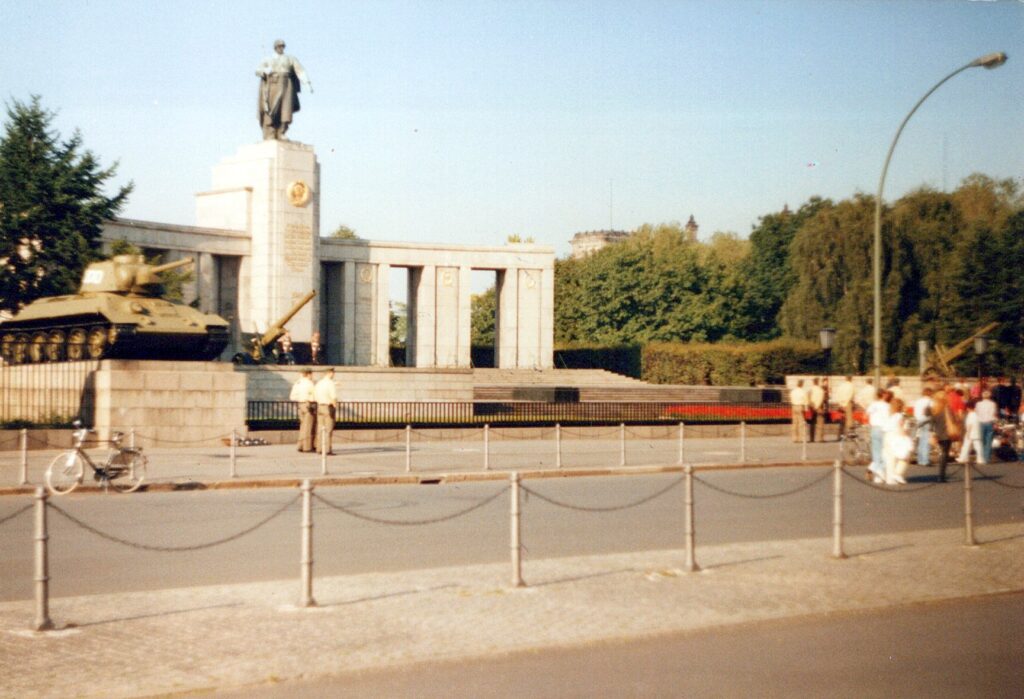
And if today was meant to be about pausing for reflection, a remembrance of all the souls that had been lost, here and globally, perhaps it was not surprising that crowds hadn’t gathered in great numbers – there were other war memorials in West Berlin that they could have gone to, which were more neutral, more utopian, reflecting on the sanctity of life, and not forgetting that across the east and west divide, in the war years, all regimes had committed en masse, the most inhumane activities imaginable.
I took a picture and moved on.
A World War Fifty Years On
I hadn’t though allowed for that thing called routine. A short while later, building up to a midday rendezvous, people were descending from all directions. The crowd was still relatively small, but it was being added to all the time. The pictures I took don’t portray a scene of rampant, placard waving, chanting protesters. Rather, it looks all quite solemn in nature. The assembling of a mass gathering most of whom are there to pause in contemplation. Just the occasional red flag.
But the choice of location was interesting. At the end of Straße des 17. Juni, in the direction we were slowly heading, on the other side of the Wall, was the giant iconic Prussian landmark, the Brandenburg Gate. Through whatever epoch is has stood, it has been indelibly associated with that era; Prussian might; Nazi triumphalism; of it being incarcerated on the eastern side of the Wall, during the Cold War; or freedom of expression and movement, after the collapse of the Wall.
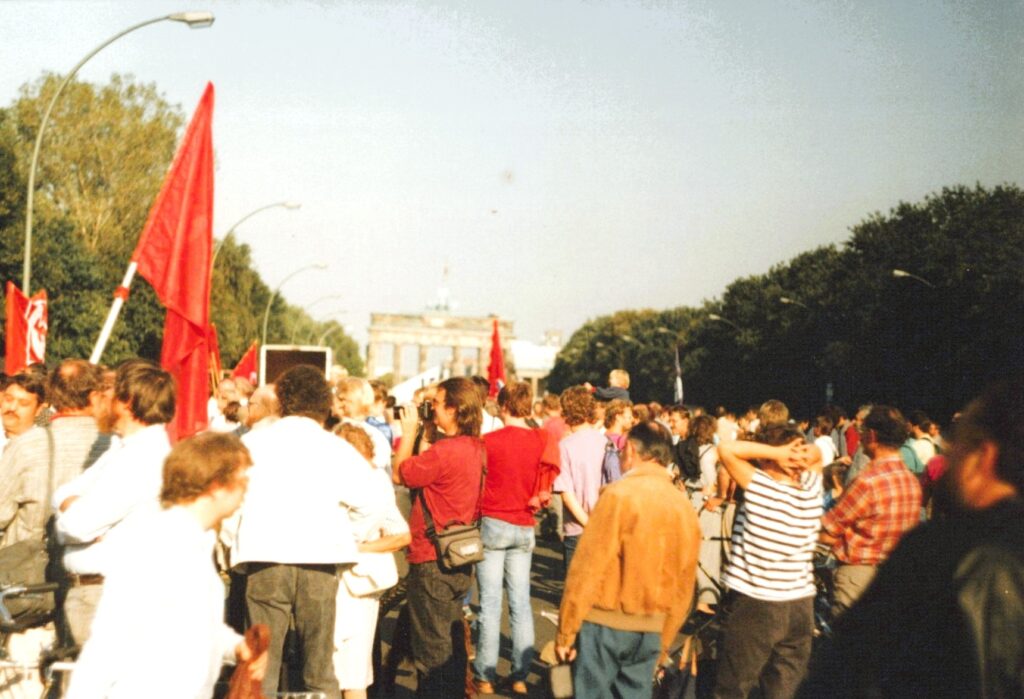
Assembling on this boulevard, with its focus seeming to be on the Brandenburg Gate, made me ponder about the perspective of the gathering. Was it about reflecting on the countless souls who had lost the lives in the worldwide conflagration that started fifty years ago that day, or was it about making a stand against a divided city with the Gate and the Wall being a key testament to this? Was it about looking back or trying to look forward?
I started to wonder about the mix of the crowd. Quite possibly, it contained adults who had been children of the Reich or who might even have been party members or officers, now fully exorcised
Alternatively, how many had relations on the other side, who they had not seen since 1961 and perhaps would never see?
You can tell I had a lot of reflection going on.
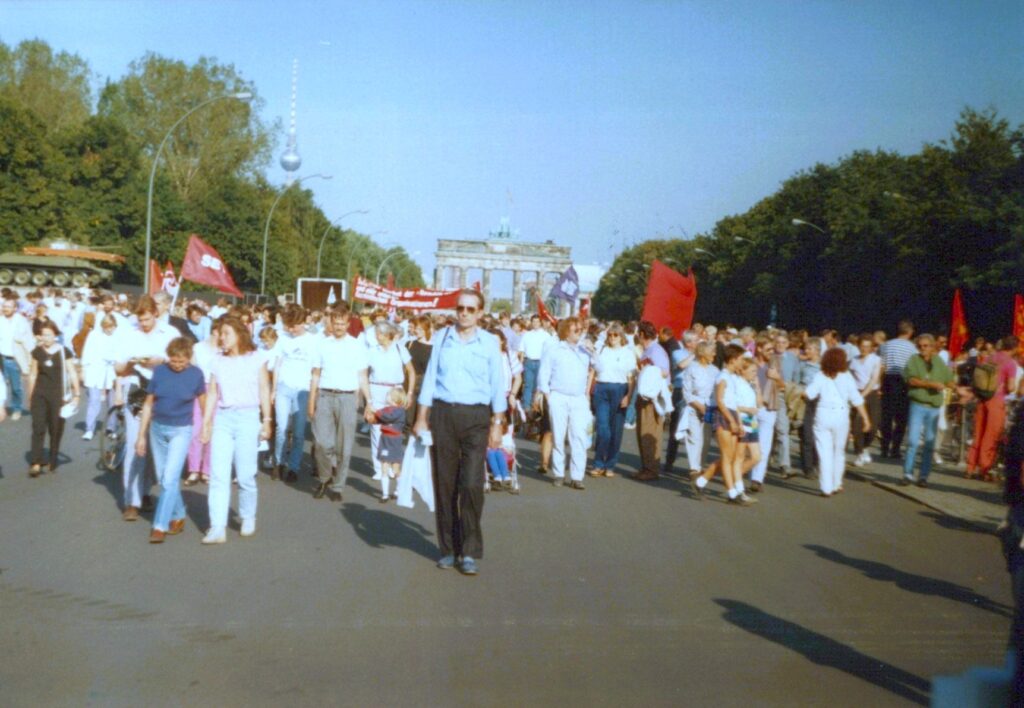
In conclusion, there seemed to be a lack of cohesion to the crowd, with nothing to indicate it was a highly organised demo. People had just randomly gathered, to mill around, because they felt the need to take part, to make a stance, on this huge anniversary and to say, what a goddamn awful era it was back then, and still quite possibly is.
Coventry & Berlin – A Moral Outrage Shared
A couple of weeks before starting my journey, I had travelled to the city of Coventry, to watch a football match. Before and during the war, the city had been a major industrial centre.
Coventry suffered bombing damage and fatality levels in World War Two that were only exceeded, in the UK, by London and Liverpool. This was overwhelmingly inflicted on a single night.
I had a couple of hours to spare in the city centre and found myself at an open-air memorial – the preserved remains of Coventry’s fourteenth century medieval cathedral, which had been heavily damaged by the bombing.
It was a powerful testament as to how the ravages of war visited Coventry one particular evening in November 1940.
But the story connects to Berlin, because I have now walked on from that demo and found myself by Kaiser Wilhelm Memorial Church, close to the Kurfürstendamm. I was here to visit department stores and to get provisions.
But the church pulled me in, startling in the way it had preserved its original bomb-damaged appearance, and in its connections with Coventry. This included the Cross of Nails that was gifted to the church and made from nails found in the ruins of Coventry’s destroyed cathedral.
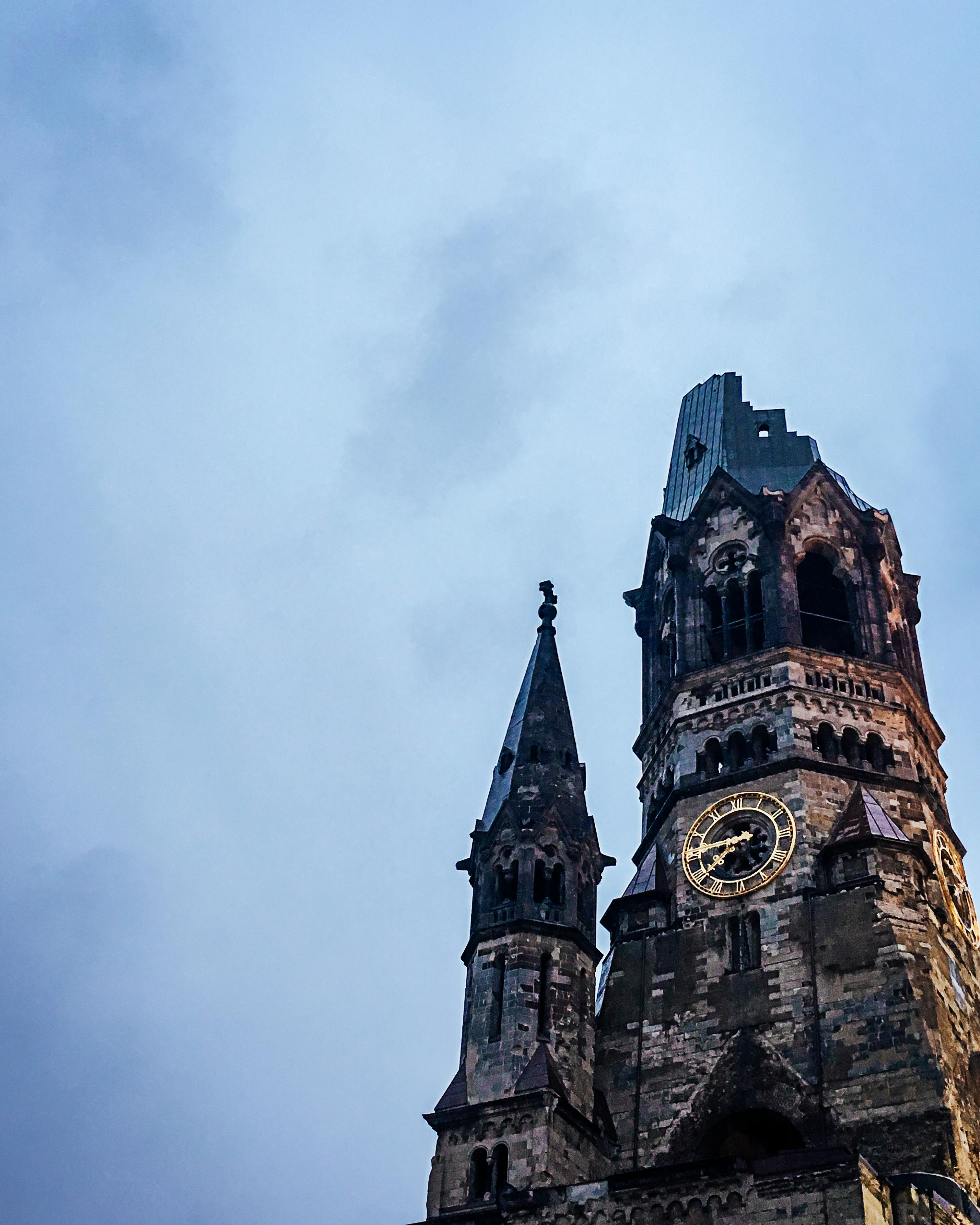
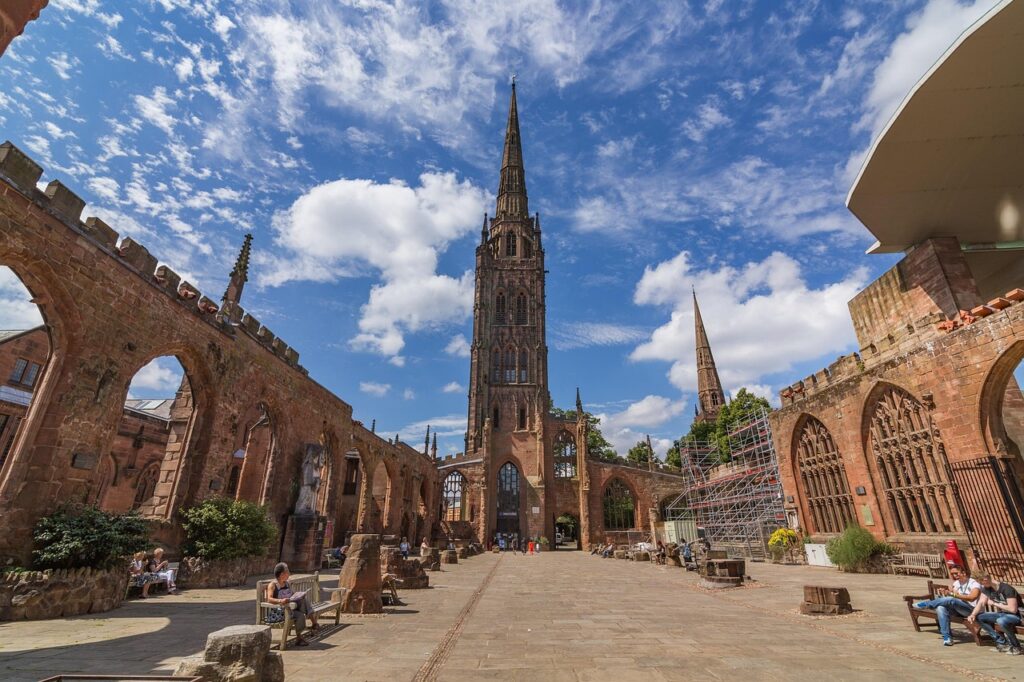
(Kaiser Wilhelm Memorial Church and Coventry Cathedral, Pexels)
I had no inkling of the link with the English city, whose cathedral remains I had stood in the middle of a few days previous. There was no twinning between the two, but strong cultural, civic and religious links existed. More like an affair than a marriage.
And yet, there had to be strong overtones of forgiveness for this relationship to take place.
There has been much speculation as to whether the British intelligence services knew about Coventry’s pending bombing but chose not to alert the city for fear of giving away their code breaking success. It was about taking the long view. If this is true, the levelling of Coventry and the loss of life was collateral damage.
But whilst Coventry’s demolition occurred just one year into the war, Berlin’s was at its tail end, when there was little to be gained strategically, as Bomber Command relentlessly pursued its mission of annihilation. Here, it was the high odds of pilots being killed that was collateral damage.
Moral outrage on different levels. Forgiving Hitler, Forgiving Churchill. Forgiving Bomber Harris. That is a lot of forgiveness.
The Church and the Sculpture
But then, as I walked on, a few strides provided a seamless link, between the City’s war time levelling and its current Cold War plight.
There, in the shadows of the bombed memorial church, was a modernist sculpture Berlin, by artists Brigitte Matschinsky-Denninghoff and Martin Matschinsky. Created in 1987, it features entwined, but fractured, steel tubes, symbolising the divided city and its hopeful reunification.
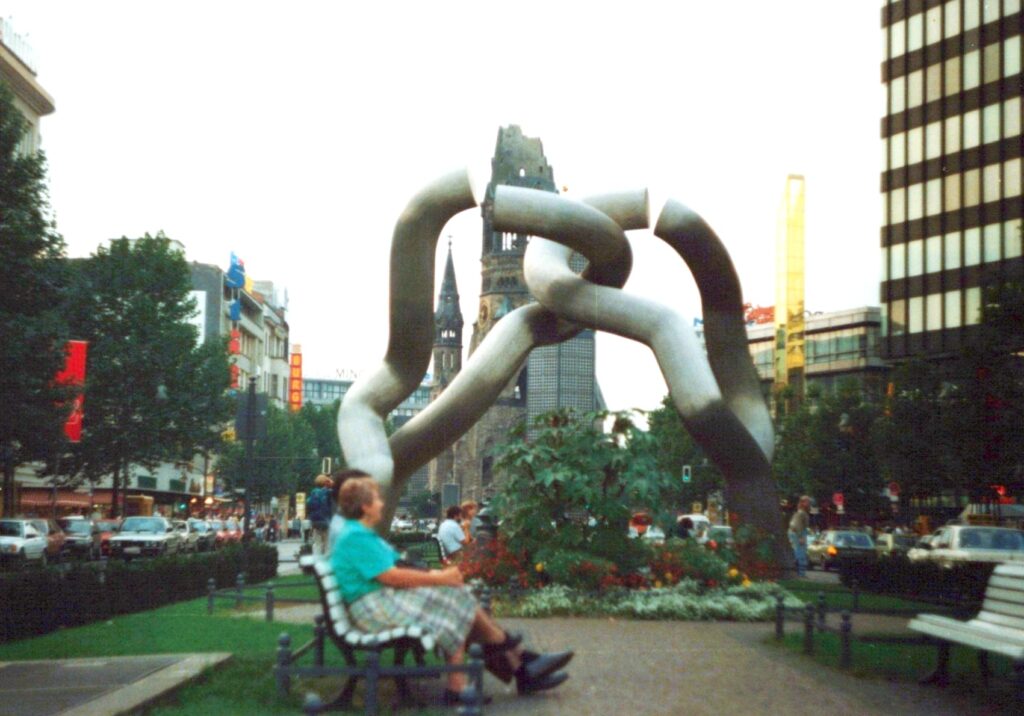
Short walk wise, one just merged into the other. Halfway through this micro war-walk, there were two seats, one faced the church and the other the sculpture.
Each seat faced an era of history that its citizens wouldn’t want to repeat. To be honest, the real reason I had come to the Kurfürstendamm in the commercial heart of West Berlin was to buy delicatessen and alcohol. But suddenly this didn’t seem to matter.
However, choosing which seat to set myself down on, for a spot of reflection, presented its own dilemma.
Should I go for the church facing one, where perhaps the key theme might be unfinished business, either with regards to its restoration or, from Bomber Command’s perspective, a complete levelling?
Alternatively, should I face the sculpture? Here, I could ruminate on finished business i.e. the broken entwined links, that signified a divided city’s permanently fractured heart. Well, that’s how it felt at this hour.
The Reichstag
Some history – All the monuments I had visited that day were iconic symbols of Berlin. But the one which had truly driven its shameful history, in providing the parliamentary framework through which the Nazis came to power, the Reichstag, lay a short walk away — within the pearl of democracy lay the seeds of tyranny.
Since the war, the Reichstag had stood as a cold unfunctioning monolith, acting as a symbol of a divided Germany. It did though, house a small museum, titled Questions About German History, and it was to here that I now headed.
On reflection – But after twenty-minutes there, I left and sat on a grass verge, recharging my batteries. I had walked a fair few miles and felt worn out with Nazi and Cold War overload.
In the distance, I could see the crowds, still lingering along 17. Juni, as they reflected on what fifty years actually meant.
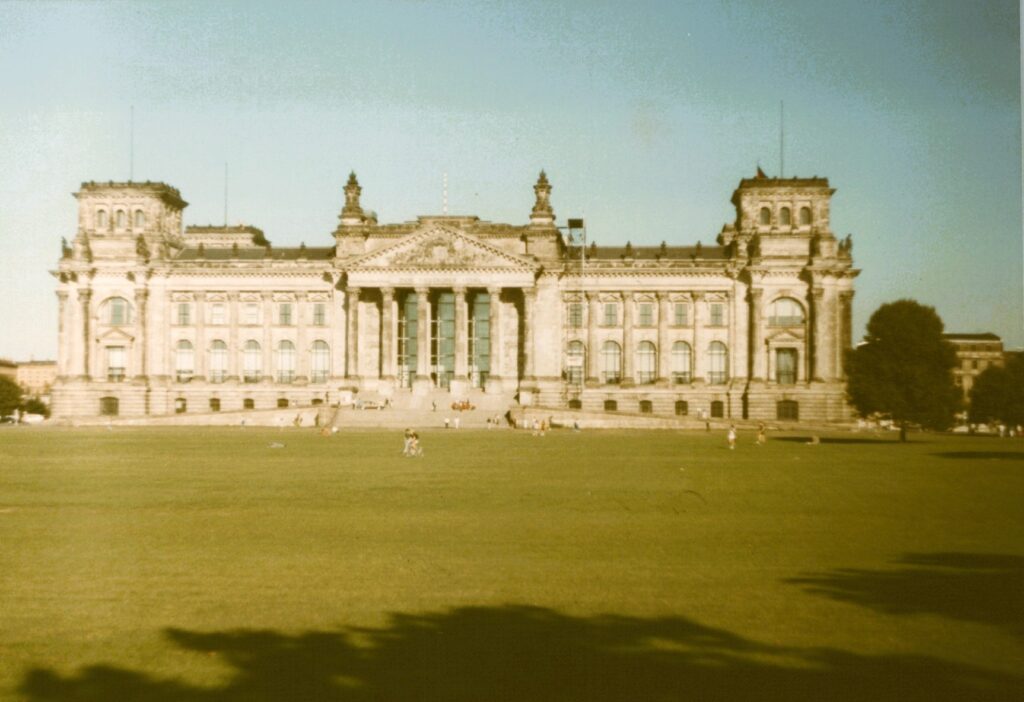
To many of them, the Reichstag must just have seemed an irrelevance and would remain so until Germany’s two halves were reunited. But, as GDR chief, Erich Honecker had said just weeks before, “The Wall will still be standing in fifty or even a hundred years, if the reasons for its existence are not removed.”
So, there you have it (or so I thought).
Red flag over the Reichstag – However, it wasn’t the information display inside the Reichstag or the receding distant crowd that I reflected on most, whilst I lay in front of the building. It was the iconic photo of the Red Flag being hoisted and waved on top of its roof, following the defeat by Soviet forces of German troops in the Battle for Berlin.
I had the picture on a pin board of postcards at home. It conveyed better than a thousand words the final vanquishment of the fascists by the Soviets.
I have always loved the tale of how Yevgeny Khaldei’s photo was doctored soon after it was taken, to remove a wristwatch from one of the soldiers. After all, this might have been taken as evidence of looting or even becoming too Westernised.
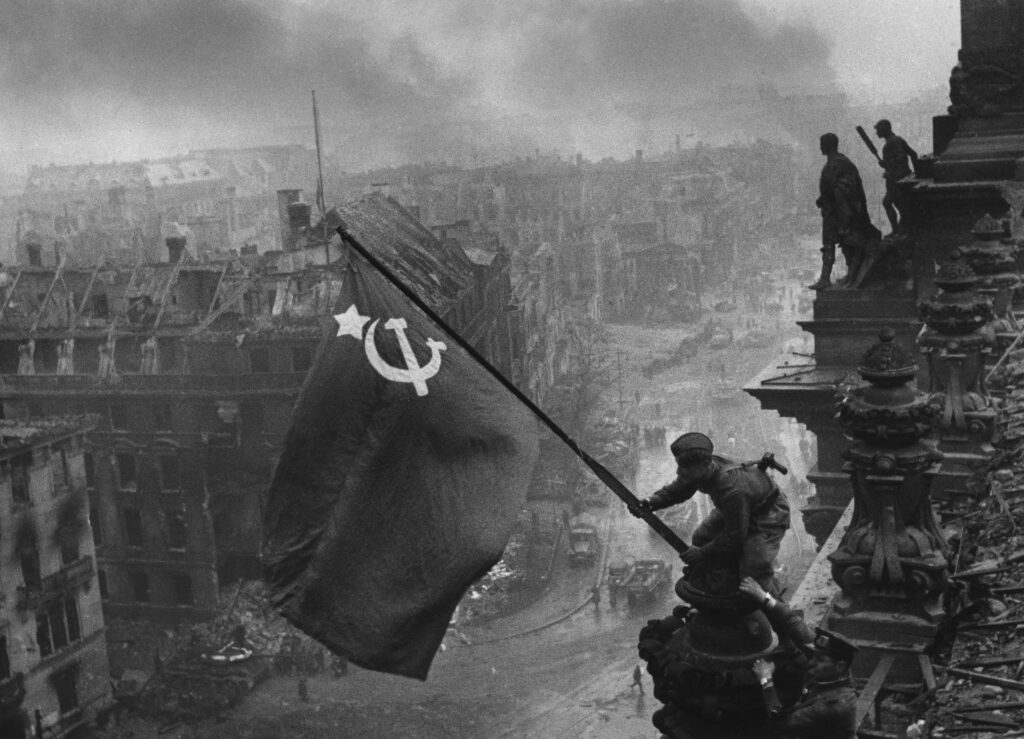
And as I sat there imagining the Russians gloriously waving that flag, stood atop of a gutted rooftop just behind me, I realised that it provided another seamless connection with the Cold War. At this moment in time, the Allies had probably outlived their usefulness to the Soviets. And so, it was to Potsdam, with great haste, to draw up a new world order, and to reinforce the deep-seated notion of East is East and West is West, and that is how it will always be.
Plötzensee Lake – The Sunbathers and the Executioner
I think that was quite enough exploring and meditation for one day.
I would have spent the evening perusing information leaflets I had acquired and drinking weisse beer. The next morning, I had made my mind up. I was to visit the Plötzensee memorial that Hertha had mentioned.
Walking there, I recall the bullet ridden and collapsed facades of some tenement buildings, that gave a feeling that post-world war renovation and gentrification in some districts took decades to catch up.
It was a strange feeling, not least because I had started out from the wealthy shopping area by Kurfürstendamm. It was a city of contrasts, like most cities. I can’t remember the names of these neighbourhoods, but searches since, would suggest Wedding or Moabit.
I arrived at the small, long standing lake side resort of Plötzensee. For decades, it had exercised a recreational pull on Berliners, who wished to boat, swim and picnic on its shores.
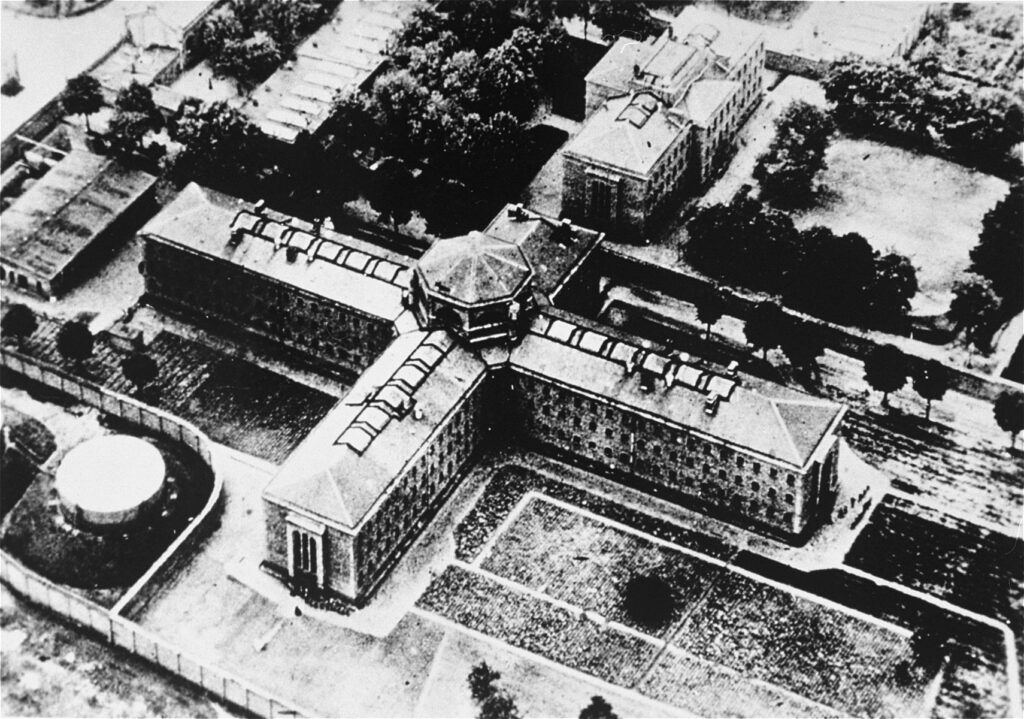
And as they relaxed here, were its war time visitors oblivious to the barbaric activities that were taking place in the prison complex, half a kilometre away, whose main role was to ruthlessly deal with any kind of dissent to the regime?
A few, maybe, but was it really possible for most of them to have remained oblivious? As good party members wouldn’t a lot of them have been clued in and connected to what was going on, even if they couldn’t hear it? For the most part it is hard to imagine. This was hardly a feature unique to Plötzensee. There are plenty of other examples of such a juxtaposition in Hitler’s death camps. But these weren’t located within a major metropolis.
I entered the memorial prison and picked up the detailed glossy information booklet. I have it in my possession now, as I write this. Possibly, the first time in over 35 years.
To give you an idea of the murderous activities that were commonplace here, I quote, “In a single night, on September 7th, 1943, between 7.30 pm and 8.30 am, 186 people were hanged, in groups of eight at a time.”
Much has been written about the July 1944 bomb plot (Operation Valkyrie), about its planning and why it failed. But my focus right there and then was on its carnivorous aftermath. Five-thousand alleged conspirators and their associates were executed, many of its senior officers at Plötzensee.
I now stood in the memorial hall, the former execution room. From a ceiling beam, several giant meat hooks were equally spaced. From these, ninety of the conspirators dangled, with piano wire around their necks.
A number of the executions were filmed for the Fuhrer’s own leisurely viewing. The meat hooks that I now looked up at were the originals. Did I stroke them, in memorial? The very thought makes me shudder.
Plötzensee’s executioners were still to enjoy regular employment, right up until the last days of the Third Reich.
Outside was a memorial wall. The inscription on the wall read, To the Victims of the Hitler Dictatorship 1933-45. To the side of this was a giant urn containing soil from all of the Third Reich’s concentration camps.
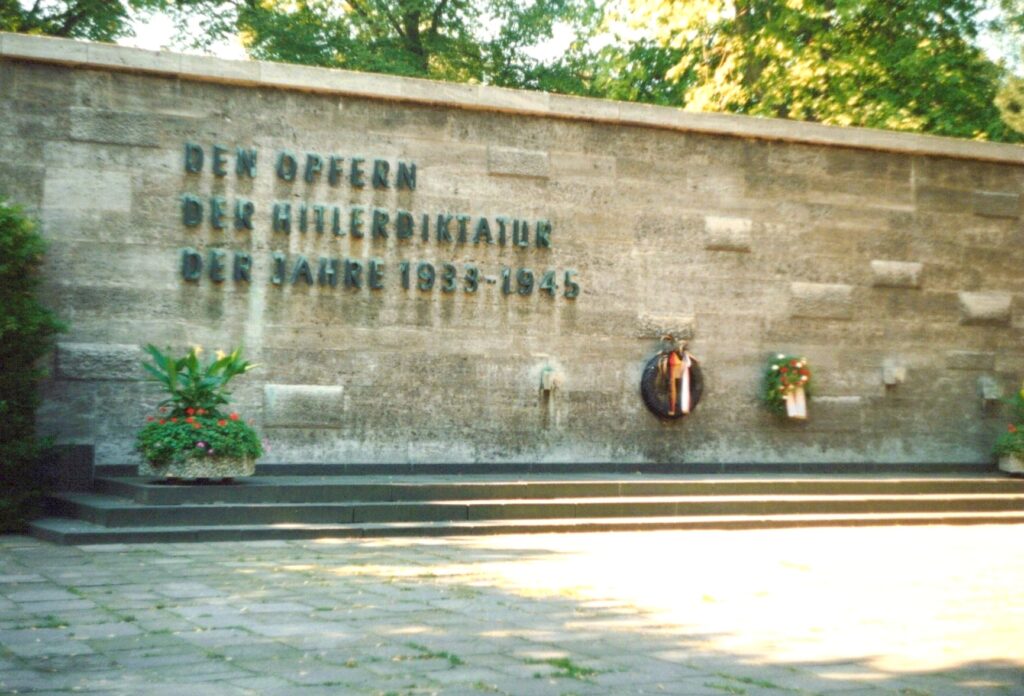
After the war there surely was a case for levelling the entire site and yet, with a certain irony, just over the wall from where I now stood, was a youth offenders detention centre, part of the original Nazi complex, and still devoted to incarceration.
I left, with a glance down to that idyllic lake shore, with its long-standing reputation for facilitating relaxation whatever the backdrop.
I then walked down to the edge of the lake and sat down. I studied the booklet some more.
Its section headings included Did we really know nothing of this? and, but did everyone want to know? Which brought me back to Hertha’s notion of ordinary Germans.
The map on the back, of key Nazi government buildings in the city that people would have walked past in the space of ten minutes was thought provoking. For example, this includes various judicial buildings, ministry of propaganda, Gestapo buildings, and two deportation points for Jews.
What would a walk to work have felt like for ordinary Germans who had to pass these buildings? I am sure most would have just kept their head down and rushed by. Some would have internalised it over time, just accepting that this is the way life was now. And of course, others would have worn it like a badge of pride.
It wasn’t healthy to linger here, and dwell on this for too long. I needed to move on and focus on another world.
It wasn’t healthy to linger here, and dwell on this for too long. I needed to move on and focus on another world.
Epilogue
From my explorations, since setting out from home, of Third Reich and Cold War history, it felt like there was a seamless transition between the two. Where one finished and the other started was quite debatable.
I was going over the Wall tomorrow, and I couldn’t see how my experiences there would switch to purely Cold War ones. It was unlikely, I thought, that the Great Patriotic War would ever be allowed to slip from the consciousness of Iron Curtain countries.
I found myself sitting on that bench again in the shadows of the Kaiser Wilhelm Memorial Church, jotting out a couple of postcards of the Wall.
I would be behind it in a few hours. But did I have any clear expectations? Probably not. Just getting over a line that until recently had sounded almost impenetrable, well that was a achievement in itself.
Perhaps, like stepping through that old wardrobe into Narnia, it would unexpectedly lead to an alternative dream world, full of threats and promises.
(Header image, Wall fortifications at Potsdamer Platz, 1965, Source Friedrich Karl Mohr)
Next Chapter in Memoir – To the East (East Berlin)
Previous Chapter in Memoir – Twilight on the Adriatic
