China travel writing :
Modern Classics – The River at the Centre of the World – The Yangtze in Real Time, Simon Winchester, 1996
I read Simon Winchester’s chronicle of his 4,000-mile journey along the Yangtze when it was first published. It has always stayed with me.
A thousand registered ships pass in and out of the Yangtze estuary every day, as well as a lot more that are not, and this is the scene that greets Winchester as he sets off. In most rivers, density of shipping would be monitored for safety’s sake, but here he is aware of it being watched with a view to state security.
He has a travelling companion, Lily, who is with him for the duration of his trip. She is a former Red Army cadre who he first met on a previous trip to China and is invaluable in smoothing the journey, ensuring that it does not get bogged down in bureaucracy or disagreements with the authorities as they move up the river. Not one to suffer fools lightly, our Lily – “When matters became too trying, she would brook no nonsense, give no quarter, take no prisoners.”
Winchester brings with him a set of detailed American, state produced, maps of China. He expresses concern as they start out their epic voyage, that if the authorities unearth these on any of their spot checks, they will think he is a spy. Don’t worry quips Lily, they will think you are a spy anyway, with or without the maps. “Where we’re going, any round-eye is thought to be up to no good,” she says.
Not that for one moment she is lacking in nationalist zeal. At one point when Winchester is secretly marvelling at how majestic some colonial buildings are, she senses this and retorts,” Look at your ridiculous buildings. They are not pretty. Not grand, not useful. We do them up in coloured lights to make them look foolish.”
The banter between Winchester and Lily, and their differences of opinion, particularly regarding colonial history provide a strong foundation to the book.
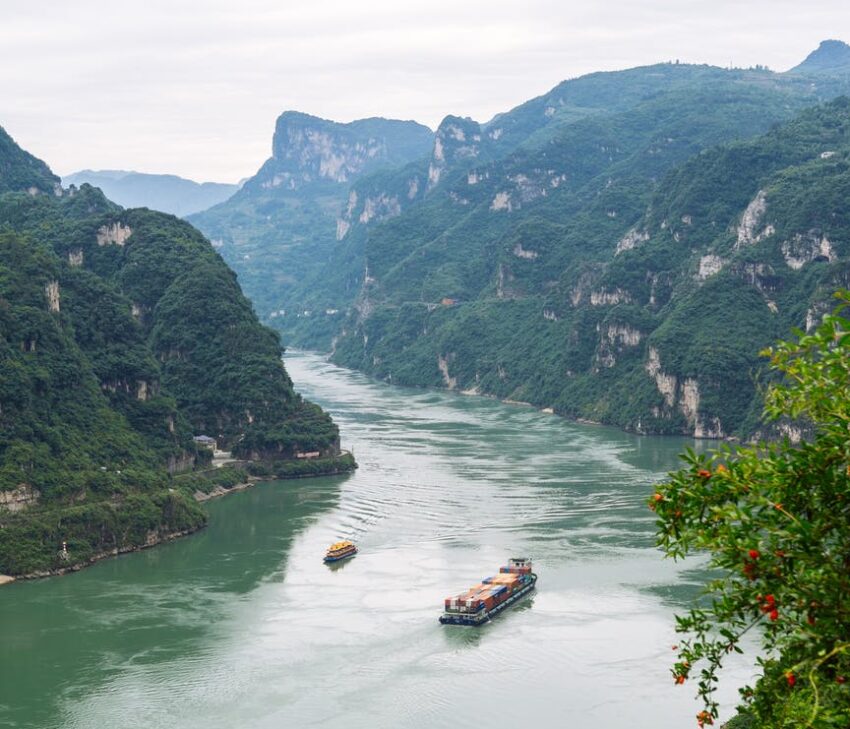
Winchester and Lily are passing through the famous Three Gorges stretch of the Yangtze, just as work is commencing on the highly contentious building of the hydro-electric damn, which is to displace 1.3 million residents. Winchester observes that, “during the process of any voyage up and down the gorges, it becomes painfully and unremittingly evident that twentieth century humans, and almost certainly twentieth century communist humans have made the most terrible mess of the place.” Although he does not seem to share this perspective with Lily (She might have thrown him over the side).
The acquaintances they make, both uniformed and non-uniformed, provide a set of fascinating anecdotes. But it is his portraits of the cities and towns they pass through, particularly their colonial past, and in the decades leading up to communist rule, that live in the memory.
Shanghai for example was, “created for and utterly dominated by the demands of the merchant. It was so dedicated in its commitment to commerce that Hong Kong by comparison seemed a dreamy city of poets and philosophers”. Much of this excess was banned under Chairman Mao, however in 1990 Shanghai was allowed to rebuild her soul with a vengeance, witnessed by Winchester’s digital- age meanderings and shrewd observations.
The colonial history that is presented, is lucid and disturbing, and a user-friendly refresher. Amongst these are his account of the Opium Wars.
The British 18th Century craving for tea underpinned a despicable triangular trade framework that spiralled out of control. This was initially based on a straight swap between trading companies of silver for tea. However, the Chinese could only find so much use for silver. The British then realised there was a gap in the market for opium. Its usage in China was not exactly rare, but the variety of opium that the East India Company could ship over super-fast from its India dominion was far superior in quality and much more addictive. And so, tea was now traded for opium. The impact on the well being of the Chinese, amongst who its use rapidly become widespread, was devastating. But at least it helped keep the owners of London’s tea houses happy. Ironically, given how much was invested in keeping the tea chain moving, Winchester cannot find a decent cuppa anywhere along his voyage.
A sobering account is provided of the Rape of Nanking in 1937, although as Winchester states, when the Japanese invaded, rape was only the start of it. For example, contests were held between Japanese soldiers to see how many heads could be cut off with a single sword blade. The winning entrant with 106 heads, was featured in the Tokyo press. Ultimately, according to the Tokyo War Crimes Tribunal 200, 000 Nanking residents were murdered, and 20,000 women raped.
Close by their hotel in Nanking, Winchester and Lily visit a huge biological experimentation camp that was set up by the Japanese in the years following invasion, where experiments were comparable to those carried out by the Nazis.
The ascent of Chairman Mao – the Cultural Revolution, the Long March and the Great Leap Forward- are brought into the picture at strategic points along the Yangtze. At one stage, Winchester and Lily stop off at a point where swimmers have gathered by a swirling section of the river. They had assembled to commemorate Mao’s ‘celebrated swim’ of 1966, as seen across the world, when the seventy-three-year-old chairman, defied the elements and swam across a perilous stretch of the Yangtze. Widely seen after this to be strong in body, spirit, and leadership skills – destined to rule – none of his inner circle would now dare pose any kind of threat him.
Winchester tells his tale with relish and as he does so, it is difficult not to imagine the swirling of the Yangtze’s currents along its huge length and the lapping of waters against the port holes of boats on which they travel.
Damian Rainford , 2021
(Header image: Pixels Free Photos)
Back Home to main website theancienthighway.com
