Best travel writing books
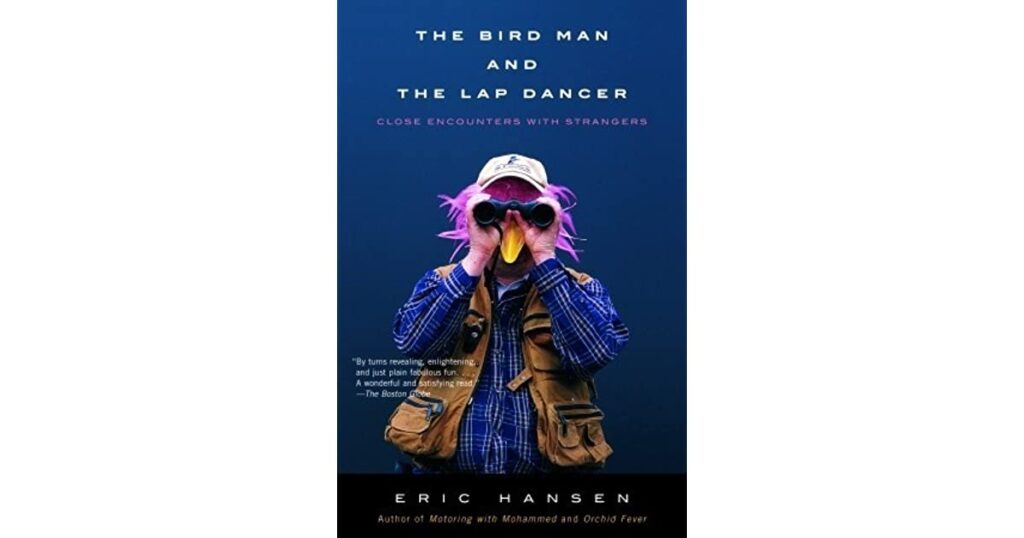
Modern classics- Travel literature book review – The Bird Man and the Lap Dancer, Eric Hansen, 2004.
Eric Hansen is an American explorer, who has been likened to a literary Indiana Jones. He has travelled extensively through anthropological environments and social conditions that most people would find very threatening, often going native. In the process he has produced an array of travel essays that frequently border on the quirky. Eight of these are assembled in The Bird Man and the Lap Dancer. A selection of these stories are are outlined below.
Arlette and Madame Perruche: Terrain wise, Hansen starts off on safe ground in Western Europe with a heart-warming parable. In France, he talks to Arlette who fifty years previous was part of a ballet troupe in Paris, but who has since lived on modest means in Cannes.
At the local park, much to the chagrin of neighbourhood residents, Arlette befriends a similarly aged homeless woman. She is nicknamed Madame Perruche and spends her days feeding pigeons. Eventually Arlette provides Madame Perruche with a roof over her head. Surely, they must be lovers, is a common piece of gossip doing the rounds. Madame Perruche though is adamant about providing something in return and is allowed to help occasionally with cleaning.
Arlette’s neighbours are even more shocked when she disappears on an extended vacation, leaving Madam Perruche in charge of the household – won’t this itinerant lady clear off with all her valuables? When Arlette returns, her apartment’s wooden floors are newly waxed throughout and glisten. Madame Perruche has transformed the apartment into something bordering on the palatial; all part of the deep spring-cleaning programme that the pigeon lady has taken it on herself to do.
When she slept on the park bench, Madame Perruche picked up occasional mail from a PO Box. These now get delivered direct to her at Arlette’s address. One such piece of correspondence remains on the hall stand, unopened, for a long period. Eventually, Arlette persuades her lodger to open the letter, after all, she speculates, someone might have left you a spot of money. The correspondence is from a Parisian solicitor requesting Madame Perruche to get in touch, and when she does, a huge amount of money has indeed been bequeathed to her.
And now things turn full circle. Madame Perruche purchases an exquisite apartment close by with her inheritance. Of course, she takes Arlette with her, but not before she is forced into accepting a modest rent from her. As you wish, says the new property owner. Landlady and tenant have now swapped roles.
Madame Perruche expresses her desire to go on vacation. Arlette wishes to stay back instead, to look after the place (and do some spring cleaning!). But Madame Perruche goes out one day and returns with two boat tickets for the Marseille to Alexandria sailing. They both now have the time of their lives sailing along the Nile and immersing themselves in the antiquities of ancient Egypt. Hansen’s time with Arlette is spent in a restaurant. During their meal, she dips into her handbag and retrieves a small photo album of their adventure. In these pictures, we see Madame Perruche, but never get to meet her in person. She is not well enough to join them at the meal, or is she just to shy I wonder?
Hansen loses touch with Arlette, but he knows that, in their old age, the ladies don’t venture as far off the beaten track as they used to. None of the original neighbours are now around and our two friends spend much of their time down the park in Cannes, one feeding the pigeons, the other feeding the cats. Adults and children relax in the park oblivious to the shared history of Arlette and Madame Perruche.
Did Arlette, and Hansen, find out Madame Perruche’s real name and family history? Surely they did? And Arlette’s neighbours, did they bend over backwards to be kind to the couple once they got wind of the pending inheritance? What are the couple up to now? Are they both assured of a place in heaven? If there is one, quite possibly they are already there.
Life at the Grand Hotel: In 1974, Hansen spends months away at sea off Australia’s north coast, walking on a prawn trawler. The vessel gets caught in a cyclone that sinks several other trawlers and wreaks havoc on the city of Darwin. Hansen’s crew drift into the Torres Straights. Lost in the middle of an archipelago of islands, they find refuge on Thursday Island, where they pull in to refuel and make repairs.
Relieved at still being alive, Hansen stumbles into the public bar of the Grand Hotel, which turns out to be another life-threatening experience for him, with its Wild West atmosphere and characters. Not that this puts him off, for he soon lands a job as barman with ‘accommodation’ provided.
He expands on his time as bar man here and the lives of the characters who frequent the place. Take Big Mary.
“One night a woman by the name of Big Mary went toe to toe with another woman. The two of them started slapping each other and throwing punches, but soon they ripped off each other’s blouses and ended up bare-breasted rolling on the floor biting, kicking, punching, and scratching. Shredded bits of blouse, tufts of hair and blood spots marked their progress, as they fought their way from the public bar to the pool room, to the veranda and then back to the bar over the course of the ten-minute combat. During this time, raucous laughter and words of encouragement were offered, and no one lifted a finger to stop the floor show.”
When customers stagger drunk into his room in the early hours, Hansen can never be sure if they are after sexual favours or are also residents and can’t find their room.
However, His time at the Grand Hotel isn’t all about violence and debauchery. Hansen recounts kind-hearted deeds of regulars, other inhabitants of Thursday Island and neighbouring isles. His tale also recalls the perils faced by other deep sea diving fishermen, whose acquaintance he makes. They, like himself, also worked the fishing trawlers.
Twenty years after his escape from Thursday Island, back in his Los Angeles home, Hansen is offered a reporting assignment by the Australian Tourist Commission. Anywhere you chose, they say. He can’t get back to Thursday Island quick enough, to catch up with former acquaintances and find out how life has changed.
As he enters the Grand Hotel, Hansen observes how it has gone through a modernisation programme – the phone now appears to be in working order, with the flex not having been torn out the wall; the establishment even owns a computer and fax machine, and accommodation can now be booked electronically via this new kit; and most importantly, all the bedrooms have secure doors, unlike twenty years previously when they were all ripped off their hinges.
A few months after his return visit, Hansen learns that the Grand Hotel has been demolished by fire.
In Three Nights on the Mountain, the most harrowing story amongst this collection, Hansen is back on familiar ground. In 1992 a disorientated Gulfstream corporate jet ploughed into a dense wall of trees in the Borneo rainforest. All twelve people aboard were killed.
Three-months later, in Los Angeles, Hansen is contacted out of the blue by Roger Parsons, who lost his wife Annie in the crash. Parsons had by chance, in a Dallas second-hand bookstore, spotted Hansen’s publication, Strangers in a Forest. This provided an account of his eight-hundred-mile trek across the rain forest with nomadic hunters. Parson’s asks Hansen if he would be willing to accompany him through stretches of the rain forest to the crash site. This is partly to help him gather information that will help with any legal case, but also to look for his wife’s engagement ring.
Before leaving for Borneo, Hansen listens to the recordings, provided by Parson, of the confused communication between Malaysian Ground Control and the pilots. In it he hears the wings of the jet slicing through the trees, seconds before impact.
Hansen and Parson are joined on this mission by Parson’s brother-in-law and local man Eibet. Several attempts ensue of their pilot trying to land through small treetop gaps in the dense forest. When the helicopter lands, they are still a considerable distance from the crash site. During their three-day exploration, as they start to make their way closer, there is increasing evidence of possessions flung far and wide from the doomed plane. Among these, Parsons believes he has found his wife’s make up bag.
As the group make their way through the forest, there is an overpowering stench of death. Despite an original ‘search and rescue’ mission and a clean-up operation by the authorities, the finding of body parts and pieces of wreckage, both on the ground and in the trees, is commonplace. At one point Hansen picks up a sealed mint condom. He contemplates keeping it as a souvenir, but then realises the error of his ways and replaces it, out of respect for the crash site.
Eibet, who was part of the original search and rescue team, is well versed with the believes of the rainforest’s tribal people about the spirit world. During the group’s seventy-two hours on the mountain side, they too start to get a sense, particularly at night, of being joined by elements from another life.
One of the pilots who arrives to take them back off the mountain, Amarjit Singh, was by coincidence the original pilot who located the crash site following the disaster. After he landed the search and rescue team, Singh took off and circled beyond the locus of the devastation. A few miles further out he saw a dishevelled brown-haired woman waving frantically up at the helicopter. Singh made a note of the co-ordinates and passed them onto the searchers on the ground. Back in America, relatives of those on board the doomed aircraft also received this piece of information. Many of them, including Parsons, desperately lived-in hope. However, the lone survivor was never found. Neither do Parson’s group locate the engagement ring. Despite this, he does discover a limited sense of closure, which in all likelihood was the real reason behind his journey.
Hansen brings a powerful sense of narration throughout this assembly. Often, he starts to relate his first-hand experiences within a particular environment, but soon the reader is transported off to an alternative world captured by the many anecdotes related to him by the people he meets along the way.
Participant observation are the hall mark of his experiences. To this end, other stories on the book involve: drinking the local mind bending grog with small island chiefs; and ostensibly engaging in an operation to smuggle rare fish from the Maldives to Sri Lanka, but contracting Hepatitis instead – and during his local hospital recuperation, receiving frequent visits from his smuggling contact, who tells Hansen far more about the sexual initiation rituals and experiences of Maldive youth, than smuggling.
It is difficult to imagine Hansen staying put at home in Los Angeles for very long. Comfort, safety and predictability have never been his thing. Rather, the ants in his pants seem to drive him on in search of alternative situations and societies, and if he can produce a book or two from it, then that is all well and good, but it is the life changing and threatening experience that really matter to him.
Damian Rainford
(Header image: Pixels Free Photos)
Back Home to main website theancienthighway.com
