Cultural Vandalism
But the churning of the Zocola has not just commenced over the last few months. Much of it has been subject to a fervour of demolition and rebuilding ever since it was hit by a huge earth quake in 1985. I was reminded of this on my wanderings around the Zocola’s perimeter, when I came across the Hospital Juarez. Here on that fateful September day, three thousand patients were crushed to death, making a total of twenty thousand across the capital.
Rebuilding to improve has not been the only motive responsible for the renovation of the Zocola down the centuries. At the heart of this zone is the great main square, the Plaza Mayor, only second in size to Moscow’s Red Square, a huge expanse across which so much pulsates day and night. When Hernan Cortez led the Spanish into this part of the city in 1519, the sight of Tenochtitlan, the inner core of the Aztec capital, greeted him. Greater Tenochtitlán at its height contained a quarter of a million people, living in fifteen square kilometres.
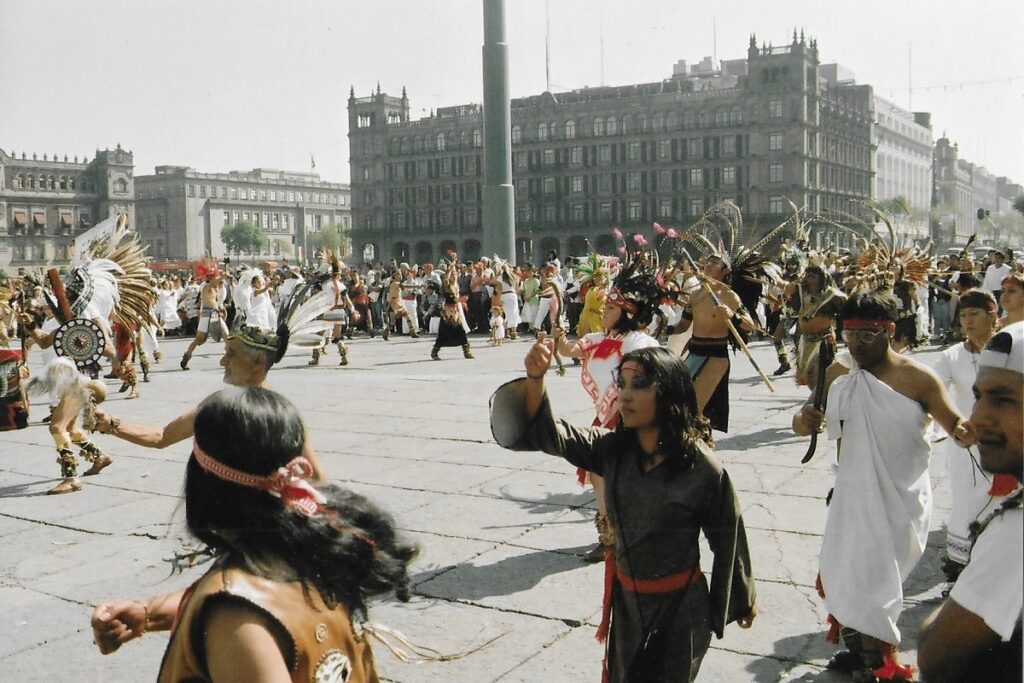
The area contained numerous civil and religious buildings. However, the Spanish soon occupied and systematically levelled the great Aztec metropolis, building their own capital on its ruins. From this new base, Spanish excursions subdued the Native American inhabitants as far north as the present United States and south into Central America.
And so whilst there are several grandiose colonial monuments around the Plaza Mayor, they arrived here, you might say, through a sad process of cultural vandalism. It reminded me of my ramblings through central Turkey’s Capadoccia region, a spectacular and spooky lunar landscape, dotted with hillside caves. Going back to the middle ages, when the Christian world had Constantinople as a major axis, many of these caves contained chapels, lavishly decorated with gold leaf frescoes. Many of these remain astonishingly well preserved, that is provided you are able to forgive the destruction of gold leaf human faces contained within these works of art, by invading Muslim armies, no image of Islamic worship being allowed to contain such an image. As with Plaza Mayor, it was another form of cultural vandalism.
The full extent of this obliteration of Aztec culture was not known until 1978 when telephone repairmen discovered an eight-ton stone carving of an Aztec goddess. It was only the start of the uncovering of seven Aztec temples. This archaeological site and a vast collection of Aztec artefacts, can be seen on the edge of the Plaza Mayor. On the day I visited the museum, the narrow road that led to it was lined with market stalls; loud battering sessions and hundreds of customers who rummaged through cardboard boxes; fake designer jeans; fake designer after shave; sandals; sunglasses; cigarettes; toiletries; nothing you understand that made any connection with the Aztec civilisation, whose past was literally and metaphorically behind these shoppers. They seemed oblivious to it. Ancient empire? What ancient empire? Oh that! Yes it’s an amazing backdrop, but please, how much for this pair of socks? What if I buy three pairs?
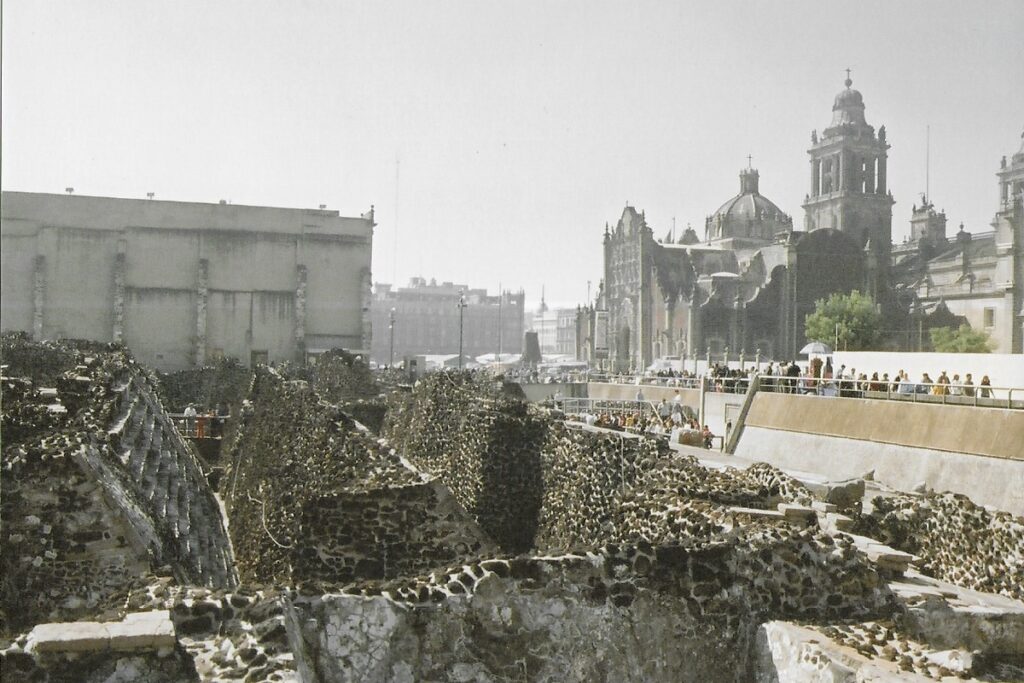
On another side, of the Plaza Mayor is the largest and oldest cathedral in Latin America, built shortly after Cortez arrived. It has been subject to subsidence over many years. As a result a lengthy programme of work is in perpetual motion inside. I wandered down one of the Cathedral’s aisles, past men operating pneumatic drills. Mass was in progress, people struggled to listen to the service. I stepped back out onto the square and was greeted by a roving official from the Mexico City Tourist Information Bureau. We chatted about the buildings that surrounded us and other Mexican cities I had visited. He approved of my itinerary, until I mentioned Guadalajara.
‘Did you know that Guadalajara is ancient Spanish for river of filth?’ he asked. ‘Yes river of excrement!’ he stated more emphatically. I could not tell if he was being serious. And if he was, surely Guadalajara’s city fathers would have done something about a name change by now. I moved on.
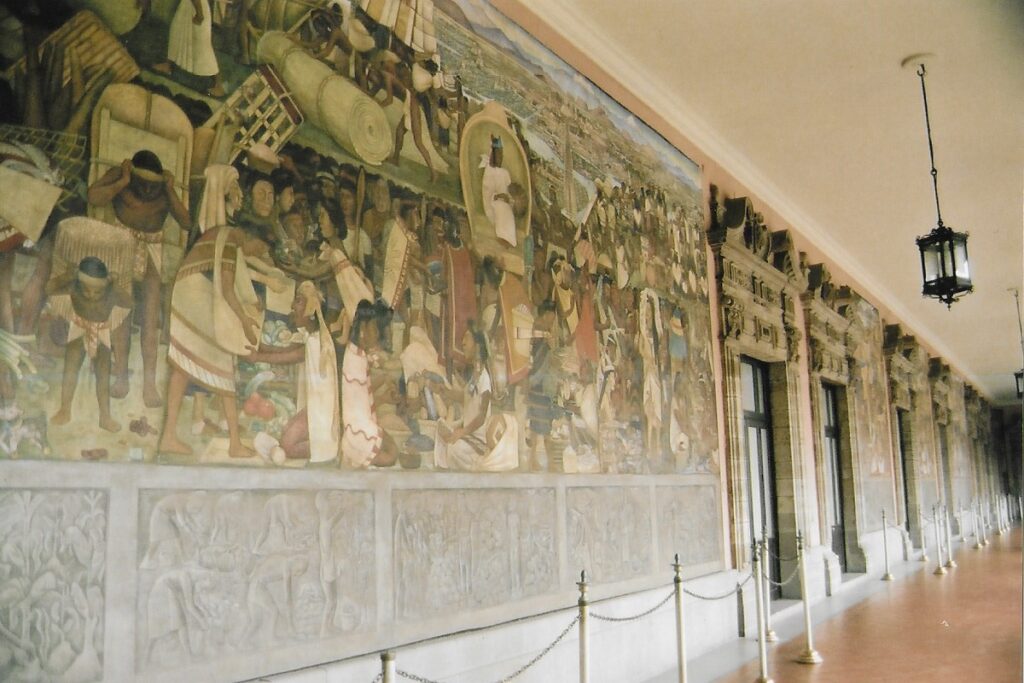
The whole of the east Side of the square is taken up by the National Palace. Built on the site of the residence of the Aztec Emperor, Montezuma, its facades are constructed from red volcanic stones. Nowadays, it houses various Government departments. I nipped inside to view the staircase and walls of its courtyard. These are decorated with frescoes by Diego Rivera. One section shows pre-Hispanic Mexico, another Mexican history from the fifteen hundreds to 1930. It is a lavish portrayal of scenes from around the Plaza going back many centuries. I wondered how different Rivera’s murals would have been if he could have survived a few more decades and witnessed the uncovering of the neighbouring Aztec temples. Imagine if he had known what was just around the corner.