Merchandise, Mines and Shrines
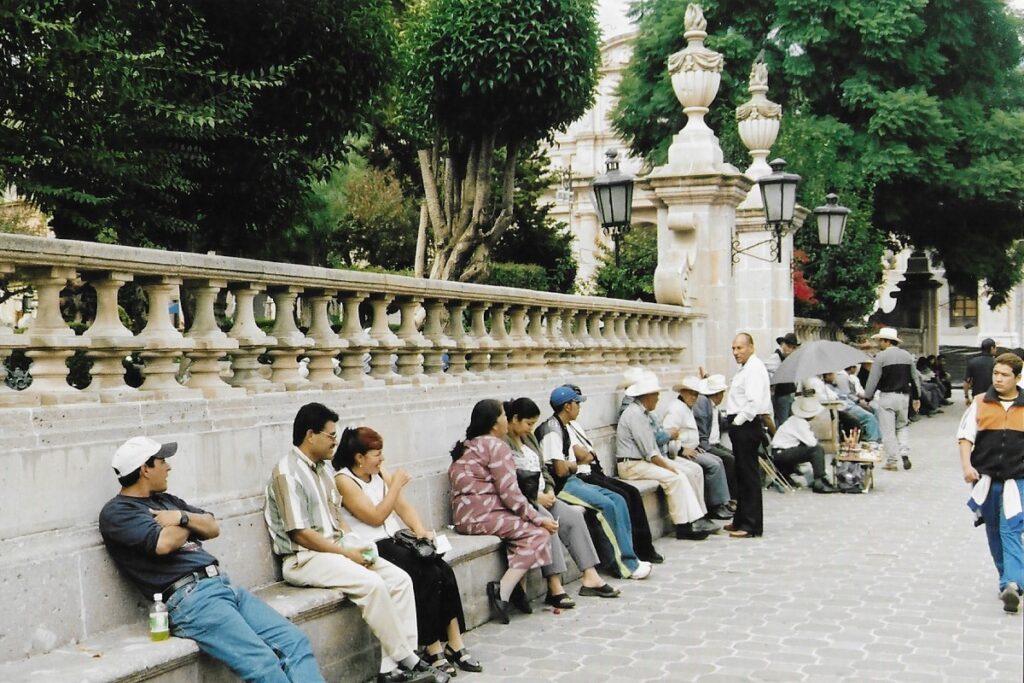
Following these boulevards of calligraphy, I would turn off down a side street, get hopelessly lost in some labyrinth and then stumble on a quiet plaza, with a statue of Hidalgo at its heart. People would be sat under the statue, surrounded by merchandise – leather belts, trinkets, marble Aztec face masks, sombreros. Shoe shine boys and portrait painters would be calling out for trade. On at least one side of the square would be a rotisserie, the smell of spit roasted chicken wafting over. The narrow streets leading off the square would contain market stalls with more leatherwear, particularly lavishly engraved and embossed boots.
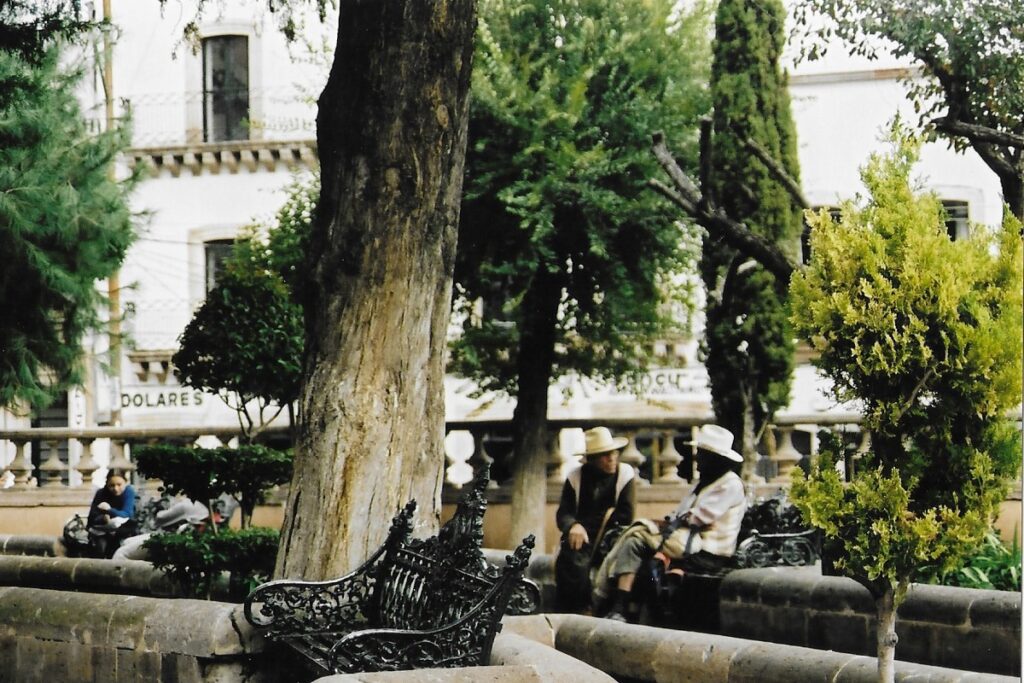
All Mexican towns had a Plaza Independiencia and contained within Zacactecas’s was a small botanical garden. In the small lanes of the garden were a series of green painted, wrought iron benches. Here I was to witness what, after a few cities, felt like a typical Mexican scene: two men maybe in their seventies sat on a bench, exchanging a few words, maybe counting beads, their sombreros sheltering them from the mid-day sun, both of them whiling away the afternoon. Sat next to them on the same bench, a young couple of lovers engaged in a very passionate, prolonged snogging session – two sets of people on the same bench, seemingly oblivious to the other’s presence. I’d carry on past, go for a bite to eat, cut back across the park half an hour later, and they would still be at it – still snogging, still counting beads.
And then across the Plaza, down another side street, was an entrance to the peach coloured central food market, which was housed in a former missionary. I walked past the vegetable sections (mountains of chillies, peppers and tomatoes). I cut through the market, moving from produce to poultry to pork (cooked and raw, whole hogs on a spit, smells of pig’s blood).
At each entrance to the market hall, a small shrine; a statue of Christ in a glass case, a velvet red heart at its base, with the inscription ‘heart of Jesus’ ; black and white portraits of the Messiah left by people on the shrine’s ledges.
On the outskirts of the centre I walked through the narrow Jardin de la Madre. Traffic zipped up and down either side of it. Chevolrets imported from north of the border were common place, but by now I was spotting with increasing frequency Volkswagen Beatles manufactured under German license in Mexico City.
The noise of the traffic was somewhat muted by the piped music that was being played in this park – a symphony instrumental of the Beatle’s ‘All your Loving’.
At the park’s exit, I located the entrance to a silver mine, Mina del Eden. In 1546, the discovery by the Spanish of silver in the northern regions of Mexico, resulted in the mining of vast quantities of the mineral. Convoys bound for Mexico City mints were filled with thousands of pounds of the stuff, a large proportion of which was exported to imperial Spain, contributing to its status as a wealthy world power. A rush of settlements in northern Mexico resulted. As a result, Zacatecas became a place of magnificence and one of Mexico’s richest cities.
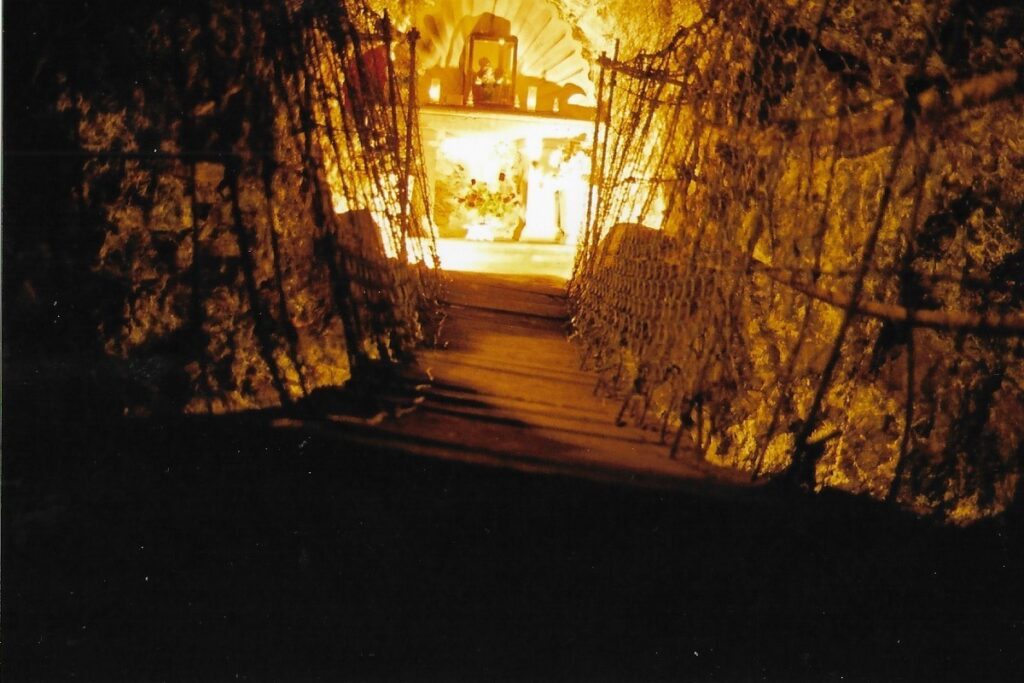
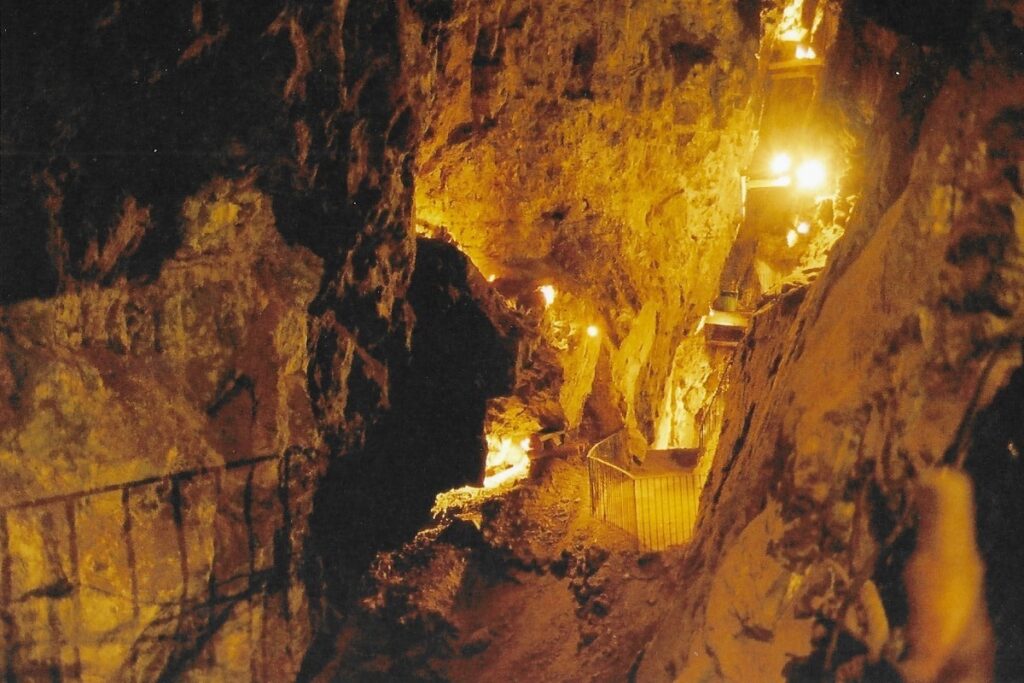
I boarded a miniature narrow gauge train into the mine’s interior. My eight fellow passengers were from Honduras and Guatemala. The segments we cut through looked like giant honey combs, with rugged golden archways. Inside the damp dark tunnels and across the rope bridges of the old mine, the guide shone her torch up to metal veins and plummeting the depths, down to flooded lower levels, where hundreds of Indian labourers lost their lives either quickly in a missed step or slowly though backbreaking toil – the average life span of a labourer was thirty-six years.
Nearby, balanced on a precarious precipice was a sculpture of mining laborers with shovels and flexed muscles. I could not decide if this was a testament to those who had died chiselling silver or whether it was meant to convey a totalitarian workers of the world unite image.
Across one of the rope bridges was a small illuminated shrine containing a statue of the Virgin Mary. The shrine followed on from the ones I had already noticed in the food market. It was a continuation of a trend for spotting Christian artifacts in the unlikeliest of places – toilet cubicles, bars, market stalls, lifts, buses. Non-believers in Mexico would have a hard time.