Waking the Dead
If you were to carry on past the bar, as I did the next day, walking away from the old town, the road starts to rise. After striding for half an hour, the view back down onto central Guanajuato gives you a good idea of the layout of the town and its relative size, but I had not come on this hike for the view. I pressed on, turned down a side road, which curled around and came to an end at a large gateway, which led to a cemetery. Just inside the Panteon Municipial (1861), two giant statues of angels looked back down on the city below.
Large busts on plinths surrounded me, commemorating people from the last century and a half, glass mausoleums contained personal effects of the dead. Set in the perimeter walls was in the region of seven hundred memorial plaques. However, this wasn’t the macabre site I was seeking out, although there was a connection.
On my way out, at the cemetery gates I asked a lady for directions ‘Las Momias?’ I enquired.
‘Si.’ And she pointed towards a narrow set of steps that lay down an alley.
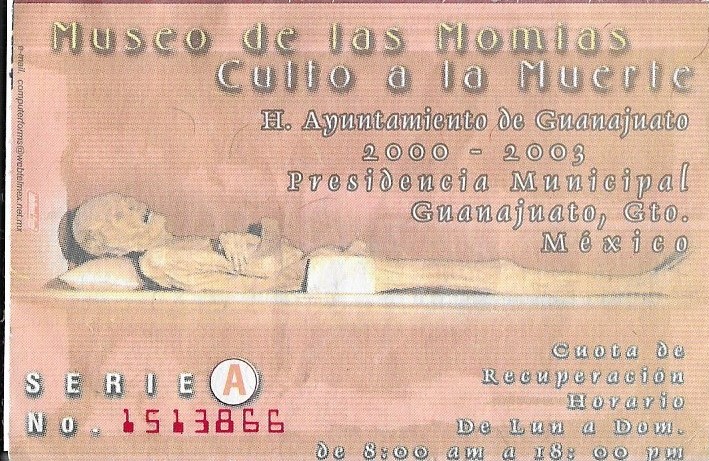
I arrived at the Mummies Museum. No one really knows why the bodies that found their way into the museum were so well preserved. Or to put it another way, the Mexicans did not exactly incorporate ancient Egyptian ceremonies into their burial rites. It appears to have occurred almost through default. Possibly a combination of the soil conditions and a dry climate of the mountainous area caused the bodies to dry out naturally before they could decompose. But how they came to be mummified is not the point, it’s more about the bone chilling manner in which they were brought to the museum in the first place, which I shall now tell you.
The two hundred bodies on display were dug up from the municipal cemetery next door between the years 1896 and 1958. A local law required relatives to pay a yearly grave tax. But not every family had an income, the likes of which could buy giant sized busts on plinths. Rather, many citizens struggled to pay this annual charge. Now the local authority, being such a kind hearted organisation, allowed its poorer residents to get up to three years in arrears with their payments. But once this point had been reached they got very nasty. As a final warning, the body would be dug up from the cemetery and kept on hold somewhere, and then if monies still weren’t forthcoming it would be placed on display in El Museo de las Momias along with all the other defaulters. Now that is what you call macabre. It was a kind of sobering reminder to people that they should really pay their taxes. And you may say that, given the high level of defaulters, the Museum curators had a full time job, having to continually rearrange the exhibits.
I entered the first of four rooms in the Museum and bumped into Juan Jaramillo. Slouched against the wall, wearing only one shoe and with a hole in his sock, he looked like an itinerant. His platted hair did not look like it had been combed that morning either, his shirt was somewhat grubby and his skin was rather anemic looking. You might say that he looked like he was on his last legs, all thought to be honest his legs gave up on him on the day he pegged it. He was of course, as the sign on the glass case read, ‘Ex-humado el 19 de Febrero de 1910’.
His neighbour, was stood up in his coffin on the other side of the doorway. When I say stood up, I mean that the coffin was leaning in a vertical position against the wall, not that it was horizontal and that he had suddenly stood up. But anyway, who ever he was, he looked set to retire for bed, wearing his long wee-willy winkie nightdress. Indeed, he had last laid horizontal in his coffin sixty years ago, just before he was unceremoniously exhumed from down under.
To help the rows of the vertical walking dead stand up straight, their heads were held up by lengths of string.
Those who were not standing lay their head down on rotted pillows. Many still wore a mixture of rotted waste coats, overcoats, shirts and footwear.
And then there were the miniature displays of child corpses, several of them clutching small broomsticks. One tiny baby mummy was labelled ‘La momia más pequeño del mundo’ – the smallest mummy in the world. The baby died during a caesarean section, as did her mother who lay in the next room.
If this had been Madagascar, where families frequently exhume their departed loved ones from tombs on feast days, to give them a bit of a day out, I could have understood. But this wasn’t what I was expecting in heavily Catholicised Mexico. It was a gruesome hour, but it clearly had novelty value for groups of Guanajuato school children, who clicked away with their cameras.
‘Well that was different’, I said to myself, as I retraced my steps back down to the old town.