Plaza Santo Domingo
A few blocks away from Plaza Mayor, I sat on the first floor of an internet café, whose balconies opened out on to the Plaza Domingo. I looked down onto a series of colonnaded crumbling arches. However, the technology on the ground outside occupied a different century from the World Wide Web. In between these arches and in front of the open fronted shops behind them, was a busy community of printers. The rattling of old printing presses and the hammering of stencil tools dominated. A range of personalised stationary was on display, which could be produced on the spot – parchment paper, paper with slithers of wood chip embedded. Choose your own font and thickness of gold lettering; design your own calendar or how about a holy picture. All crafted with care; antiquated, archaic, highly artistic.
On the other side of the Plaza was the Museum of Medicine. However three hundred years ago, what lay behind its huge oak carved doors was something much more sinister and definitely had nothing to do with the preservation of life through medical science. It was the headquarters of the Spanish Inquisition, where thousands of heretics, after being arrested on a whim, were interrogated, sentenced to death and executed.
Lying in Wait
All the survival literature I had read on Mexico, and in particular Mexico City indicated that violent crime was a problem. However, walking around the streets of the Zocola in the early evening, it felt like, as long as I kept my wits about me – no wandering down completely empty and dark side streets – this should not be a problem. I came to this opinion after making a mental note of the myriad of different law enforcement agencies that mingled with each other on most street corners.
In navy blue, there were the Seguridad Police; in royal blue, the Centro Historico Police; looking a bit more menacing in both their stride and green khaki attire, the Military Police; and then at the top of the scale in terms of nastiness, the Riot Police, with tear gas, shields and helmets with visors. Many of these officers were wearing lengthy fire arms, strapped horizontally across their mid rift and when walking past them along narrow busy footpaths, it really did feel like giving them a wide berth was the best policy.
These police agencies did not exactly strut around the place in platoons, but intermingled quite nonchalantly, getting involved in mundane activities; giving the less nimble people a hand up and down kerbs; helping staff the ticket booths and exits at underground stations; pointing people in the right directions inside museums; a case of helping their municipal colleagues out when they were busy.
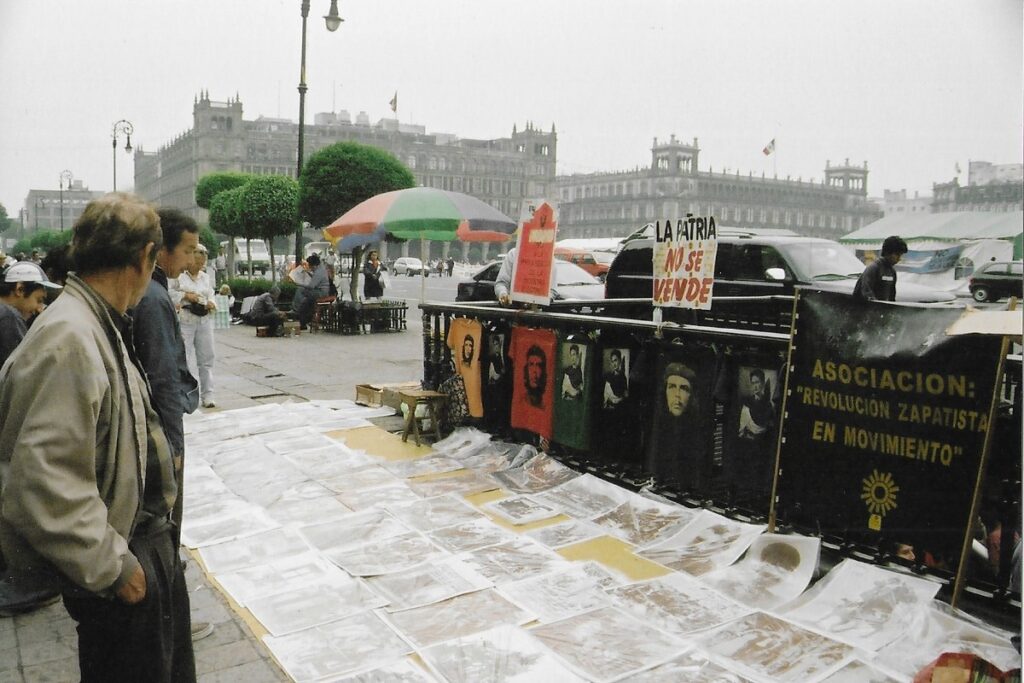
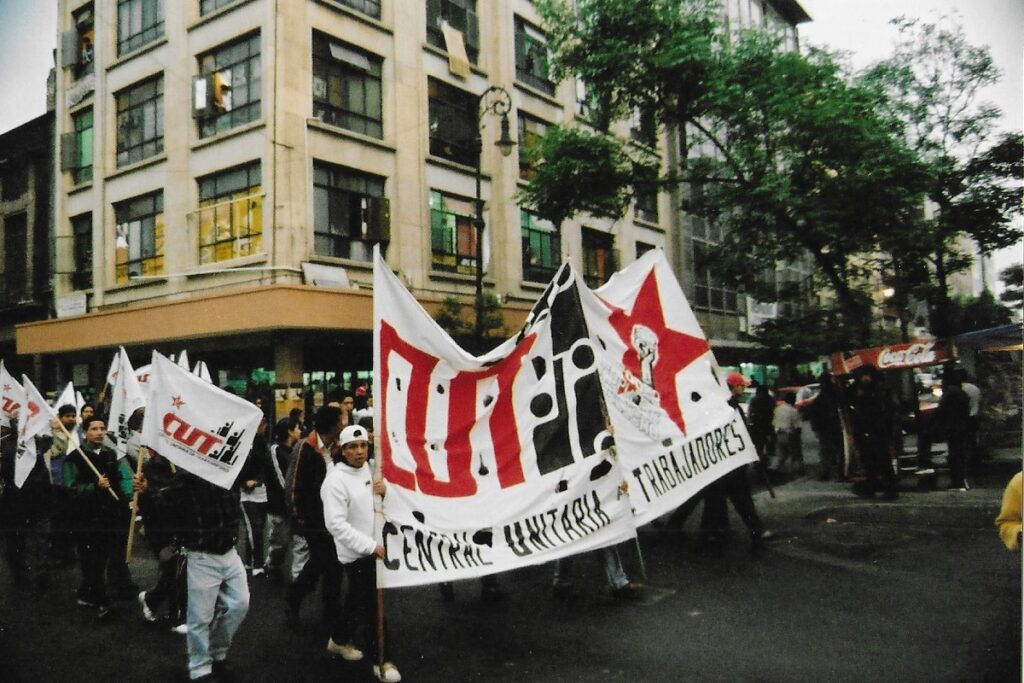
However, it was quite easy to delude oneself into thinking that these officers of the law were really quite a sedate bunch. For another perspective, you only needed to walk across the Plaza Mayor and observe the nightly public protests that were conducted between the arches of the City Hall, the Adjuntament.
A different protest was held on each of the five evenings that I wandered over to observe (tonight, as I jot these notes it’s the turn of the Confederación de Trabajadores de México – Confederation of Mexican Workers; last night it was a campaign for the release of Mexican political prisoners); hundreds of people with banners, stopping passers by to sign petitions, vans with loud speakers addressing the crowd in front of the arches. Freedom of speech might have mushroomed since the last Mexican dictatorship. But, at both ends of the Adjuntament, on horseback and sat in vans, the riot police lay in wait. It was all very good-natured. But of course the riot police would not stand for any real nonsense. I had no doubt that a fair few would have experience of quelling serious dissent ruthlessly and in quite an effective manner, and had served under previous Mexican dictatorships.
Closed! Closed!
Down town Mexico City, the Zocola. Being the third largest city on earth, you would fully expect it to be a twenty-four hour location; a place where at its heart, you could get a drink or bite to eat any time of the day or night.
Shortly before dusk, I went on reconisence, making mental notes of where the most interesting bars tended to be; wild west type swing doors; long heavy set mahogany bar counters; countless brands of tequila lining the shelves; intense games of chess; all these establishments doing a brisk early evening trade. I was quite looking forward to a spot of imbibing a couple of hours hence. A small drink in each would do quite nicely. I went back to the hotel, showered and then started to retrace my steps. However, the ambience looked very different. Street lamps were not turned on. The small expanses that were lit were only done so with the aid of floodlights there to assist workmen dig up the road. I’d locate one of the bars that I had spotted earlier, but its shutters were pulled down. Terminar! And likewise then the next one would be in darkness. Terminar! After half an hour I found one that was open, but no sooner had I ordered a drink, I was turfed out with the rest of the customers back onto the street. Sorry, terminar! In three hours, the Zocola had transformed itself from being a vibrant quarter into a morgue. Nightlife? You had to check out further flung residential districts for that.
I trudged back to my hotel disappointed. My belly was pining for food and liquid. But then a matter of yards around the corner from my lodgings, I spotted what looked like a sticky cake café. I had no choice but to check it out – maybe a slice of gateaux would keep me going until the morning. A constant stream of families came and went. Business was brisk. I sat on a stool at the counter and was handed a menu, which to my pleasure featured much more than just sticky cakes and ice cream. Yes, they served real meals, with meat. And then things got even better as I got down to the bottom of menu, because yes, they sold Sol Beer as well. It felt like I had landed.
I ordered a beer and a main meal. Fifteen minutes later, I finished the small bottle of beer and, still eating, ordered another. I finished my meal and then ordered a third small bottle. This took me to the one and a third pint level. But this café had standards to observe, and ordering more than two of these tiny bottles was asking for it. I was presented with a third bottle and the bill. In other words, move on, what do you think this is? A bar?
The following night the streets appeared to be lifeless again. But then tucked around a small side road near my hotel I spotted a cabin which looked like it should have been selling newspapers, cigarettes and lottery tickets. In front of the counter were two plastic tables and a number of chairs, on which people sat drinking beer.
I bought a bottle of Sol from this makeshift bar and positioned myself between the two tables. On my right sat Eduardo, who, was rather inebriated and who would not stop shaking my hand for several minutes whilst asking me slurred questions. On my left was Joseph, and his girl friend, both drinking tea. He told me about disdain for the USA and his passion for the Mexico City Eagles, the Capital’s premier football team. Three more men appeared and sat with us. They all shook hands with Joseph and myself.
But then things got a bit sinister. One of the new arrivals retrieved a small package from his pocket, and emptied its contents of white powder onto a piece of paper. People from both tables then took it in turn to snort the cocaine. Joseph declined, as did myself. Eduardo was too inebriated to make the transfer from one table to the next.
‘It’s OK’, Joseph said, ‘Don’t worry’.
Two policemen walked by, whilst the snorters were inhaling. Joseph looked at me and said again, ‘It’s OK. Don’t worry.’ The officers waved, the snorters waved back. ‘See,’ said Joseph, ‘It’s no problem.’
The following evening, near the stroke of mid night, I found myself back at the same establishment. I sat with Antonia, the owner and her husband, just the three of us, the snorters were still sleeping it off. We talked about the places in Mexico I had visited. But this was just a preamble for what was one of Antonia’s hobbyhorses.
‘My husband and I both think that lardidi was murdered. The whole think was a conspiracy.’
‘ Who?’ I asked
‘Lardidi,’ she repeated.
It took us a few minutes to hit the right pronunciation and interpretation. Lardidi, it turned out was her English pronunciation for ‘Lady Di’. And the Mexican media, so Antonia told me, has been full of conspiracy theories ever since her death. By the end of my Mexican journey, I certainly believed her. This was the first time that discussions had turned to that Parisian underpass, but it certainly was not the last.
