Street Corners
I left the Palacio and walked through a series of residential districts, in search of a strongly recommended restaurant. Eventually I arrived at No. 26 Vincente Guerro. Well, whatever this establishment’s business was, it did not involved serving food, and even if it did, all the lights were out and the doors locked.
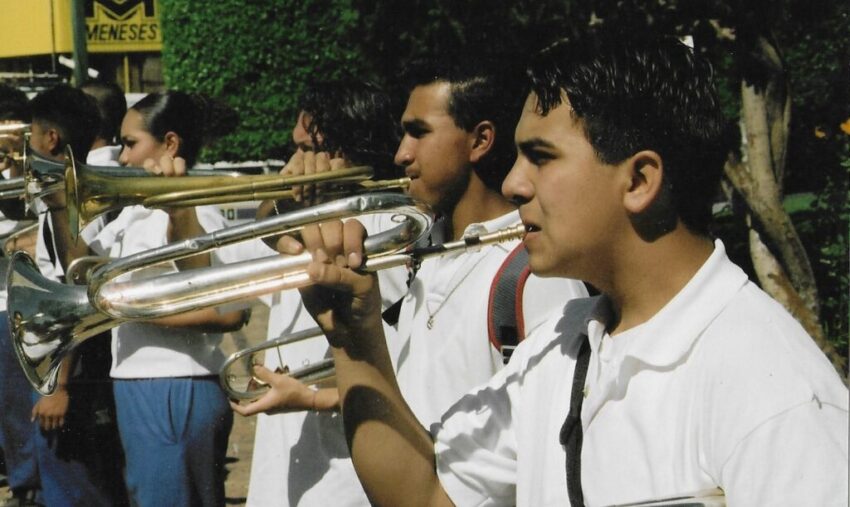
On one corner of the small crossroads on which I stood was a bar. Outside loitered ten middle-aged men dressed in gray suits, white shirts and cravats. Two of them held guitars and plucked away at their strings in an impromptu manner.
‘Hello Sir,’ one of the crowd greeted me. We shook hands. ‘What are you looking for?’
I pointed to the restaurant, which was shrouded in darkness.
‘Yes, but it is now a pharmacy and it’s closed. Where are you from?’
‘Near Liverpool, England.’
‘Ah yes, there is a famous bar there. A bar with bittles.’
‘I think you mean bottles’ (bar/bottles. It seemed to be an obvious connection).
‘No I mean the bittles in the Cavern Bar.’
‘Ah I see, the Cavern Club. It’s still there actually, but no Bittles.’
‘Hey Michael, ‘ he called over one of his accomplices and pointed to me, ‘From Liverpool, England.’
‘Ah the Beatles,’ said Michael.
Hanging around on dark neighbourhood streets like this reminded me of corner shops I had lived near in the past; juvenile delinquents sitting on steps, ghetto blasters, drinking cans of lager, smoking, hissing at passers by. All this contrasted with the current gathering, which was much older and more nattily dressed with suits and white ruffled shirts. It had a ritualistic purpose about it; lots of male bonding; hugging of new arrivals; a very macho affair; an evening constitutional of sorts, without the walking.
In addition to the two acoustic guitars, I had noticed four big bass cases propped up in each of the bar’s corners. So where was the music? After all, with their uniformity of dress, the men could easily have been part of a male choir.
As in Zacatecas, I longed for them to trot out some rendering of, well anything, even ‘All my loving’. But I couldn’t wait forever. I moved on in search of food, and when retracing my steps one-hour later the crowds had dispersed or moved onto another street corner.
Guanajuato
Three hours south of Zacatecas, I arrived at another UNESCO city, Guanajuato. Further large helpings of ecclesiastical architecture, cobbled streets and plazas. However, there the similarity with Zacatecas ended. Zacatecas and Guanajuato, compare and contrast would have made a good essay title. For while the industriousness of Zacatecas gave it a work a day, touristless feel, Guanajuato’s vitality was rooted more in high culture.
In the Constancia neighbourhood, on the steps of the cathedral stood a male choir with purple capes, ruffled collars and caps. Their ages ranged from seven to seventy. The choir stood on the steps in age order, with the angelic little up starts at the front. They sang three songs and then moved over for another ensemble dressed in burgundy.
Next to the cathedral steps was an artists market, where the range of Guanajuato’s splendid architecture was laid out on canvas. I made note of a number of aesthetically pleasing buildings to visit the next day.
By the cathedral was a plaza – another botanical garden at its heart, more wrought iron benches, more aging men with sombreros and courting couples. Wandering minstrels – trios of boys, girls and men, and lone musicians – strode around the plaza in1 packs, with guitars and mandolins. These Mariachis – popular strolling bands – would stop in front of a bench or a table of diners outside one of the restaurants that surrounded the botanical garden, and break into song. For the musicians, diners and the slow moving stream of families out for their evening constitutional, being there was what it all seemed to be about.
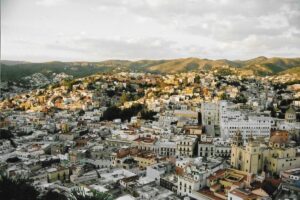
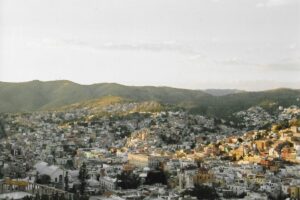
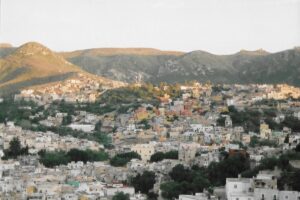
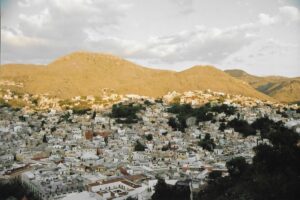
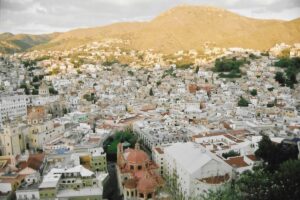
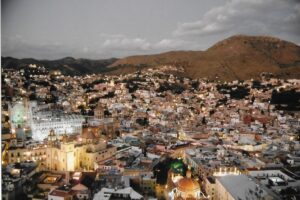
Over the next fourty-eight hours I came to the opinion that the crowds of families that flocked around the streets of Guanajuato – the citizens of this mini-metropolis located in yet another volcanic crater – had to be among the most contented bunch of people I had ever seen. Houses it seemed where only somewhere that you disappeared to for a few hours sleep, and then this was only in the small hours. Sure it had its share of dimly lit back streets but these did not feel threatening and any obvious signs of destitution were far from apparent.
It felt like I was living in the middle of a perfect society. Surely there had to be some dark secret. It reminded me of the 1970s film, Logan’s Run, where everyone lived in a blissful paradise and where all needs were provided for. However, the trade off was that, unknown to the general populace, life only extended as far as thirty. The day this age arrived, was the day life ended for those who had made it to their fourth decade.
