Trumpets
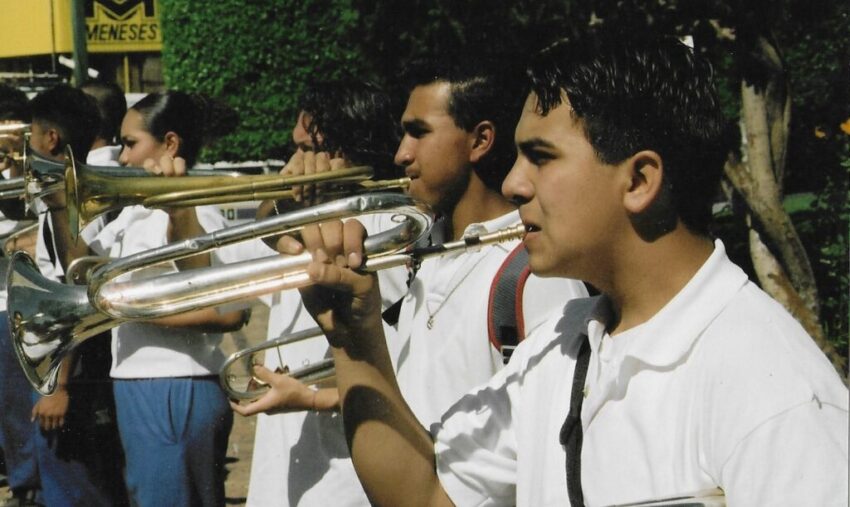
Back at the hotel that evening, I lay across my big brass bed reading. The balcony windows were open. The eight o-clock chimes boomed out from the cathedral dome. Somewhere not too far away a brass band struck up. I put my book down and went out to locate it. The full ensemble had taken up position on a plaza two streets way, on the other side of the cathedral. Its members ranged from seven to seventy. The adults and children in this eighty strong assortment had a captive audience of about five hundred people, either standing in the square or peering over walls and balconies, from houses and restaurants. Trumpets dominated, but at the back of the band, I stood next to two strapping lasses. One was the big bass player and the other one, well she sported a fine pair of symbols.
Three hours later on the other side of town, the rains came. I sheltered under the canopy of a shop window. I had company in the form of an itinerant set of musicians – a small set of drums on a prop, a trumpet and two guitars. Across the street, looking like they had participated in the brass band from earlier, clustered around an ornate gilded iron lamp post, were four men in sequin shirts and trousers sheltering under umbrellas.
It felt surreal – I waited for twenty minutes in the hope that the musicians with whom I was sheltering would play their instruments, maybe with a yell to the nearby sequined gathering of, ‘Hey now this is what you call music, real spontaneous street music’. But nothing happened, just the pitter-patter of rain and the sound of pistachio nuts being spat out.
Las Ruinas
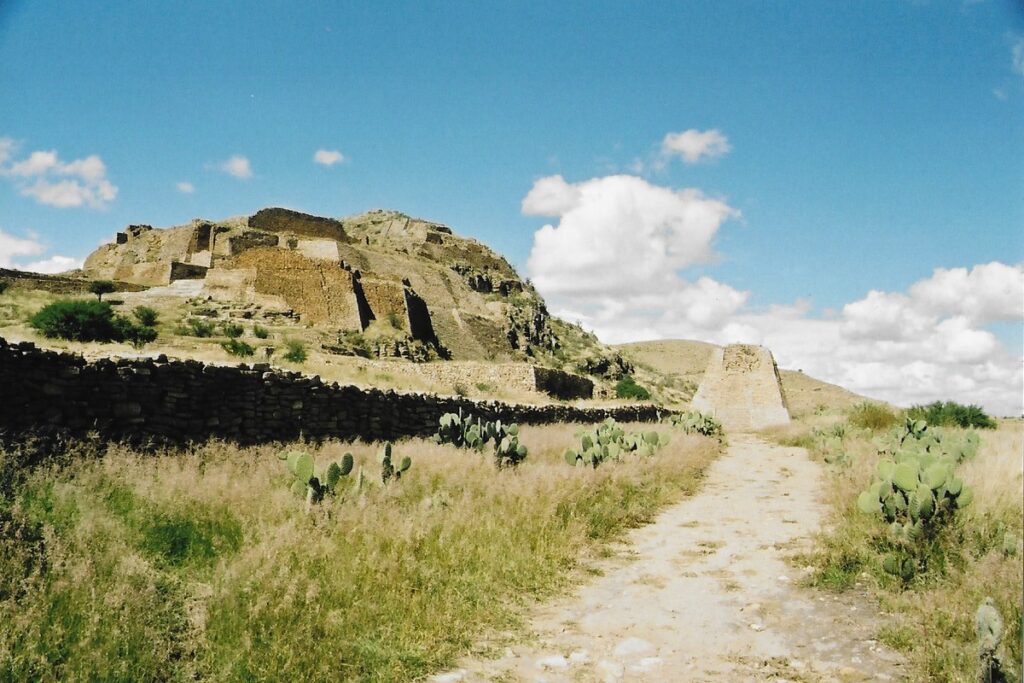
The following morning, I bordered a bus and asked for La Quemada – an Aztec site some twenty miles outside of Zacatecas. Half an hour later, the bus pulled over onto the hard shoulder of a dual carriage way. A passenger in the seat behind tapped my shoulder and pointed towards a dusty track off the main road. “Las Ruinas”, he said.
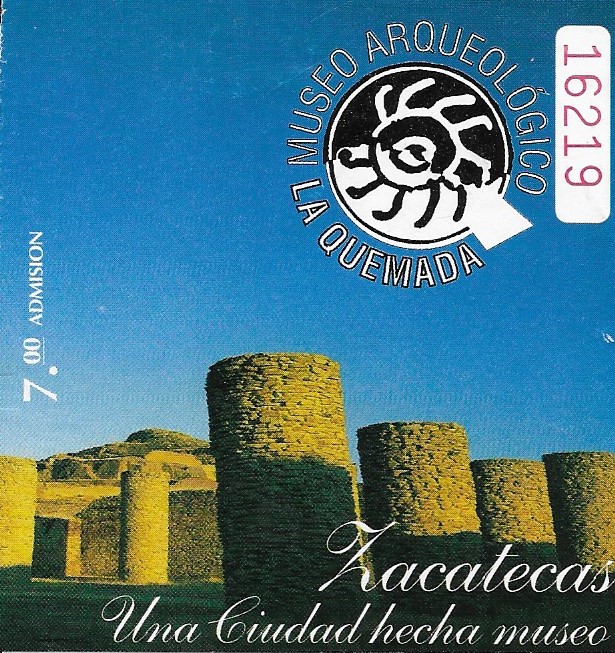
I started my hike and after a mile the outline of a monolithic fort loomed large. Another mile and I arrived at the ticket office at the base of the fort. I say ticket office, rather it consisted of a man sat on a stool under the shade of a tree. Next to him was his chevolret. A radio blared from inside the vehicle – more trumpets. He handed me the visitor’s book to sign. In the last two days a total of five people had signed in, from Chile, Argentina, El Salvador and Berlin.
The civilisation that founded La Quemada flourished between 500 and 900 AD and was involved in the trading of minerals across northern Mexico. However, for all that has been wrote about about them, there is little agreement about who the people were who inhabited the complex, where they came from and where they went to.
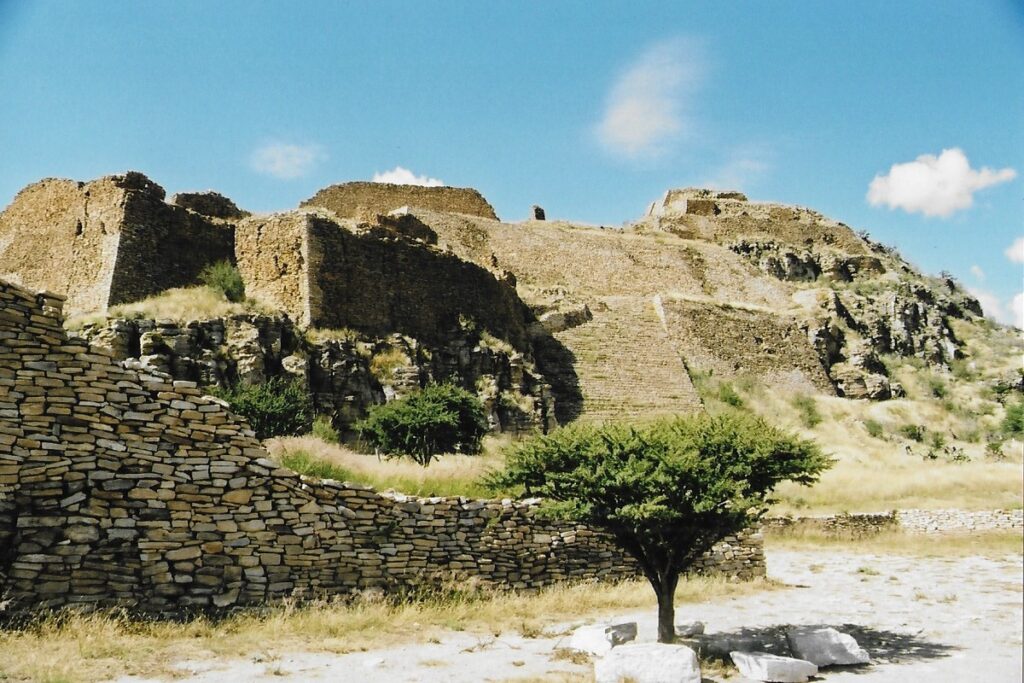
The site is an extensive complex of plaster and lime construction, much of which has now been eroded, It consists of a walled city, a fortress, giant columns, pyramids and sacrificial alters. When viewed from the top of the fort, traces of roads, built of slab and clay are still visible, radiating off to other numerous satellite annexes across the fields of the Malpaso valley.
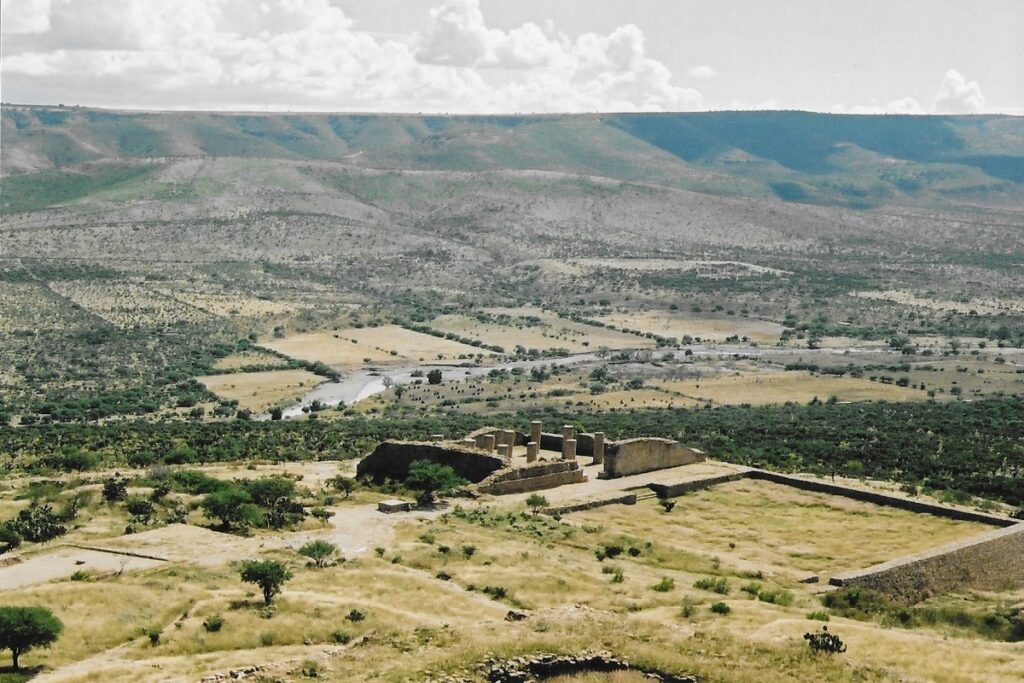
Archeologists have deemed the constructions to be too extensive and the quality of the architecture to high for La Quemada to have been only a temporary settlement. Yet at the same time, the evidence points to them having upped and left in quite a hurry, with traces of fire and torching throughout the site. Indeed, La Quemada is Spanish for ‘the burnt one’.