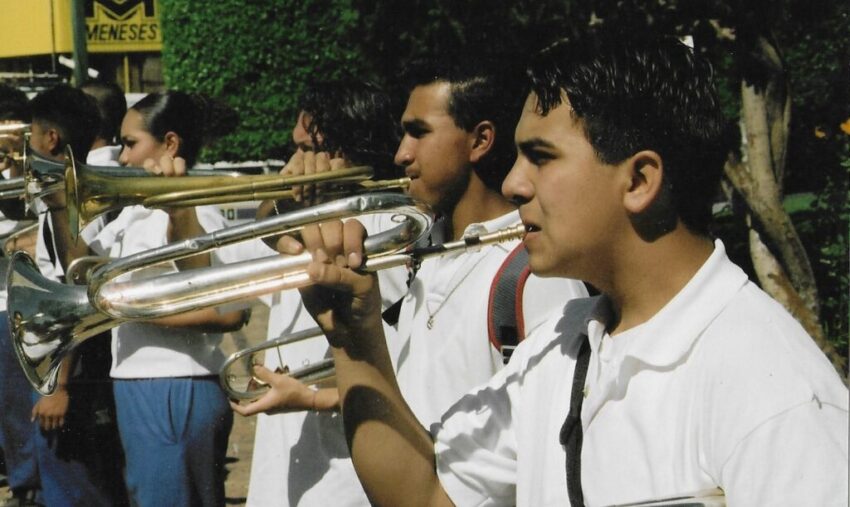
Hidalgo
The next morning, on another side of Plaza de Armas, At the entrance to the Palacio Municipal, I paused at an information booth. In a rapid fire monotone voice, that sounded as though it was computer generated, a lady spoke to me with a heavily Americanised accent. She handed over a map, on the back of which was an advert, ‘Calling back to the USA from Mexico is easy with AT & T Direct Service.’ It started to feel once again that I was not far from North America.
At the top of the Palacio’s central staircase, I stood admiring a huge mural. At its centre was a painting of one of Mexican history’s most prominent characters, Miguel Hidalgo, issuing a proclamation against slavery from the steps that were just outside my current location.
I came to realise after a week in Mexico that there were certain key figures in the country’s history, who, judging from the frequency with which they revealed themselves in one form or another, enjoyed the status of superstar. At the top of the list, I would have to put Hidalgo. He was, it seemed, much revered. So just who was he?
At the start of the nineteenth century Hidalgo formed a secret society dedicated to freeing Mexico from the oppression of the Spanish colonial government. Thousands of Mexicans joined his crusade. and revolution which resulted in the capture of the cities of Guanajuato and Guadalajara in 1811. However, shortly after, his army was completely routed. Like most Mexican heroes, Hidalgo was captured and shot. After the establishment of the Mexican republic in 1824, he came to be regarded almost as a saint. The day on which he proclaimed his revolt, is celebrated as Independence Day.
This priest, come politician, come Mexican revolutionary and icon, kept on popping up in all manner of places. Every town it seemed had a plaza, boulevard, sculpture, several restaurants and hotels named after him. This is not to mention an international airport, a football stadium, a public holiday and a Mexican state.
Paint Pots and Calligraphy
The next morning, at the bus station, I purchased a ticket for the mountainous seven hour ride to Zacatecas. I stocked up on a number of provisions for the journey, but then, alas as I boarded the coach, the conductor handed me a small packet. ‘Lunch,’ he said.
‘Ah two lunches then,’ I replied.
However, this was not the only thing included in the price. How could I possibly forget the series of loud video films that passengers were subjected to . Yes the video-bus. Unfortunately my earplugs were in the boot, and my Walkman certainly couldn’t compete with the coach’s sound system.
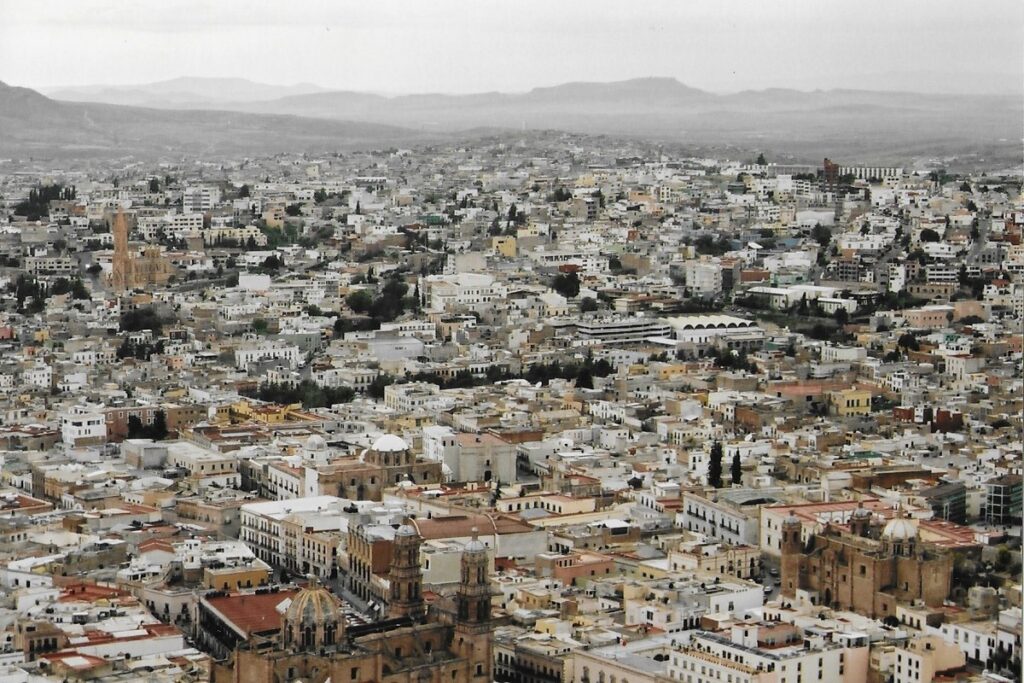
Founded in the mid-sixteenth century, Zacatecas is built in a ravine with pink stone houses scattered over hills. A hundred years ago it possessed the busiest silver mine in the world, but things have quietened down a bit since.
I looked up a steep set of steps by a busy traffic intersection, at the top of this climb hung the sign Hotel Felix – a tip-top recommendation from my guide book. Behind a counter in a state of slumber, slouched the receptionist. I tapped several times and woke him up. He asked what I wanted. I can only think that my Spanish was so poor as to mistranslate as ‘Hello, I am the decorator’, for the receptionist’s next move was to show me into a small room over-looking this busy cross roads. The tiny space was crammed with ladders and tins of paints. The smell of white spirit was over-whelming. But at least there was just enough floor space to slip in a mattress, if that was what the owner had in mind.
‘Are you going to put a bed in here?’ I asked, not really sure if he owner understood why I had woke him up.
‘Si’ he replied. But something did not quite feel right and so I left in search of an alternative.
The following morning around the back of the cathedral, up several steep back streets, I looked across from my bedroom balcony onto the rooftops of Zacatecas. The cathedrals colonial architecture and its imposing dome drew my attention. However, as I marvelled at the view, its resounding hourly chime interrupted the relative calm. It was not the last time during my Mexican travels that ear plugs were a must for a decent night’s sleep.
Local laws have imposed a ban on neon lighting, which contributes in a big way to the City’s charm. As a result, the painting of signs onto the white, peach or sandstone coloured plaster walls, of shops, businesses and hotels was widespread. However, it was not just a case of someone shimmying up a ladder and crudely daubing on a word or two. It was after all a form of art, with a wide variety in fonts, all perfectly scripted. Some of the calligraphy looked relatively new, other signs retained an appearance of faded elegance sitting on top of crumbling plaster.
Zacatecas, with its UNESCO World Heritage status, has an abundance of conquistador churches, cobbled boulevards, plazas in varying states of repair, colonial mansions and religious and modern art galleries. Its lure should have been quite sizeable. The City felt like it was full of surprises. However, a place tends only to be full of surprises to those who don’t live there. Yet, there were no tour buses, nor did I hear any other European or North American accents. Maybe Acapulco was doing a good job at keeping them several hundred miles at bay.
Every ancient building had its use, and not necessarily those for which it was originally designed. Calle de Gomez was a boulevard of businesses, all located behind lavish colonial facades – dentists, chiropodists, hairdressers, medical consultants, paediatricians, banks, all sat proudly behind columns, archways, wrought iron gates, and a riot of imaginatively hand painted signs. Some of these buildings were crumbling. Others had been restored to their original state. After I had spent an hour admiring these establishments, I dined at the end of the Boulevard, in the 18th century Bishop’s palace, now a Chinese restaurant.
